
Within the supply chain of ultra-precision equipment, many purchasers focus on comparing flatness, dimensional tolerances and quotations of granite components, yet easily overlook a key variable that determines the service stability of products over years: the aging cycle before and after granite precision machining. Aging is not merely simple storage. It serves as the core process to gradually release cutting stress trapped inside granite. Although the aging duration adopted by different manufacturers only seems to affect production scheduling and delivery lead time, it creates a barely visible performance gap after product delivery that exerts huge impacts on precision equipment. ZHHIMG has continuously verified the profound influence of aging processes on long-term component precision through years of ultra-precision granite manufacturing practices.
Some manufacturers in the industry adopt short aging processes to shorten lead times and cut warehousing costs. They only arrange short-term static storage at room temperature and skip multi-stage aging procedures such as constant-temperature standing and thermal cycling. Components are shipped rapidly right after lapping. At the point of factory inspection, indicators including flatness and straightness fully meet specifications and easily pass incoming acceptance. However, sawing, cavity milling, grooving and rough grinding leave massive residual cutting stress trapped inside granite crystals. If the aging cycle is insufficient and stress is not fully released, residual stress will keep releasing slowly after the component is installed on equipment. As time goes by, micro-deformation emerges gradually on reference surfaces.
This deformation brings diverse long-term consequences. When applied to CMM machines, optical AOI inspection and femtosecond laser platforms, slow distortion of reference surfaces triggers continuous drift of equipment repeat positioning accuracy. Frequent shutdowns for recalibration are required, greatly reducing production line uptime. For bases of semiconductor equipment, perovskite coaters and X-ray inspection devices, tiny deformation directly alters optical paths and air-bearing gaps, resulting in distorted inspection data. Especially for large granite beds and long metering rulers, more material removal during machining accumulates higher total stress. Precision decay caused by inadequate aging will be further magnified. Some short-aged components suffer continuous precision degradation within six months to two years of service. In severe cases, re-lapping at the factory becomes necessary, incurring high costs of disassembly, assembly and production downtime.
In contrast, sufficient multi-stage long-term aging is a core manufacturing procedure for precision granite components made by ZHHIMG. Relying on our 200,000 m² factory area and independent large raw stone yard, we have ample space for graded aging treatment of components. After raw stone cutting and rough machining, components go through the first round of constant-temperature aging. After rough grinding, they enter the constant-temperature workshop for secondary aging, combined with vibration stress relief and thermal cycle aging. Internal stone stress is released step by step. Only after stress stabilisation do we proceed to fine grinding and manual nano-precision lapping. The full aging workflow is matched with our constant-temperature, constant-humidity and vibration-isolation workshop to avoid environmental disturbance during stress release.
Precision granite parts treated with complete long aging achieve full stress release, and long-term deformation is limited to the nanometer range. Under long-term working conditions, the geometric shape of reference surfaces remains stable, significantly cutting the frequency of regular equipment calibration. For demanding scenarios such as semiconductor equipment and precision metrology instruments, granite bases with long-term stability guarantee consistent operation of laser, optical and linear motor platforms. Combined with ZHHIMG self-developed black granite raw material with high density up to 3100kg/m³, the complete aging process further restrains composite deformation induced by temperature change and load, which distinguishes our products from ordinary marble workpieces. 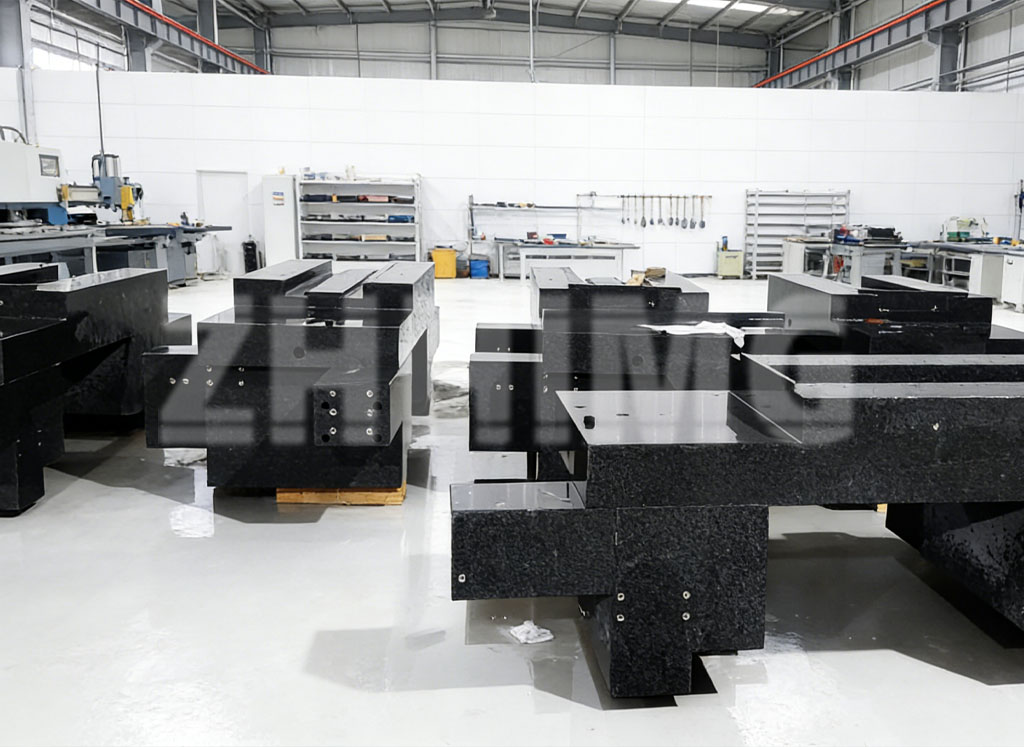
The trade-off of aging cycle is essentially a choice between short delivery efficiency and long-term benchmark stability. Shortening aging can reduce production cycles and lower costs, at the expense of precision reliability over years of service. Adhering to multi-stage long aging occupies more factory space and extends production cycles, yet it is the fundamental guarantee to safeguard stable operation of high-end ultra-precision equipment.
Ultra-precision manufacturing competition is not only about inspection data at the time of delivery, but also the persistence of precision across years. The aging process is invisible and hard to test, yet it quietly decides whether a granite reference part can continuously undertake precision missions for high-end equipment. ZHHIMG always sticks to the complete multi-stage aging workflow and refuses to simplify aging procedures for faster delivery. We trade time for stability, supplying long-term stable precision granite reference components for metrology institutes, universities and Fortune Global 500 enterprises worldwide.
Post time: Oct-15-2026