
The semiconductor industry has entered the era of nano-scale ultra-precision manufacturing. Core processes such as lithography, wafer inspection, chip packaging and laser micro-machining impose extremely stringent requirements on the stability, flatness and environmental adaptability of equipment bases. As chip manufacturing processes evolve from micron to nanometer scale, tiny deformation, vibration offset and temperature deviation of the base will directly cause wafer alignment errors and pattern etching deviations, ultimately leading to a sharp drop in chip yield. Among many base materials including metal alloys, ordinary stone and new composite materials, precision granite platforms have become standard load-bearing bases for high-end semiconductor equipment. This is not an habitual choice of the industry, but an optimal technical solution verified over the long term to fit ultra-precision semiconductor processes, and a core demand of the ultra-precision manufacturing sector.
Unlike traditional mechanical processing equipment, the core pain point for semiconductor equipment is not load capacity, but precision retention with ultimate stability. Semiconductor production lines operate 24/7 continuously. Slight fluctuations in workshop temperature and humidity, mechanical vibration generated during equipment operation, heat accumulation from module movement and minor external interference all become precision destroyers for precision manufacturing processes. Supported by unique natural material properties and ultra-precision processing technology, ZHHIMG® precision granite platforms perfectly solve various precision challenges in semiconductor manufacturing and serve as the cornerstone safeguarding the precision of chip production.
1. Ultra-low Deformation Property to Secure the Precision Baseline of Nano-scale Processes
Nano-scale semiconductor manufacturing sets harsh requirements on the thermal and structural stability of materials. Traditional metal bases such as steel and aluminum feature high thermal conductivity and large thermal expansion coefficients. Heat generated during long-time equipment operation and minor temperature fluctuations in constant-temperature workshop systems will trigger slight expansion and contraction of the base. For semiconductor equipment at nano precision, micron-level deformation is enough to scrap an entire wafer. Meanwhile, metal materials tend to suffer stress relaxation and micro-creep under long-term load, resulting in flatness drift over time and failing to meet the long-term high-precision operation requirements of semiconductor equipment.
High-end precision granite boasts unique physical advantages. ZHHIMG® exclusive black granite reaches a density of 3100kg/m³, featuring dense and uniform texture, no internal pores or residual stress. It completely avoids thermal deformation and stress deformation plaguing metal materials. Its ultra-low thermal expansion coefficient ensures almost no dimensional shift of the base within normal temperature fluctuation ranges of semiconductor workshops. Even with prolonged continuous equipment operation and partial heat accumulation, the overall structural dimension remains constant, fundamentally eliminating overlay and alignment errors caused by thermal deformation. In addition, the material delivers high hardness and rigidity, with outstanding compression and deformation resistance superior to ordinary stone and metals. It will not collapse, wear or deform under long heavy-load conditions, perfectly fitting the year-round non-stop high-precision operation of semiconductor equipment.
It is worth noting that many low-cost bases on the market use ordinary marble as a substitute for high-grade granite. Marble has loose texture, poor stability and high deformation rate, prone to precision drift under environmental impacts, and cannot satisfy nano-scale semiconductor manufacturing demands. This is the key reason why high-end semiconductor equipment rejects ordinary marble and only adopts high-quality precision granite platforms.
2. Natural Vibration Damping Property to Isolate Micro-vibration Interference in Processes
Semiconductor lithography, AOI optical inspection, X-ray defect detection, femtosecond laser micro-machining and other core procedures are extremely sensitive to vibration. Even faint ground vibration in workshops, micro-tremors from high-speed moving equipment modules and tiny displacement induced by airflow can lead to optical path drift, distorted inspection data and failed machining precision. Traditional metal bases have high elasticity. Instead of absorbing vibration, they conduct and amplify micro-vibration generated during equipment operation and trigger resonance, severely undermining the stability of semiconductor precision manufacturing.
Precision granite has inherent high damping vibration absorption performance, an advantage that metal materials cannot replicate. Its dense natural crystal structure efficiently absorbs and dissipates micro-vibration from external sources and the equipment itself, rapidly attenuates vibration energy and prevents vibration superposition and transmission, building an almost vibration-free working substrate for semiconductor equipment. Combined with vibration isolation trenches and silent operation systems in professional constant-temperature, constant-humidity and dust-free workshops, it further realizes nano-level vibration control, fully meeting the ultra-high precision requirements of semiconductor optical inspection, precision alignment and micro-nano machining, and guaranteeing processing consistency of every wafer and chip.
3. High Compatibility with Cleanroom Standards for Semiconductor Dust-free Workshops
Semiconductor manufacturing is fully carried out in dust-free cleanrooms. The dust resistance, wear resistance and corrosion resistance of base materials directly affect workshop cleanliness and chip yield. Metal bases are vulnerable to oxidation and rust, and produce debris when worn. Rust particles and metal scraps contaminate the clean environment and cause chip short-circuit and surface defects. Ordinary stone has loose texture, easily adsorbs dust and moisture and is hard to clean and maintain, making it unsuitable for high-cleanliness semiconductor production scenarios.
After ultra-precision grinding and polishing, ZHHIMG® precision granite platforms have dense, smooth and pore-free surfaces that do not trap dust or generate debris. They feature excellent dust-proof, rust-proof and anti-corrosion performance, fully complying with semiconductor cleanroom standards. No impurity contamination will occur during long-term use, and maintenance and cleaning are convenient. The platforms sustain workshop cleanliness for a long time, reducing defective products caused by dust pollution. They apply to high-end clean manufacturing scenarios including semiconductors, perovskite photovoltaics and new-energy lithium battery inspection.
4. Ultra-precision Machining Enables Full-area Nano-scale Flatness
The upper precision limit of semiconductor equipment depends on the lower flatness limit of the load-bearing base. Core semiconductor equipment such as coordinate measuring machines, optical comparators, laser machining platforms and linear motor platforms relies on perfectly flat bases for accurate positioning and high-speed movement. Minor height difference or flatness deviation on the base surface will directly convert into operating precision errors of the equipment.
With top-tier ultra-precision machining and inspection systems, precision granite platforms achieve full-area nano-scale flatness, far exceeding the precision limit of traditional materials. From raw material selection and integrated forming by large CNC equipment, to nano manual grinding by senior craftsmen with over 30 years of experience, and full-range calibration by world-leading inspection tools including Germany Mahr, Swiss WYLER and UK Renishaw, the precision of each granite base is traceable to national metrology standards and compatible with global measurement standards of Germany, USA, Japan, China and other countries. Such extraordinary flatness and precision stability provide an absolute reference plane for module assembly, optical path calibration and dynamic measurement of semiconductor equipment, supporting high-speed, high-precision and stable equipment operation. 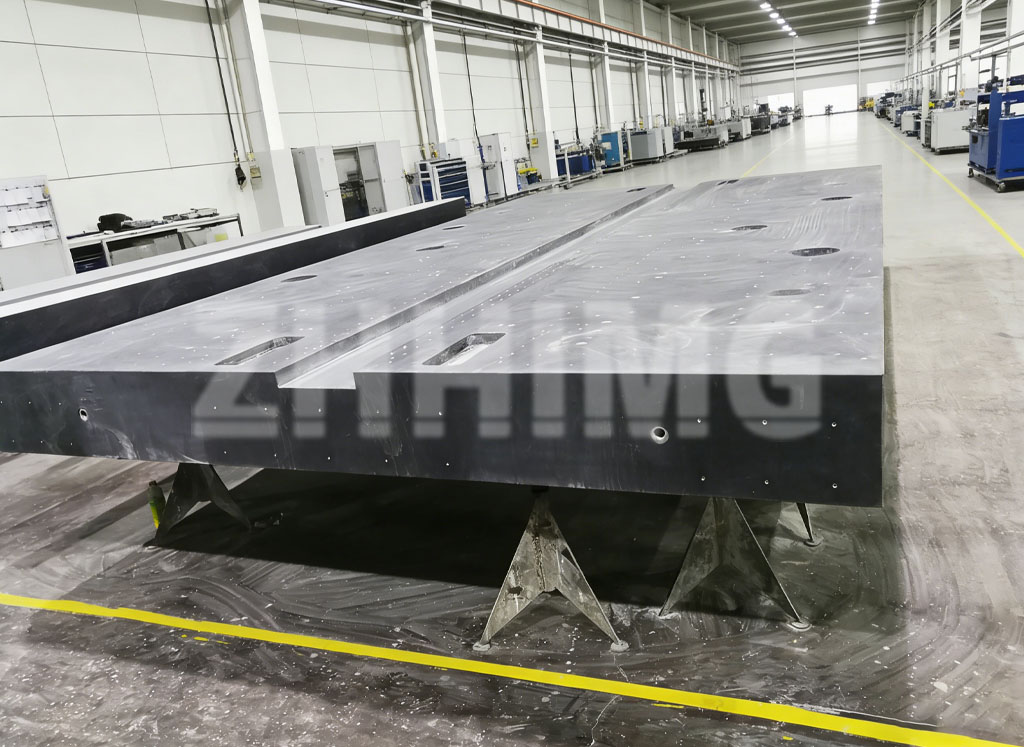
5. Long-term Stable Performance to Adapt to Mass Industrial Production
Semiconductor production lines require huge investment and have long service life, demanding high durability and sustained precision retention of bases. Metal bases easily wear, deform and rust with long service time, requiring frequent calibration and replacement, which raises maintenance costs and disrupts production capacity. Ordinary stone suffers rapid precision degradation and cannot maintain precision manufacturing standards for long.
Precision granite features extremely stable physical and chemical properties. It is wear-resistant, anti-aging and corrosion-resistant, unaffected by temperature-humidity variation, acid-base environment and long heavy load. Its precision shows no obvious attenuation for more than ten years without frequent calibration. For large-scale semiconductor manufacturers, it greatly cuts equipment maintenance costs and downtime losses while consistently securing chip yield, matching the high-volume, high-precision and continuous production characteristics of the semiconductor industry.
Conclusion
The iteration from micron to nano manufacturing processes essentially demands extreme upgrades in stability, precision and environmental adaptability of equipment substrates. With five core strengths: stress-free deformation, natural vibration damping, cleanroom compatibility, nano flatness and long-term stability, precision granite platforms resolve core pain points of ultra-precision semiconductor manufacturing and become indispensable load-bearing substrates for high-end semiconductor equipment. This is not merely a winning material selection, but an inevitable trend for the semiconductor industry to pursue ultra-high precision, yield and stability. It also reflects ZHHIMG’s commitment to the ultra-precision sector, delivering rigorous quality to support the upgrade of global high-end precision industries.
Post time: Oct-08-2026