
In high-precision manufacturing, the foundation of accuracy is not software, tooling, or even spindle speed—it is structural stability. For decades, steel has been the dominant material for machine bases due to its strength, availability, and familiarity. However, as tolerances tighten and industries such as semiconductors, optics, and advanced metrology demand sub-micron and even nanometer-level precision, the limitations of steel have become increasingly evident. In 2026, a clear shift is underway: granite machine bases are rapidly replacing steel in high-precision applications.
This transition is not a trend driven by novelty, but by physics, material science, and performance outcomes. Manufacturers are reevaluating their foundational materials to meet the evolving demands of ultra-precision environments. Granite, particularly engineered high-density black granite, is emerging as a superior alternative.
One of the primary drivers behind this shift is vibration damping. Steel, while strong, is inherently elastic and transmits vibrations efficiently. In high-speed machining or precision measurement systems, even minor vibrations can lead to dimensional inaccuracies, poor surface finish, and tool wear. Granite, by contrast, has a naturally high internal damping coefficient. It absorbs vibrations rather than transmitting them, significantly improving machine stability. In applications such as coordinate measuring machines (CMMs), semiconductor inspection systems, and ultra-precision grinding equipment, this property alone can justify the transition.
Thermal stability is another critical factor. Steel expands and contracts relatively quickly with temperature fluctuations, which can compromise accuracy in environments where thermal control is not perfectly uniform. Granite has a much lower coefficient of thermal expansion and responds more slowly to temperature changes. This means that machines built on granite bases maintain dimensional stability over longer periods, reducing the need for constant recalibration. In industries where even a few microns of deviation can result in product rejection, this stability is invaluable.
Beyond physical properties, granite offers significant advantages in long-term durability and maintenance. Steel structures are susceptible to corrosion, especially in humid or chemically active environments. Protective coatings can mitigate this, but they introduce additional cost and maintenance requirements. Granite, being a natural stone, is inherently corrosion-resistant. It does not rust, degrade, or require surface treatments, making it particularly suitable for cleanroom and laboratory environments.
Another often overlooked advantage is stress relief. Steel components, especially those that are welded or machined, can retain internal stresses that may deform over time. Even after heat treatment, residual stress can lead to gradual distortion. Granite, on the other hand, is formed over geological timescales and is naturally stress-relieved. Once machined and lapped to precision, it maintains its shape with exceptional consistency over decades.
From a manufacturing perspective, advancements in precision machining and metrology have made granite more viable than ever. CNC grinding, diamond tooling, and high-precision lapping techniques now allow manufacturers to achieve flatness and parallelism within microns. Furthermore, the integration of threaded inserts, air bearings, and hybrid assemblies has expanded the functional capabilities of granite structures. What was once considered a passive base material is now an active component in high-performance systems.
Cost considerations also play a role, though not always in the way one might expect. While the initial material and processing costs of granite can be higher than steel, the total cost of ownership often favors granite. Reduced maintenance, longer service life, fewer recalibrations, and improved product quality all contribute to lower operational costs over time. For manufacturers operating in high-value sectors, these savings can be substantial.
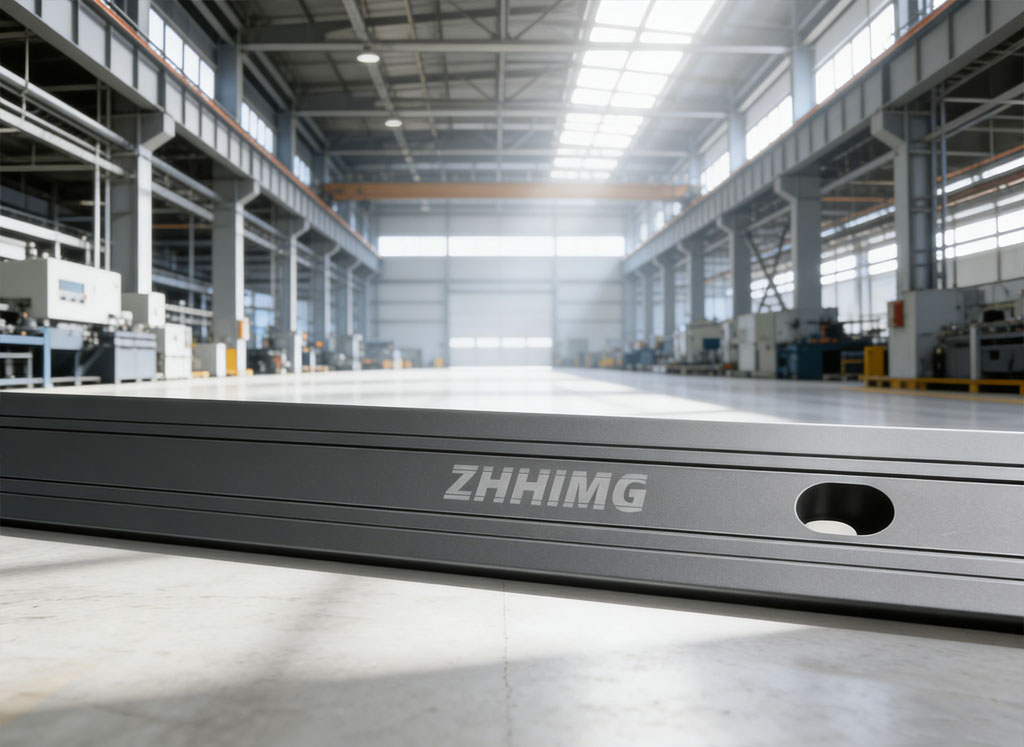
The comparison between granite and steel is not merely technical—it reflects a broader shift in manufacturing philosophy. Precision is no longer achieved solely through tighter machining tolerances or advanced control systems. It is increasingly dependent on system-level optimization, where every component, including the base, contributes to overall performance. In this context, granite is not just an alternative material; it is an enabler of next-generation manufacturing capabilities.
Industries leading this transition include semiconductor fabrication, where wafer processing equipment demands extreme stability; aerospace, where precision components must meet stringent specifications; and medical device manufacturing, where consistency and reliability are critical. In these sectors, the adoption of granite machine bases is not optional—it is becoming standard practice.
It is also worth noting that sustainability considerations are beginning to influence material choices. Granite, as a natural material, has a lower environmental impact in certain aspects compared to steel, which requires energy-intensive processes such as smelting and forging. Additionally, the longevity of granite structures reduces the need for replacement, further contributing to sustainability goals.
Despite these advantages, granite is not without limitations. It is more brittle than steel and requires careful handling during transport and assembly. Design considerations must account for this, particularly in applications involving dynamic loads or impact forces. However, with proper engineering and integration, these challenges are manageable and do not outweigh the benefits.
Looking ahead, the role of granite in high-precision manufacturing is expected to expand further. As technologies such as AI-driven machining, ultra-fast laser processing, and quantum-level measurement systems evolve, the demand for ultra-stable platforms will only increase. Granite, with its unique combination of mechanical, thermal, and chemical properties, is well-positioned to meet these demands.
In conclusion, the replacement of steel by granite in machine bases is not a temporary shift but a structural evolution in manufacturing. Driven by the need for higher precision, greater stability, and improved efficiency, manufacturers are embracing materials that align with the realities of modern production. Granite machine bases represent a convergence of natural material advantages and advanced engineering, offering a foundation that supports the future of high-precision manufacturing.
As 2026 unfolds, the question is no longer whether granite will replace steel in precision applications—but how quickly industries can adapt to leverage its full potential.
Post time: Apr-23-2026