
In the high-stakes arena of quality assurance, the Coordinate Measuring Machine (CMM) stands as the ultimate arbiter of truth. Whether verifying the complex geometry of an aerospace turbine or the delicate contours of a medical implant, the CMM must provide measurements that are accurate to within a fraction of a human hair. To achieve this level of performance, the machine requires a physical foundation that is virtually immune to environmental interference. This is why black granite has become the preferred material for the structural components of world-class CMMs.
The Foundation of Dimensional Stability
The primary challenge for any CMM is maintaining its geometry over time and through varying conditions. Metal components, while strong, are susceptible to internal stresses and significant thermal expansion. If the bridge or the base of a CMM expands or warps even slightly, the entire coordinate system is thrown out of alignment.
Black granite, specifically high-density varieties like ZHHIMG Black Granite, offers a natural solution. As a material that has spent millions of years underground, it is naturally “stress-relieved.” It does not have the “memory” of a manufacturing process like casting or welding, which means it will not slowly change shape over years of use. This long-term dimensional stability ensures that a CMM calibrated today will remain accurate for years to come, providing a consistent baseline for industrial production.
Superior Thermal Performance
Temperature is perhaps the greatest variable in a metrology lab. While many labs are climate-controlled, the heat from motors, electronics, and even the human operator can create micro-climates that affect machine accuracy. Black granite is renowned for its low coefficient of thermal expansion. Furthermore, its high thermal mass means it responds very slowly to temperature changes.
While a steel component might react instantly to a draft of warm air, granite acts as a thermal “sink,” absorbing heat without immediate dimensional change. This slow response time allows the machine’s software to more easily compensate for environmental shifts, leading to more reliable data in real-world shop floor conditions. For global manufacturers who operate in diverse climates, this thermal inertia is a critical benefit that protects the integrity of their quality control process.
Vibration Damping and Mass
Accuracy is not just about staying still; it is about resisting movement. CMMs often operate in environments where heavy machinery, forklifts, or HVAC systems create constant floor vibrations. These vibrations can travel through the machine frame and manifest as “noise” in the measurement data, leading to false rejects or inconsistent readings.
The high density of black granite (typically around 3100 kg/m³) provides the necessary mass to ground the machine. More importantly, granite possesses excellent internal damping characteristics. It naturally dissipates kinetic energy much faster than cast iron or aluminum. When the CMM’s probe moves at high speeds, the granite components help swallow the resulting inertia, allowing the machine to settle quickly and take measurements faster without sacrificing precision.
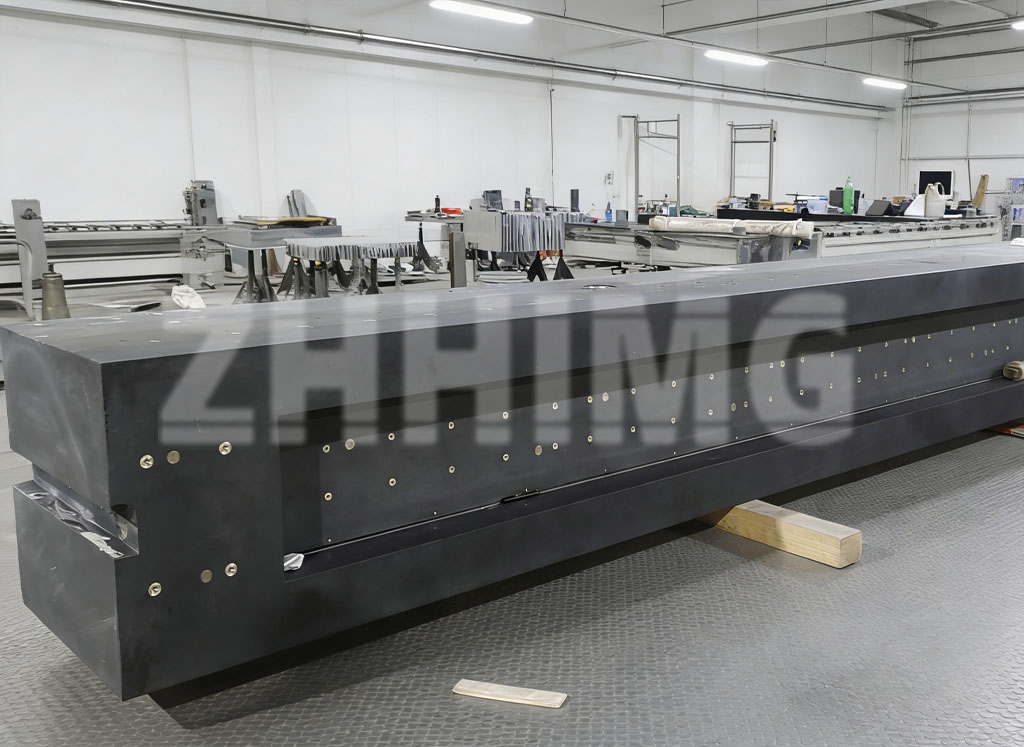
Wear Resistance and Maintenance
A CMM is a significant capital investment, and its longevity is directly tied to the durability of its surfaces. The guide-ways of a CMM—the surfaces upon which the air bearings float—must remain perfectly flat and smooth. Black granite is exceptionally hard, often ranking higher than most metals on the Mohs scale. This hardness makes it highly resistant to scratches and abrasions.
Furthermore, black granite is non-magnetic and non-conductive. It does not attract metallic dust or shavings that could interfere with sensitive electronic probes or scratch the guide-ways. Because it is chemically inert, it does not rust or corrode when exposed to humidity or the oils from an operator’s hands. This “low-maintenance” nature is a major operational benefit, reducing the downtime required for cleaning and resurfacing.
Achieving High-Precision Lapping
The manufacturing of black granite components involves a process known as lapping, where the stone is ground down using progressively finer abrasives. Because of granite’s uniform grain structure, technicians can achieve flatness tolerances that are nearly impossible to replicate with metals. A black granite CMM base can be lapped to a flatness measured in light bands, providing a near-perfect plane for the air bearings to glide over.
This smoothness is essential for the “frictionless” movement required by modern high-speed CMMs. The air bearings require a consistent gap of only a few microns; if the granite surface had even microscopic irregularities, the bearing could “crash,” leading to expensive repairs. The ability of black granite to hold these extreme tolerances is the reason it remains the undisputed king of metrology materials.
Conclusion: The Global Standard for Accuracy
As manufacturing moves toward “Zero-Defect” production, the role of the CMM becomes even more critical. By choosing black granite components, manufacturers are investing in the highest possible level of stability, durability, and precision. From the damping of ambient vibrations to the resistance against thermal drift, the benefits of black granite are what allow modern metrology to push the boundaries of what is measurable.
For companies engaged in global export, providing CMMs with black granite foundations is a mark of quality that is recognized worldwide. It is a material that speaks the universal language of precision, ensuring that no matter where in the world a part is measured, the truth remains as solid as the stone it stands on.
Post time: Apr-22-2026