
In the world of high-precision manufacturing, heat is the ultimate enemy. As machines run, friction generates warmth; as factory lights hum, ambient temperatures shift; and as seasons change, the very air inside a facility expands and contracts. For most objects, these fluctuations are a minor nuisance. But in the realm of nanometer-scale fabrication—where a single deviation can ruin a silicon wafer or misalign a satellite’s optical array—thermal expansion is a catastrophic variable. This has led to the rise of Zero-Expansion Materials, with granite and advanced ceramics emerging as the foundational heroes of the high-tech industrial age.
The Physics of the “Perfect” Foundation
To understand why granite and ceramics have become indispensable, one must first understand the “Coefficient of Thermal Expansion” (CTE). This value measures how much a material’s dimensions change per degree of temperature change. Steel and aluminum, while strong, have relatively high CTEs. If a measurement rail made of steel grows by even a few microns due to a 1°C shift, the precision of the entire assembly is compromised.
Zero-expansion materials—or more accurately, low-expansion materials—provide a solution by offering near-total dimensional stability. Granite, a natural igneous rock formed under immense pressure and heat, and technical ceramics, engineered through precise chemical synthesis, offer the lowest expansion rates available in industrial-scale materials. By using these substances as the “bed” or “spine” of a machine, engineers can ensure that the “zero point” of their measurements remains truly fixed, regardless of the thermal environment.
Granite: Nature’s Answer to Stability
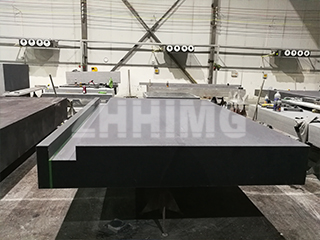
Granite has long been the gold standard for metrology foundations. Its secret lies in its composition. Formed over millions of years, granite is a composite of quartz, mica, and feldspar. This natural structure is inherently “relaxed.” Unlike metals, which may have internal stresses from the casting or forging process, granite has had eons to settle into a state of equilibrium.
In high-tech manufacturing, such as the production of Large-Scale Integration (LSI) circuits, granite serves as the base for lithography machines. These machines must project complex patterns onto wafers with sub-micron accuracy. Even the slightest vibration or thermal drift would result in a “blurred” circuit. Granite’s high density provides excellent vibration damping, while its low CTE ensures that the machine’s internal geometry remains frozen in time.
Furthermore, black granite—specifically varieties like “ZHHIMG Black Granite”—is prized for its high mineral density and low water absorption. This makes it resistant to humidity-induced swelling, adding another layer of stability to the “Zero-Expansion” promise. When an engineer specifies a granite base, they aren’t just buying a rock; they are buying a predictable, unchanging physical constant.
Advanced Ceramics: Engineering the Impossible
While granite is nature’s masterpiece, advanced ceramics are the triumph of human engineering. Materials like Alumina (Aluminum Oxide) or Silicon Carbide are engineered to push the boundaries of what is physically possible. Ceramics are often the material of choice when granite reaches its limits—specifically in terms of weight-to-stiffness ratios and extreme thermal environments.
Advanced ceramics can be engineered to have a CTE that is nearly zero over a specific temperature range. This makes them vital for components that move at high speeds, such as the air-bearing stages used in semiconductor inspection. Because ceramics are lighter than granite but significantly stiffer, they allow for faster acceleration and deceleration without the “lag” or deformation caused by inertia.
In the aerospace sector, ceramic measurement tools are used to verify components for rocket engines and telescope mirrors. These tools must operate in environments where temperature swings are extreme. The “Zero-Expansion” characteristic of ceramics ensures that the measurement taken at -50°C is identical to the one taken at +50°C. This level of reliability is why ceramics are often referred to as the “ultimate” metrology material.
The Synergy in the Modern Cleanroom
In today’s most advanced factories, you will rarely find just one material. Instead, you see a strategic synergy. Granite forms the massive, unmoving base—the “earth” of the machine—providing the weight and damping needed to ground the system. Atop this base, ceramic components handle the high-speed movement and critical measurements, providing the “intellect” of the system.
This combination is driving the next generation of high-tech manufacturing. As we move toward 2nm chip architecture and beyond, the tolerance for error is effectively zero. Every component in the manufacturing chain must contribute to a “thermal neutral” environment. By utilizing Zero-Expansion Materials, manufacturers can eliminate one of the most difficult variables in the precision equation.
A Global Shift Toward Stability
The demand for these materials is no longer localized to traditional industrial hubs. As high-tech manufacturing spreads across the globe, the logistics of exporting these “Zero-Expansion” foundations have become a specialized industry. Shipping a five-ton granite base or a fragile ceramic master rail requires more than just a crate; it requires an understanding of how these materials behave.
Leading exporters now provide comprehensive thermal mapping and calibration certificates that prove the material’s stability under various conditions. This transparency allows a manufacturer in one part of the world to build a machine with the absolute certainty that its foundation, sourced from halfway across the globe, will remain stable the moment it is bolted to the cleanroom floor.
Conclusion: Building on an Unchanging Foundation
The phrase “Zero-Expansion” is more than a technical specification; it is a philosophy of manufacturing. It represents a refusal to accept the fluctuations of the natural world and a commitment to absolute, repeatable accuracy. Whether it is the ancient, weathered strength of granite or the futuristic, laboratory-perfected precision of ceramics, these materials are the silent partners in every technological breakthrough of the 21st century.
As we look to the future—to quantum computing, deep-space exploration, and beyond—the role of granite and ceramics will only grow. In a world that is constantly changing, these materials provide the one thing high-tech manufacturing needs most: a place to stand that never moves.
Post time: Apr-22-2026