
In the rapidly evolving landscape of global manufacturing, where the difference between success and failure is often measured in microns, the foundation of quality control remains as solid as stone. Specifically, black granite. As industries from aerospace to semiconductor fabrication push the boundaries of what is possible, the demand for High-Grade Granite Surface Plates & Precision Measuring Tools has reached an unprecedented peak. This surge is not merely a matter of quantity but a rigorous pursuit of quality, reliability, and the logistical capability for Global Export.
The Bedrock of Precision
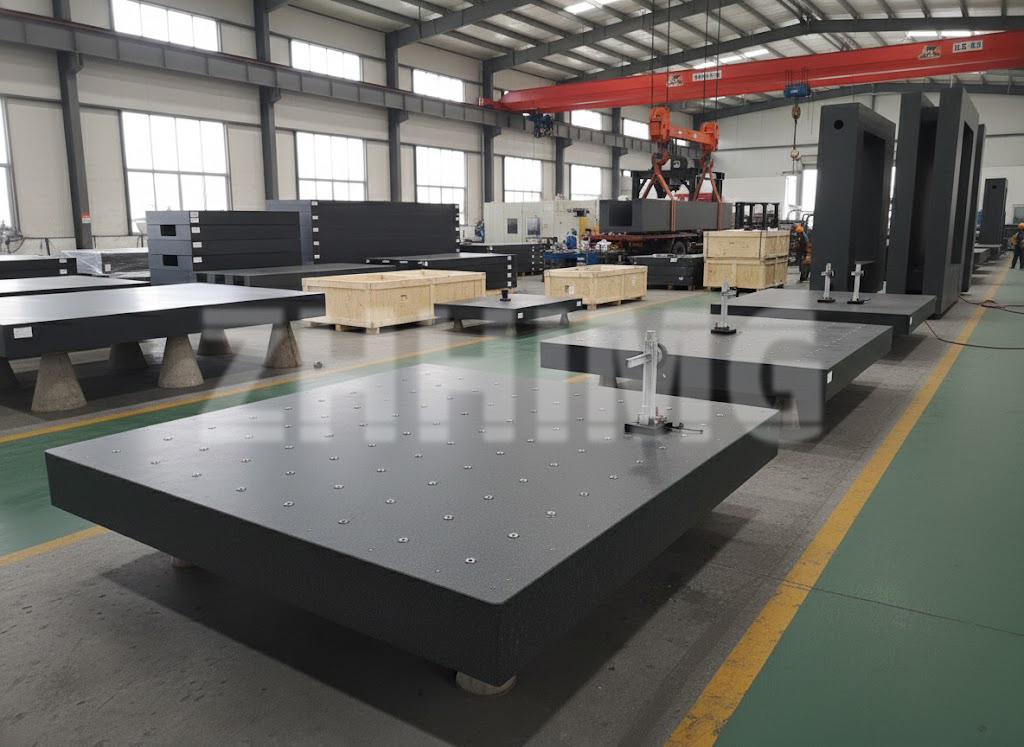
Every high-precision component, whether it is a turbine blade for a jet engine or a microscopic circuit on a silicon wafer, begins its journey of verification on a surface plate. A surface plate serves as the primary horizontal reference plane for inspection, tool marking, and layout. While various materials have been used over the decades—including cast iron and glass—granite has emerged as the undisputed champion of the metrology world.
The reasons for granite’s dominance are rooted in its geological properties. Unlike metals, granite is naturally aged over millions of years, resulting in a material that is internally stress-relieved. This means it will not warp or shift over time due to internal tension. Furthermore, granite possesses a very low coefficient of thermal expansion, making it remarkably stable in environments where temperature fluctuations might otherwise compromise measurements. For a global exporter, providing plates that maintain their flatness regardless of whether they are installed in a humid tropical factory or a dry, high-altitude laboratory is a critical selling point.
Engineering Excellence for a Global Market
Producing a high-grade granite surface plate is a marriage of heavy industrial labor and delicate artisan craftsmanship. The process begins with the selection of the raw material. Not all granite is created equal; metrology-grade granite must have a specific mineral composition—typically a high percentage of quartz—to ensure hardness and wear resistance.
Once the raw slabs are quarried and cut to size, the true magic of precision engineering begins. The slabs undergo a rigorous grinding and lapping process. Lapping is a manual or semi-automated technique where abrasive pastes are used to wear down the high spots of the stone. This is a time-consuming process that requires immense skill. A technician must constantly measure the surface using electronic levels or laser interferometers to ensure the plate meets specific grade requirements, such as Grade 00 (Laboratory Grade), Grade 0 (Inspection Grade), or Grade B (Toolroom Grade).
For companies focused on global export, adhering to international standards is non-negotiable. Whether it is the DIN 876 standard common in Europe, the GB/T 20428 in China, or the ASME B89.3.7 in the United States, an exporter must be able to certify that their products meet or exceed these benchmarks. This cross-compatibility ensures that a manufacturer in Germany can seamlessly integrate a plate manufactured in Asia or the Americas into their existing quality management system.
Beyond the Plate: A Comprehensive Toolset
While the surface plate is the stage, the precision measuring tools are the actors. A holistic approach to metrology export includes a suite of granite-based accessories that complement the surface plate:
-
Granite Squares and Tri-Squares: Used for checking the perpendicularity of machine axes and workpieces.
-
Granite Straight Edges: Essential for measuring the flatness and straightness of long surfaces, such as machine tool ways.
-
Granite Master Parallels: Used to elevate workpieces while maintaining a perfect parallel relationship to the surface plate.
-
Granite V-Blocks: Vital for supporting cylindrical parts during inspection.
The advantage of using granite for these tools mirrors the advantages of the plates themselves: they are non-magnetic, non-conductive, and resistant to corrosion. In an export context, these tools are often bundled with the plates, providing a “turnkey” metrology solution for new facility setups overseas.
Navigating the Logistics of Global Export
Exporting high-grade granite is a feat of logistical engineering. A standard $2000 \times 1000$ mm surface plate can weigh several tons. Ensuring that such a heavy, yet ironically fragile, instrument arrives at a destination halfway across the world without a single scratch requires specialized packaging.
Custom-built wooden crates, reinforced with steel strapping and internal cushioning, are the industry standard. Furthermore, since these tools are often destined for climate-controlled labs, the shipping process must account for moisture protection to prevent any wooden packaging from warping or affecting the stone.
The “Global Export” aspect also involves navigating complex customs regulations and international trade agreements. Leading exporters invest heavily in documentation, ensuring that every shipment is accompanied by NIST-traceable (or equivalent) calibration certificates. These documents are the “passport” of the measuring tool, proving its accuracy to the end-user before it even leaves the crate.
The Role of Innovation in Traditional Materials
One might think that a field based on ancient stone would be stagnant, but the opposite is true. Innovation in granite metrology is currently focused on integration. We are seeing the rise of “Smart Surface Plates,” where sensors are embedded within the granite to monitor temperature gradients and vibration in real-time. This data can be fed directly into a factory’s Digital Twin, allowing for automated compensations in measurement based on environmental factors.
Additionally, the development of lighter-weight “honeycomb” structures—where granite is bonded to lighter substrates—is an area of active research. This aims to reduce shipping costs and floor loading requirements without sacrificing the superior surface properties of the stone.
Why the World Chooses High-Grade Granite
In the end, the global reliance on these tools comes down to trust. In an era of “planned obsolescence,” a high-grade granite surface plate is a generational investment. If properly maintained and periodically re-lapped, a single plate can serve a manufacturing facility for thirty to fifty years.
As emerging markets in Southeast Asia, Latin America, and Eastern Europe expand their high-tech manufacturing capabilities, the demand for reliable, export-ready metrology equipment will only continue to climb. By combining the natural stability of the earth’s oldest rocks with the cutting-edge precision of modern calibration technology, exporters of granite surface plates are providing the foundation upon which the modern world is built—one micron at a time.
Whether it is supporting the assembly of a satellite or ensuring the perfect fit of a medical implant, the humble granite plate remains the silent partner in human progress. For the global exporter, the mission is clear: to deliver unwavering stability to a world that never stops moving.
Post time: Apr-22-2026