
In the current era of semiconductor miniaturization, where features are measured in nanometers, the structural integrity of manufacturing equipment is as critical as the light source itself. As global demand for more powerful and energy-efficient chips skyrockets, engineers are re-evaluating the physical foundations of their cleanroom assets. The conversation often centers on a single, uncompromising material: natural black granite. But what exactly makes a granite stage for photolithography the superior choice over advanced alloys or synthetic composites in the pursuit of sub-micron accuracy?
The primary challenge in lithography is maintaining absolute positional accuracy during high-speed scanning and exposure. Any microscopic vibration or thermal drift can lead to overlay errors, effectively ruining a silicon wafer and incurring significant financial loss. Granite’s high density and exceptional vibration damping properties provide a silent, inert environment. Unlike metals, which react predictably but significantly to temperature fluctuations, the low thermal expansion coefficient of granite ensures that the stage remains dimensionally stable throughout the production cycle. This stability is the literal bedrock upon which the entire semiconductor industry is built.
Moving from the nanometer scale to the high-volume world of printed circuit board production, the requirements for mechanical stability remain equally stringent. A granite base for PCB drilling machine must withstand constant, high-frequency mechanical stress and rapid accelerations. Modern PCB drilling involves spindles rotating at hundreds of thousands of RPM, moving with incredible speed across the X-Y plane. Without a massive, rigid foundation to absorb these kinetic forces, the precision of the drill holes would drift, leading to misaligned vias and electrical failures in the final product. By utilizing high-quality granite foundations, manufacturers can achieve higher throughput without sacrificing the structural longevity of the machine.
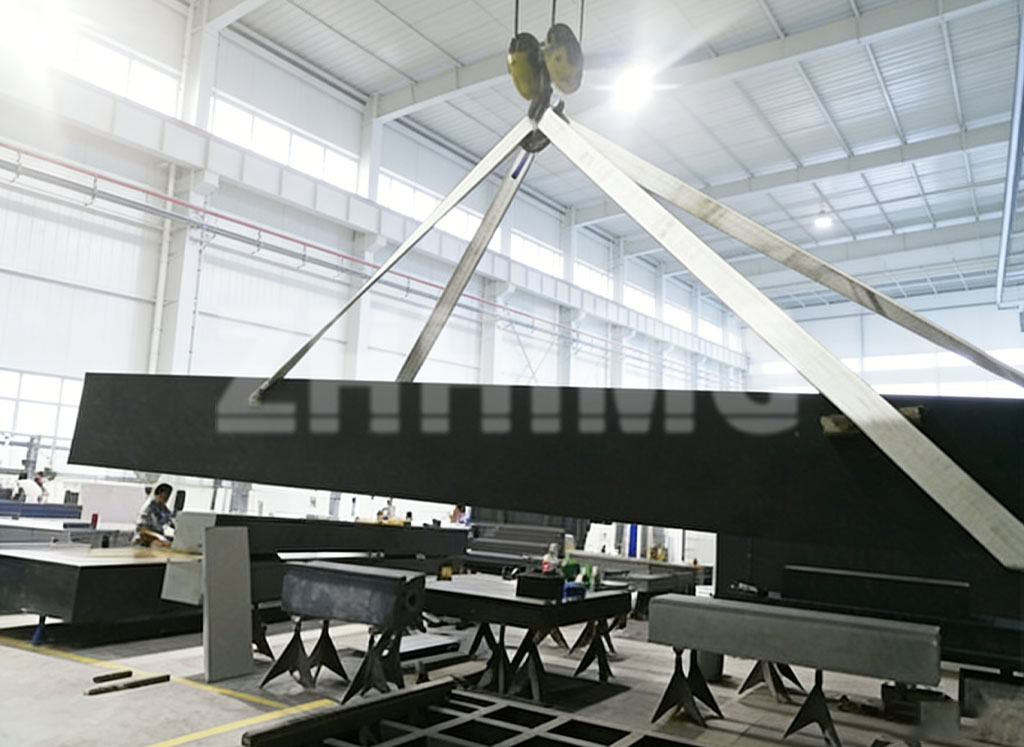
Technical specifications often define the boundary between a standard component and a high-performance solution. One of the most critical metrics requested by European and American quality controllers is the surface finish. A granite base with surface roughness Ra < 0.8μm is not just an aesthetic achievement; it is a functional necessity for advanced motion control. Such a smooth surface allows for the seamless integration of air bearing systems, which are ubiquitous in high-end stages. When the air film between the stage and the base is only a few microns thick, even the slightest protrusion on the granite surface could cause a catastrophic “crash,” leading to expensive downtime and permanent equipment damage.
ZHHIMG Group has spent decades refining the manual lapping techniques required to achieve these sub-micron tolerances reliably. While modern CNC grinding provides the initial geometry, the final “Ra < 0.8μm” finish is often the result of human expertise and rigorous environmental control. Our production facilities maintain a constant temperature and humidity level to ensure that the stone is measured and finished in its most stable state. This dedication to craftsmanship is why ZHHIMG has become a preferred partner for global OEMs who cannot afford to compromise on their equipment’s foundational accuracy.
Looking toward the future, the role of granite in the electronics industry is only set to expand. As we move toward 2nm and 1nm process nodes, the tolerances for flatness and roughness will become even more aggressive. The industry is no longer just looking for a material supplier; they are looking for a partner who understands the complex relationship between material science and mechanical output. By integrating advanced inserts, complex cable routing channels, and secondary coating technologies, ZHHIMG is transforming the humble granite slab into a sophisticated engineering platform.
In conclusion, whether it is the rapid-fire precision required for a granite base for PCB drilling machine or the atomic-level stability needed for a granite stage for photolithography, the choice of material is clear. The natural properties of granite, when enhanced by precision engineering and a surface roughness Ra < 0.8μm, provide the only viable path forward for the world’s most demanding manufacturing processes. As technology advances, ZHHIMG remains committed to pushing the limits of what is possible, ensuring that the foundations of the digital world remain as solid as rock.
Post time: Mar-03-2026