
Precision granite components have become indispensable in semiconductor manufacturing equipment due to their exceptional thermal stability (coefficient <0.001mm/°C), natural vibration damping, and ability to maintain nanometer-level flatness over large areas. As semiconductor feature sizes approach single-digit nanometers, the positioning accuracy requirements for wafer inspection, lithography, and metrology equipment have escalated beyond the tolerance capabilities of metallic materials. Leading semiconductor equipment manufacturers including those serving the 5th axis machining, wafer inspection, and advanced packaging sectors have standardized on granite as their foundation material for air bearing platforms and precision positioning systems.
1. The Precision Challenge in Semiconductor Manufacturing
Modern semiconductor fabrication operates at scales that push the boundaries of engineering materials and manufacturing processes. Current advanced logic chips feature transistor gate lengths measured in nanometers—smaller than many viruses and approaching the limits of atomic-scale manufacturing. Achieving this precision requires measurement, inspection, and processing equipment with positioning accuracy measured in nanometers rather than micrometers.
Coordinate measuring machines and optical inspection systems used in semiconductor quality control must detect defects invisible to the naked eye while maintaining throughput compatible with production line requirements. These seemingly contradictory demands—extreme precision and high speed—require machine foundations that eliminate vibration, maintain thermal stability, and provide rigid, non-deforming reference surfaces for component positioning.
Air bearing platforms, the workhorses of precision positioning in semiconductor equipment, depend entirely on their mounting foundations for performance. Air bearings provide frictionless linear motion by suspending moving elements on thin films of compressed air. Any foundation deflection or vibration transmits directly to the payload, compromising the precision positioning capability that air bearings provide. A granite machine base provides the immovable reference frame that makes air bearing technology effective.
The thermal environment in semiconductor fabs presents additional challenges. Equipment operating continuously generates heat, while facility HVAC systems create temperature gradients across production areas. Even minute thermal expansion in machine foundations can translate to positioning errors that exceed nanometer-level tolerances. Granite’s near-zero thermal coefficient eliminates this error source entirely, allowing equipment to maintain specification across varying thermal conditions.
2. Vibration Damping: Protecting Nanometer-Scale Processes
Semiconductor manufacturing equipment operates in environments filled with vibration sources that can compromise precision processes. Nearby equipment including vacuum pumps, cryogenic systems, gas handling equipment, and material transport vehicles all generate vibrations that propagate through facility floors and building structures.
Granite’s natural vibration damping characteristics derive from its crystalline microstructure. When mechanical vibrations enter a granite component, energy dissipates through internal friction between mineral crystals and microstructural boundaries. This energy conversion to heat occurs efficiently across a wide frequency range, including the problematic low-frequency vibrations that most commonly affect precision equipment.
Metallic materials including cast iron and steel exhibit poor damping characteristics compared to granite. Vibration energy passes through metallic structures with minimal attenuation—a property engineers describe as “ringing” when struck. In semiconductor applications, this transmitted vibration can cause positioning errors, image blur in optical inspection systems, and measurement uncertainty that compromises process control.
The density of 3,100 kg/m³ in premium Jinan Black Granite provides substantial mass for absorbing vibration energy. Heavier granite foundations resist both excitation from external sources and self-generated vibration from moving components. This mass-based damping complements the material’s intrinsic damping characteristics for comprehensive vibration isolation.
Semiconductor equipment manufacturers serving advanced packaging applications—including 5th axis machining systems for precision mold preparation—have documented significant quality improvements following granite foundation upgrades. Surface finish measurements in micro-machined features show reduced variation when equipment operates from granite bases rather than alternative materials.
3. Cleanroom Compatibility and Contamination Control
Semiconductor manufacturing occurs in controlled environments with strict limits on airborne particle contamination. Particles as small as 10 nanometers can cause catastrophic defects in advanced memory and logic devices, making contamination control a primary design consideration for all equipment operating in fab cleanrooms.
Granite components contribute minimal contamination risk compared to metallic alternatives. The non-shedding, non-corroding nature of dense granite prevents particle generation from material degradation. Unlike cast iron, which can produce rust particles, or aluminum, which can oxidize and flake, quality granite maintains its surface integrity indefinitely under normal operating conditions.
The thermal stability of granite provides an additional contamination control benefit. Temperature fluctuations in equipment foundations can cause condensation and outgassing from metallic components, introducing moisture and organic contaminants into cleanroom environments. Granite’s dimensional stability prevents these thermal cycling effects, contributing to more consistent cleanroom conditions.
For equipment operating in vacuum environments—such as certain deposition and etch processes—granite’s outgassing characteristics are significantly superior to polymeric materials or machined composites. This low outgassing property supports the ultra-high vacuum requirements of advanced semiconductor processes.
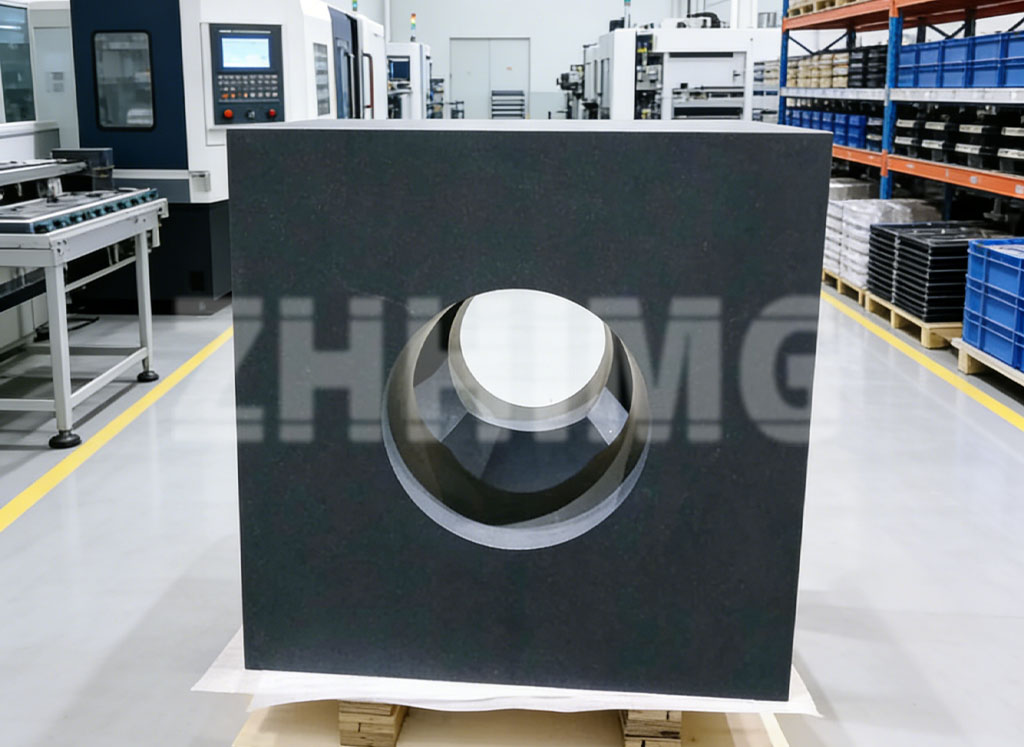
4. Long-Term Stability and Equipment Lifecycle
Semiconductor fabrication equipment represents substantial capital investment with expected operational lifetimes measured in decades. Equipment foundations must maintain precision performance throughout this extended service period without degradation, recalibration, or component replacement.
Granite machine bases demonstrate exceptional long-term stability under continuous use. The material does not fatigue like metals, does not creep like polymers, and does not delaminate like composite materials. Once manufactured and installed, a granite foundation maintains its properties indefinitely with minimal maintenance.
This long-term stability translates to reduced total cost of ownership for semiconductor equipment. Eliminating foundation-related recalibrations, remediation of thermal issues, or equipment replacement due to degraded positioning accuracy provides ongoing operational savings throughout equipment lifecycle.
The sub-micron accuracy maintained by granite foundations also supports equipment utilization efficiency. When machines maintain specification across shifts, seasons, and facility changes, equipment scheduling can optimize throughput without accommodating accuracy variations or calibration downtime.
5. Industry Standards and Supplier Qualification
Semiconductor equipment manufacturers maintain rigorous qualification requirements for component suppliers. These requirements typically include ISO 9001:2015 quality management certification, documented manufacturing processes, comprehensive inspection documentation, and demonstrated capability for precision manufacturing.
ZHHIMG® meets these qualification requirements as the only manufacturer in this industry sector holding simultaneous ISO 9001:2015, ISO 45001, ISO 14001, and CE certifications. This certification combination demonstrates systematic quality management, workplace safety, environmental responsibility, and European regulatory compliance—qualifications increasingly required for semiconductor supply chain participation.
Equipment manufacturers also require suppliers to demonstrate traceability and consistency. ISO/IEC 17025 compatible manufacturing processes ensure that granite components meet specifications consistently across production lots. This traceability supports semiconductor manufacturers’ own quality system requirements and regulatory compliance documentation.
Custom manufacturing capabilities enable granite component suppliers to serve specialized semiconductor equipment designs. Threaded inserts, precision-machined mounting features, and custom configurations are standard offerings from qualified suppliers. Close collaboration between equipment designers and granite manufacturers during product development optimizes component performance and manufacturing efficiency.
Performance Verification and Testing
Semiconductor equipment manufacturers verify granite component performance through rigorous testing protocols. Laser interferometry measures flatness and straightness of precision-machined surfaces with nanometer resolution. Dynamic stiffness testing characterizes vibration response across relevant frequency ranges. Thermal chamber testing simulates facility temperature cycles to verify dimensional stability under worst-case conditions.
These verification protocols ensure granite components meet demanding semiconductor specifications before integration into final equipment assemblies. ZHHIMG® provides comprehensive test documentation including dimensional reports, flatness measurements, and material certificates for each shipment, supporting customers’ incoming inspection and qualification requirements.
Frequently Asked Questions
What flatness specifications can granite achieve for large semiconductor equipment bases?
Premium granite machine bases can achieve flatness tolerances down to 0.5μm/m (Grade 00) over areas exceeding several square meters. For semiconductor applications requiring nanometer-level positioning, these flatness specifications ensure reference surface quality that does not limit overall system accuracy.
How does granite perform in ultra-high vacuum semiconductor processes?
Granite exhibits excellent vacuum compatibility with minimal outgassing under high vacuum conditions. The dense, non-porous structure prevents moisture and gas release that could contaminate vacuum processes or compromise system performance.
What maximum sizes are available for semiconductor equipment granite foundations?
Manufacturing capabilities extend to 20,000 × 4,000 × 1,000mm for large-format granite components. For extremely large equipment foundations, modular designs with precision-matched interfaces enable configurations that exceed single-piece manufacturing limits while maintaining alignment accuracy.
Can granite components integrate with modern semiconductor equipment designs?
Yes, granite components can be manufactured with precision-machined features including threaded inserts, T-slots, dowel pin holes, and custom mounting interfaces. These features integrate seamlessly with modern equipment mounting systems and facilitate installation, alignment, and future maintenance.
What vibration damping performance should semiconductor equipment buyers expect from granite bases?
Laboratory testing and field experience document vibration attenuation of 80-90% across typical vibration frequencies when comparing granite to cast iron foundations. This damping performance effectively isolates equipment from facility-generated vibrations that could compromise semiconductor process precision.
How do semiconductor manufacturers verify granite component quality?
Incoming inspection protocols for semiconductor equipment typically include dimensional verification, flatness measurement using laser interferometry or coordinate measuring machines, and visual inspection for surface defects. Calibration certificates from ISO/IEC 17025 accredited laboratories provide documented evidence of conformance to specifications.
Partner with a Qualified Granite Supplier for Semiconductor Applications
The precision requirements of semiconductor manufacturing demand foundation components that perform flawlessly at nanometer scales. ZHHIMG® supplies precision granite components to leading semiconductor equipment manufacturers worldwide, supporting wafer inspection, metrology, and precision positioning applications.
Our manufacturing capabilities include precision granite machine bases, surface plates, and custom configurations up to 20,000mm in length. With monthly production capacity exceeding 20,000 units and 30+ years of hand-lapping expertise, we deliver the consistency and quality that semiconductor supply chains require.
Contact our engineering team to discuss your semiconductor equipment granite requirements. We provide technical consultation, custom manufacturing, and documentation supporting your supplier qualification processes.
Post time: Jun-02-2026