
The landscape of global manufacturing is undergoing a radical shift toward sub-micron accuracy, where the difference between a successful production run and a costly failure lies in the very ground the machines stand on. As engineers across Europe and North America design the next generation of semiconductor lithography and automated inspection systems, the conversation inevitably turns to the fundamental stability of the machine base. For years, cast iron and steel were the industry standards, but the inherent limitations of metallic structures—thermal expansion and internal stress—have led top-tier manufacturers to a superior alternative.
One of the most critical challenges in a modern cleanroom or high-speed production environment is managing the subtle but destructive forces of vibration and static electricity. This is where an anti-static granite platform becomes more than just a surface; it becomes a critical component of the quality control ecosystem. In the production of sensitive electronic components, even a minor electrostatic discharge can compromise integrated circuits, leading to catastrophic yield losses. By utilizing specialized granite treatments and grounding integration, ZHHIMG ensures that our platforms provide a neutral, stable environment that protects the most delicate technological processes.
Beyond electrical properties, the physical demand for structural permanence has never been higher. A high rigidity granite foundation offers a level of mass and natural damping that synthetic materials simply cannot replicate. Granite, aged over millions of years, possesses a unique grain structure that absorbs high-frequency vibrations from the factory floor, ensuring that the robotic actuators and optical sensors mounted above remain perfectly calibrated. This structural integrity is essential for maintaining the long-term accuracy of CMMs and laser cutting systems, where any microscopic deflection could result in a deviation from design specifications.
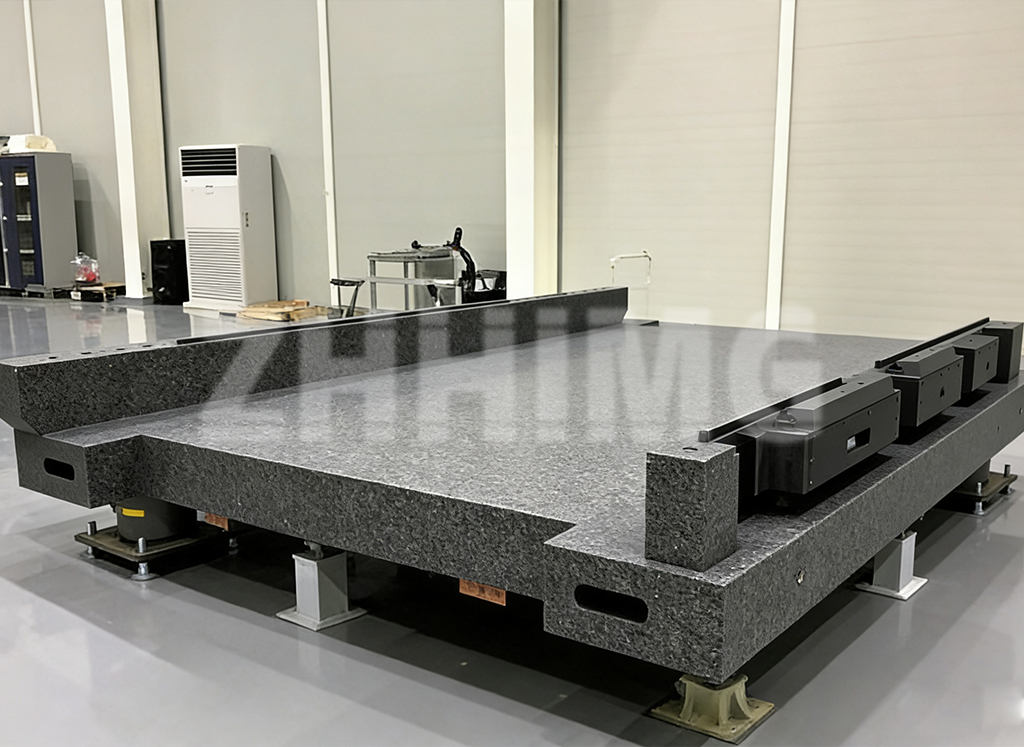
However, the technical superiority of a granite component must also be matched by its practical utility during the installation phase. Large-scale precision bases can weigh several tons, making their transport and positioning within a facility a complex engineering feat. This is why a granite base with lifting holes is not merely a convenience but a safety requirement. At ZHHIMG, our engineering team integrates precision-drilled, reinforced lifting points directly into the base design. This allows for balanced, secure handling by overhead cranes and specialized rigging equipment, minimizing the risk of damage to the ultra-flat surface or injury to facility personnel during the setup of a new production line.
The adoption of granite solutions is particularly prevalent among European high-tech clusters, from the aerospace hubs in France to the automotive heartlands of Germany. These industries demand adherence to rigorous standards such as DIN and ISO, where surface flatness is measured in microns across several meters. ZHHIMG’s commitment to these standards is reflected in our manual lapping processes, which achieve a level of finish that CNC machines alone cannot reach. By combining ancient stone with modern metrology, we provide a foundation that supports the most ambitious engineering projects of the 21st century.
As we look toward the future of the “Industry 5.0″ era, the synergy between human craftsmanship and automated precision will only deepen. The choice of a machine base is a long-term investment in a company’s technological capability. A foundation that resists thermal deformation, suppresses vibration, and manages electrostatic risks is the hallmark of a world-class manufacturing facility. ZHHIMG Group remains dedicated to being the silent partner beneath the world’s most accurate machines, providing the literal and figurative bedrock for innovation.
Post time: Mar-03-2026