
Large-stroke precision motion stages are widely used in semiconductor inspection, large-area optical scanning, high-precision PCB drilling, perovskite film coating and other scenarios. When the effective stroke extends to several meters, the platform faces great challenges in accuracy retention, motion straightness and long-term stability. Many equipment designers repeatedly weigh options during solution selection: metal welded bases, mineral castings and ordinary stone bases. Which type can balance large-span structure and nanoscale motion indicators? For long-stroke working conditions, granite air bearing bases have gradually become the mainstream choice in the industry, mainly because they can simultaneously solve multiple difficulties including deformation, friction disturbance and reference drift brought by large spans.
The primary challenge for large-stroke platforms is the deflection deformation of the base under self-weight and temperature changes. The longer the stroke, the larger the span of the base. The self-weight deformation and thermal expansion effect of metal materials such as cast iron and aluminum alloy will be amplified many times. Even if the indicators meet requirements after factory commissioning, tiny ambient temperature differences or long-term continuous load will bend the guide reference surface and directly damage the straightness of long-distance motion. Ordinary spliced stone bases have joint stress, and dislocation easily occurs at joints under long-term load, failing to meet the requirements of continuous motion reference above meter level.
The granite air bearing base adopts an integrally formed high-density granite blank. The material features high rigidity and ultra-low creep, and the deflection deformation caused by self-weight is kept at an extremely low level, suitable for manufacturing ultra-long single-piece bases. The integrally machined monolithic stone has no splicing gaps, and the long-stroke guide reference surface is a continuous and complete single benchmark, fundamentally eliminating segmented errors caused by seams. Equipped with the non-contact air-floating motion mode, the slide table has no mechanical friction with the base, completely avoiding wear, increased clearance and accumulated frictional heat of traditional linear guides during long-distance reciprocating movement. When traditional mechanical guides move back and forth over a long stroke, frictional heat accumulates along the guide rail and forms an uneven temperature field. The farther away from the starting point, the more obvious the accuracy drift. In contrast, air flotation supports the slide by a thin gas layer, almost generating no heat during movement. Stable benchmarks can still be maintained during long-distance high-speed reciprocating motion.
During assembly and calibration of large-stroke platforms, the continuous and complete granite reference surface brings another advantage: full-range metrology calibration. A large-stroke platform cannot only detect local points; continuous straightness and flatness inspection along the whole motion trajectory is required. Benefiting from the good dimensional stability of the granite substrate, after full-range calibration with laser interferometer under constant temperature, the reference is not prone to slow offset over time. Even if the platform performs high-speed long-distance reciprocating scanning, the contour of the reference surface remains stable, reducing the frequency of re-calibration in later stage and cutting maintenance costs for end customers.
Another easily overlooked factor is vibration suppression. Large-stroke platforms tend to produce impact vibration during start-stop and high-speed direction switching, which transmits along the base and interferes with optical inspection and precision measurement. Granite has better damping characteristics than metals and can quickly absorb micro-vibration generated during motion start and stop. Combined with the flexible air film buffering effect of the air bearing structure, the switching impact is further weakened, ensuring consistent motion smoothness of the slide table at the start, middle and end points throughout the full stroke range without jitter at the far end. 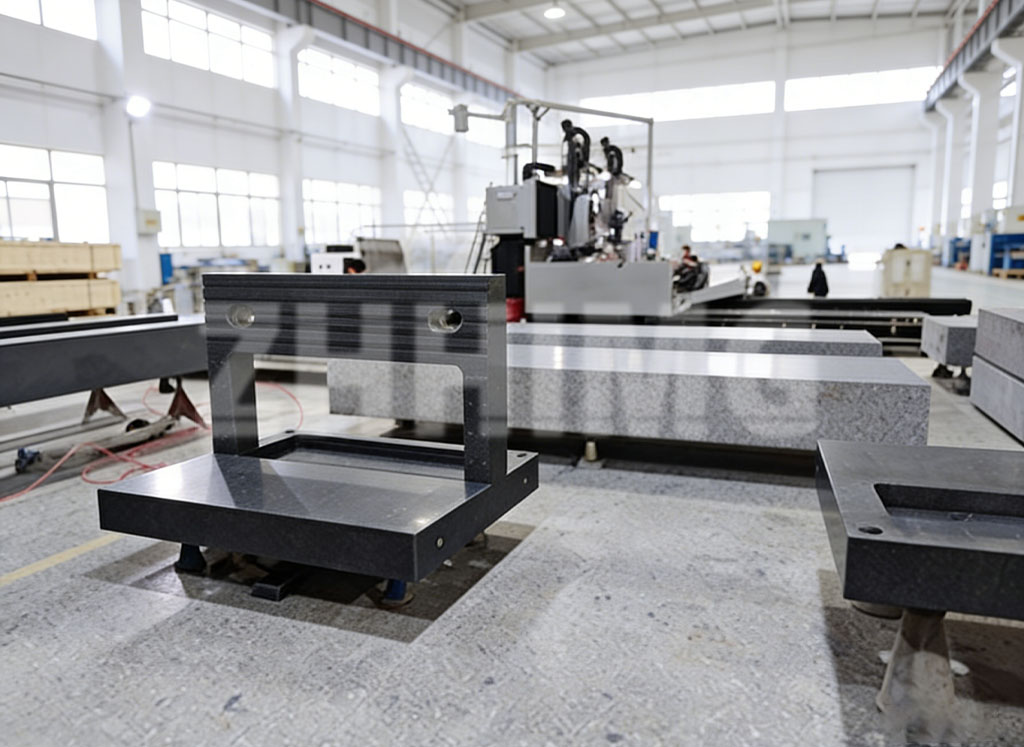
Naturally, large-stroke granite air bearing bases set extremely high thresholds for machining and inspection. Stress release of ultra-long stone blanks, uniform grinding of full-length air outlet surfaces and consistent machining of microhole arrays are all indispensable. Only manufacturers with ultra-large-size machining capacity and full-stroke metrology verification capability can stably deliver qualified products. Targeting the demands of large-stroke platforms, ZHHIMG realizes integrated machining of ultra-long monolithic granite components, together with full-stroke surface inspection and air film uniformity verification to guarantee reference consistency of the entire long-stroke guide rail.
Selecting granite air bearing bases for large-stroke precision motion platforms is essentially the optimal engineering solution to balance structural rigidity, thermal stability, frictionless motion and vibration damping under long-span working conditions. In high-end equipment fields such as large-area optical inspection, semiconductor XY large-stroke platforms and new energy film coating, this solution can guarantee sustained nanoscale motion accuracy across the full stroke and serve as the benchmark choice for high-end long-stroke precision equipment.
Post time: Oct-09-2026