
Many requests for a custom granite machine base go through three or four rounds of emails before anyone can actually quote. The reason is rarely the price discussion; it is missing information: no drawing revision number, tolerances described in words instead of on the drawing, or no agreement on which surfaces will be inspected. This page is a checklist you can copy and use directly. It lists what to send us so that one enquiry is enough for a technical review, a quotation, production and final acceptance.
It is deliberately not a design guide. Design advice is useful at the review stage; before that, what a supplier needs is a complete and unambiguous set of RFQ documents. If you are preparing your first custom granite machine base enquiry, the following sections show exactly what to include.
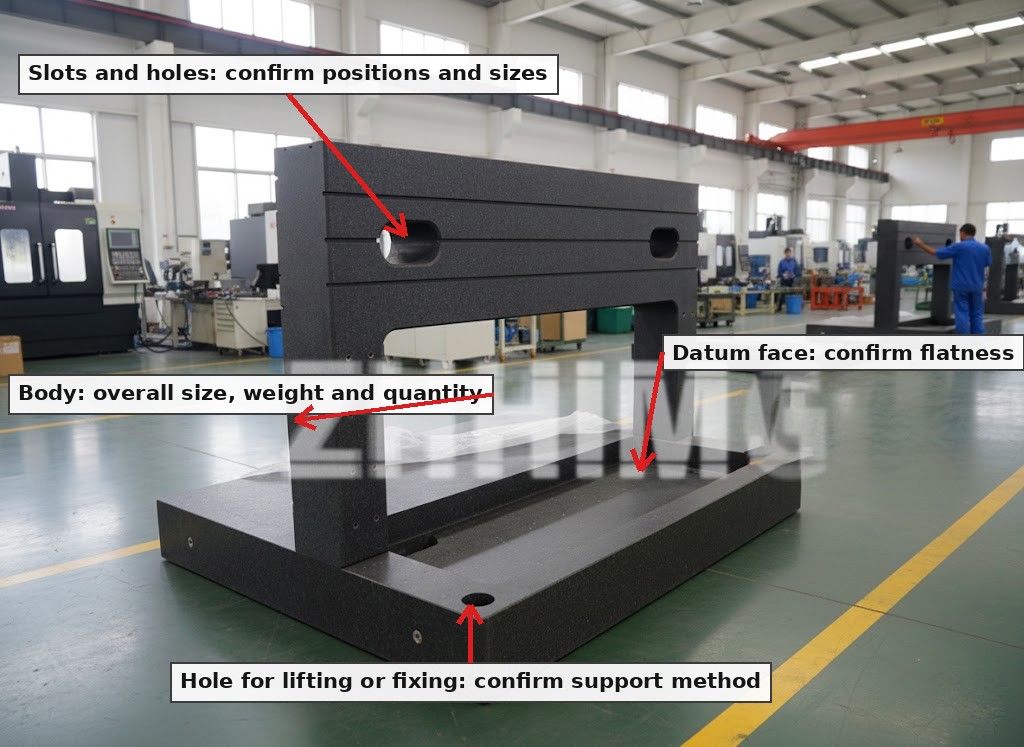
The photo above shows a custom granite base in our workshop. Before we can quote a part like this, we normally need the following information from you. Each item can be copied into your enquiry email.
1. Drawings and Models
- 2D drawing (PDF or DWG) with dimensions, tolerances and datums marked on the drawing itself, not only in the email text.
- 3D model (STEP or IGES) for parts with 3D features such as recesses, inclined surfaces or complex pockets.
- Drawing revision number and date, so that any later change is traceable to a specific version.
If your company has a standard title block, keep it: revision history is one of the most useful fields on a granite base drawing requirements package, because it tells both sides which version production and inspection must follow.
2. Sizes, Quantity and Delivery Window
- Overall dimensions (length x width x height) and approximate weight, if known.
- Quantity: a single R&D unit, a pilot batch, or an annual volume. Quantity changes which process is economical, so honest numbers get you a more accurate quotation.
- Target delivery date, including any fixed project milestones such as a machine exhibition or a customer acceptance test.
3. Datums, Mounting Faces and Acceptance Items
Tell us which surfaces matter most. In practice this means marking datum faces (A, B, C) on the drawing, identifying the faces that carry guideways, sensors or workpieces, and stating which of them are acceptance items. When the acceptance surfaces are defined before quotation, the price you receive already includes the inspection work, and there is no argument at delivery about what “good enough” means.
4. Geometric Tolerances to Specify
Put the numbers on the drawing, one line per feature:
- Flatness of each reference surface, and over which area.
- Straightness of rails or guide edges.
- Parallelism between reference faces.
- Perpendicularity between square faces or to the main reference.
- Hole and slot position tolerances, if components are mounted by us.
If you are not sure which values are realistic for your application, tell us the function instead (for example, linear guide mounting or CMM bridge mounting) and we will propose values based on similar projects for you to confirm.
5. Holes, Slots, Inserts and Interfaces
- Hole and slot sizes: diameter, depth, thread specification, and position dimensions with a datum.
- Inserts: material (steel or stainless steel), type (tapped inserts, dowel bushes), and whether we supply or you supply them.
- Interfaces to other components: rail seats, motor mounts, sensor brackets, cable channels or covers, so machining can be combined in one setup.
6. Supports, Lifting, Packing and Shipping
- Support method: levelling screws, vibration isolation pads, or a steel frame, and whether it is in our scope.
- Lifting points or lifting holes, so we can machine them and mark them before packing.
- Packing: export wooden case is standard; state any cleanroom or special packing requirement.
- Shipping destination and preferred terms, so the quotation includes freight correctly.
7. Inspection Reports and Acceptance Documents
State with the enquiry which documents you need at delivery, for example: a flatness inspection report with the measuring instrument named, a hole position check record, material certificate, or photos before packing. We measure and report against the drawing revision you sent, so acceptance is based on documents both sides agreed at the start.
8. Fill-in RFQ Checklist
Copy this table into your email and fill in each row; the example column shows the level of detail we need.
| # | Item | Your information | Example |
|---|---|---|---|
| 1 | Drawing and revision | GB-2024-07 Rev. B, PDF + STEP | |
| 2 | Overall size | 1200 x 800 x 150 mm | |
| 3 | Quantity and delivery window | 2 units pilot, need by Q3 | |
| 4 | Datums and acceptance faces | Top face datum A for inspection | |
| 5 | Flatness / straightness / parallelism / perpendicularity | 0.005 mm on datum A, per drawing | |
| 6 | Holes, slots, inserts | M8 tapped inserts, positions on dwg | |
| 7 | Guideways or other components | Rail seats machined, rails by customer | |
| 8 | Support and lifting | Levelling screws included, 4 lifting holes | |
| 9 | Packing and destination | Export case, port of destination | |
| 10 | Inspection reports needed | Flatness report with instrument named |
9. If Your Information Is Not Complete Yet
These are the three questions we hear most often, with the short answers that keep an enquiry moving.
Q: We only have a sample, no drawing. Can you quote?
A: Yes. Send photos with a ruler or scale visible, key dimensions you have measured, and the application. We can produce the drawing for your confirmation before machining.
Q: We have not decided the tolerance values yet.
A: Send the drawing without geometric tolerances and describe what the base carries. We will propose values used on comparable projects; you confirm them before quotation.
Q: Our 3D model is confidential.
A: An envelope model with interfaces only is usually enough for quotation, and we are glad to sign an NDA before you send the full model for production.
10. What Happens After You Send the Checklist
We review the documents, confirm machining feasibility and acceptance items, and reply with questions in one round if anything is unclear, followed by a quotation. During production, changes are managed against your drawing revision, and delivery includes the inspection reports defined in item 10 above.
Send your 2D drawing, 3D model, quantity and inspection requirements for a technical review and quotation.
Post time: Oct-09-2026