
Every precision machine project eventually reaches the same meeting: the base material has to be fixed before the design can move forward. And the honest answer to “which material should we use?” is that no single material wins everywhere. The right choice among granite, mineral casting and cast iron comes from your machine’s requirements: the accuracy it must hold, the dynamics it will see, how components are mounted, how many units you plan to build, and what the project actually costs over its life.
This guide sets out a practical way to compare a granite vs mineral casting machine base with cast iron alternatives, based on the five questions we discuss with customers before recommending a material. The goal is not to sell you granite; it is to match the material to the working conditions.
1. Five Questions That Decide the Material
| Comparison dimension | Questions to answer |
|---|---|
| Accuracy and stability | Which geometric accuracy must the machine hold over time? What is the working environment, including temperature range and gradients? |
| Vibration and dynamic behaviour | Are there high-speed movements, impacts or periodic loads? How much damping does the structure need? |
| Structure and installation | How will guideways, screws, sensors and other components be mounted, positioned and referenced? |
| Manufacturing and modification | Is this a single R&D machine or a series product? How likely is a design change after the first units? |
| Project cost | Beyond raw material, what are the machining, assembly, transport and maintenance costs? |
Keep these five questions open until you have numbers for your specific machine. A material that is ideal for a metrology lab can be the wrong answer for a high-speed laser cutting cell, and vice versa.
2. The Three Materials at a Glance
The table below summarises typical, published property ranges for the three common precision machine base materials. Treat the values as orientation only: exact figures depend on the specific grade, recipe and heat treatment, and should be confirmed with the manufacturer’s material data sheet for your project.
| Property (typical range) | Granite | Mineral casting | Cast iron |
|---|---|---|---|
| Density | approx. 2,600-3,100 kg/m³ | approx. 2,000-2,500 kg/m³ | approx. 7,200 kg/m³ |
| Vibration damping | Good | Excellent | Moderate |
| Thermal conductivity | Low | Very low | High |
| Corrosion behaviour | No corrosion, no coating needed | No corrosion | Requires protection against rust |
| Geometry achievable | Very high flatness by lapping | Accurate as-cast with machined inserts | High, by machining and scraping |
| Design freedom for complex shapes | Limited by quarry blocks and machining | High: cast into near-final shape, inserts and channels possible | Moderate: pattern required |
| Typical lead time behaviour | Longer for very large or complex parts | Short for complex shapes once mould exists | Short for series with existing pattern |
3. When Each Material Makes Sense
Granite: reference quality and long-term stability
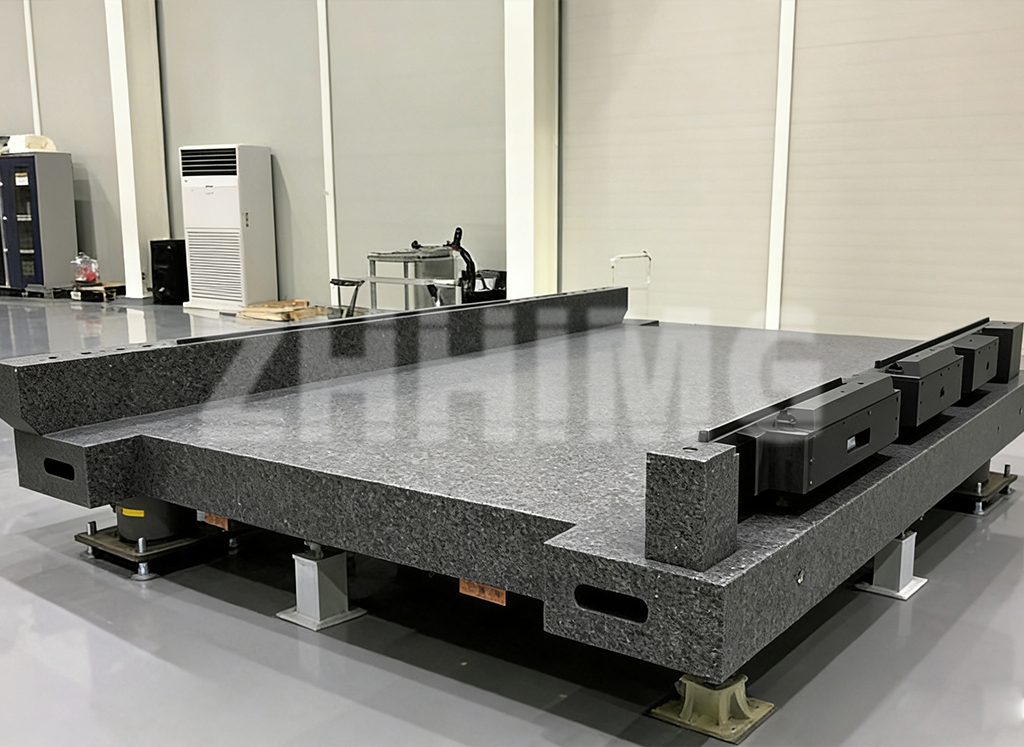
Granite remains the reference material where flatness and dimensional stability dominate: metrology equipment, CMMs, optical inspection systems and semiconductor measurement stages. It does not rust, it does not carry memory from machining stresses the way metals can, and its low thermal conductivity makes it tolerant of touch and slow air-temperature changes. A granite machine base is machined and hand-lapped to sub-micron flatness over large areas, which no other base material matches economically at that accuracy level.
On the other hand, granite is heavy, it is cut from blocks so very complex internal channels are impractical, and for high-volume series production the machining time makes it less attractive than casting.
Mineral casting: damping and design freedom
Mineral casting (also called epoxy granite or polymer concrete) combines aggregate with an epoxy binder. Its outstanding property is vibration damping, which is why it is popular for high-speed machining modules, laser cutting heads, printing and dispensing machines and measurement platforms with moving axes. Because it is cast near to final shape, rail mounts, cable channels, pipe passages and threaded inserts can be integrated directly, reducing assembly work. Its very low thermal conductivity also slows down the response to ambient temperature swings.
Limits to keep in mind: the surface finish and flatness as-cast do not reach lapped granite, so precision interfaces are usually achieved with embedded metal inserts that are machined after casting. Compressive strength is lower than granite or cast iron, so point loads and mounting concepts deserve early attention.
Cast iron: the industrial workhorse
A cast iron machine base is often the most economical answer for series machinery: the material is well understood, machining and scraping can achieve high accuracy, graphite in the microstructure gives useful damping, and service or modification in the field is straightforward. Standard profiles and existing patterns shorten lead times for repeat orders.
The trade-offs are weight, the need for corrosion protection, and thermal conductivity that transmits ambient temperature changes into the structure faster than stone-based materials. For machines in harsh environments, consider coatings or stainless covers as part of the concept.
4. A Short Selection Example
A customer building optical inspection machines asked us to evaluate bases for a new series. The requirements: sub-micron measuring repeatability at the sensor, a fast scanning axis with frequent direction changes, annual volumes of roughly two hundred units, and a plan to revise the optical layout after the first batch.
The discussion followed the five questions above. Granite offered the best reference flatness for the measuring plane, but the scanning axis dynamics and the planned redesign favoured damping and shape freedom. The final solution combined both: a mineral cast bed carrying the motion system, with a lapped granite bridge bonded and pinned as the measuring reference, and machined metal inserts defining all mounting interfaces. Acceptance was defined by three numbers: flatness of the granite reference after delivery, repeatability of the scanning axis over eight hours, and relative drift between reference and bed over a 4°C ambient swing. The project passed acceptance on the first attempt, and the second-batch redesign only required a mould update, not a new material decision.
The lesson is not that this combination is “the answer”. It is that the requirements, not the material brochure, drive the concept.
5. How We Work With You on Base Materials
Because we manufacture granite components, mineral casting beds and precision machined metal parts in-house, our engineers can discuss all three routes with you on equal terms, including the hybrid concepts that many precision machines end up using. For every project we provide the material data we will actually build to, the machining concept for mounting interfaces, and the inspection reports for the delivered geometry, so your acceptance criteria are measurable from day one.
Share your machine application, loading conditions and accuracy requirements so we can discuss suitable base materials.
Post time: Oct-09-2026