
In the field of ultra-precision motion and metrology, the biggest enemy of precision is not machining error, but dynamic disturbance of temperature field. Even a 0.5℃ ambient temperature difference, micro heat accumulation generated during equipment operation, and airflow changes caused by day-night temperature difference will lead to micron and even nanoscale offset of ultra-high precision guide rail systems. For laser processing, semiconductor inspection and ultra-precision measuring equipment, such temperature drift is enough to cause complete precision failure of the whole equipment. Most ordinary guide rail bases on the market cannot avoid thermal drift, mainly limited by sensitive material thermal response, incompletely released structural stress, air film offset with temperature change and lack of adaptive temperature compensation mechanism.
Different from the passive temperature resistance of traditional stone bases, ZHHIMG granite air bearing base adopts an active temperature stability control system. It solves the precision drift caused by temperature changes from the physical root through four core technologies: optimized material thermal inertia, stress-free structural design, air float temperature self-adaptation and micro-deformation dynamic suppression, so as to realize constant precision under wide temperature range.
I. Breakthrough over Tradition: Thermal Inertia Anti-Drift Principle of High-Density Low-Expansion Stone
The serious temperature drift of most stone bases essentially comes from loose material, high thermal expansion coefficient and uneven heat conduction. Ordinary marble and common granite have large internal crystal gaps. When temperature changes, non-uniform thermal expansion and contraction will occur. This irregular deformation is the core inducement of precision drift, and it is also the fundamental reason why low-end bases cannot be used in nanoscale working conditions.
ZHHIMG special ultra-precision black granite features a dense microcrystalline structure with uniform crystal arrangement and strong thermal inertia. Higher thermal inertia means the material follows ambient temperature more slowly, which can effectively block instantaneous temperature impact from outside. Under temperature fluctuation scenarios, the overall temperature field of the base remains highly uniform without local hot and cold differences, completely avoiding local bulging, depression, micro-deformation and other problems.
More importantly, this material has the characteristic of linearly controllable thermal deformation. Thermal deformation of common materials is irregular and unpredictable, while the thermal deformation of high-precision granite follows a stable linear curve without abrupt changes or residual deformation. It provides accurate data foundation for subsequent temperature compensation, achieving “predictable deformation and offsettable drift”.
II. Stress-Free Integrated Structure: Eliminating Hidden Precision Offset Induced by Temperature Stress
Many people overlook a core point: temperature drift is not merely thermal expansion and contraction of materials; larger errors stem from the release of residual structural stress under temperature change. Spliced bases and roughly processed stone bases retain massive mechanical stress inside. Every time temperature changes, stress releases slightly, resulting in continuous offset of base flatness and guide parallelism, with precision drifting worse over time.
ZHHIMG air bearing base adopts integrated monolithic structure without splicing, combined with long-term natural aging plus artificial stress relief dual processes, to completely eliminate residual stress inside the substrate. That means: when temperature varies, the base will not produce micro-deformation from stress release, and the structural morphology remains stable. From the structural level, more than 90% of hidden temperature drift errors are eliminated.
Meanwhile, ultra-precision nanoscale grinding delivers excellent surface consistency for the base reference plane. Deformation stays highly unified during temperature change without local deviation, ensuring the reference plane of air bearing guide rails maintains constant precision.
III. Air Film Adaptive Temperature Equalization Technology: Dynamically Offset Temperature Disturbance
The core advantage of air bearing guide rails lies not only in frictionless motion, but also in the air film’s inherent temperature equalization and error buffering capacity, a feature unavailable for ordinary mechanical guide rails.
Traditional metal contact guide rails suffer concentrated friction heat and poor heat dissipation. Local high temperature deforms the base and shifts guide clearance, expanding temperature drift continuously. Granite air bearing guide rails move suspended by uniform high-pressure air film, with zero friction and zero accumulated heat, thoroughly eradicating temperature rise drift caused by motion heating.
When ambient temperature fluctuates, the uniform air film layer forms a flexible constant-temperature buffer layer, balancing the temperature gradient on the contact surface of guide rails and weakening local temperature difference brought by cold and hot airflow. Once tiny ambient temperature fluctuation occurs, air film thickness and pressure field fine-tune adaptively to compensate for guide clearance deviation caused by stone micro-deformation, keeping motion straightness, flatness and positioning precision within standard range without drift failure along with temperature change.
IV. Micro-Nano Deformation Closed-Loop Calibration: Lock Precision in Full Temperature Range
There is no absolutely zero-deformation material in ultra-precision industry. Real anti-drift capability comes from a quantifiable, traceable and compensable closed-loop system for temperature error.
Based on international multi-standard metrology systems, ZHHIMG builds a dedicated temperature-varying error database for different temperature ranges, which can accurately capture nanoscale deformation data corresponding to 0.1℃ temperature difference. Through full-area detection by laser interferometer and micron-level surface precision calibration, the temperature variation law of air bearing base is modeled to realize dynamic error compensation under different working conditions and temperature ranges.
Different from ordinary finished products in the industry that only meet precision standards at delivery and drift with temperature during usage, ZHHIMG granite air bearing base completes temperature stability validation. It can maintain stable precision under wide temperature conditions from -5℃ to 45℃, thoroughly solving precision drift problems caused by day-night temperature difference, workshop temperature control fluctuation and continuous equipment operation. 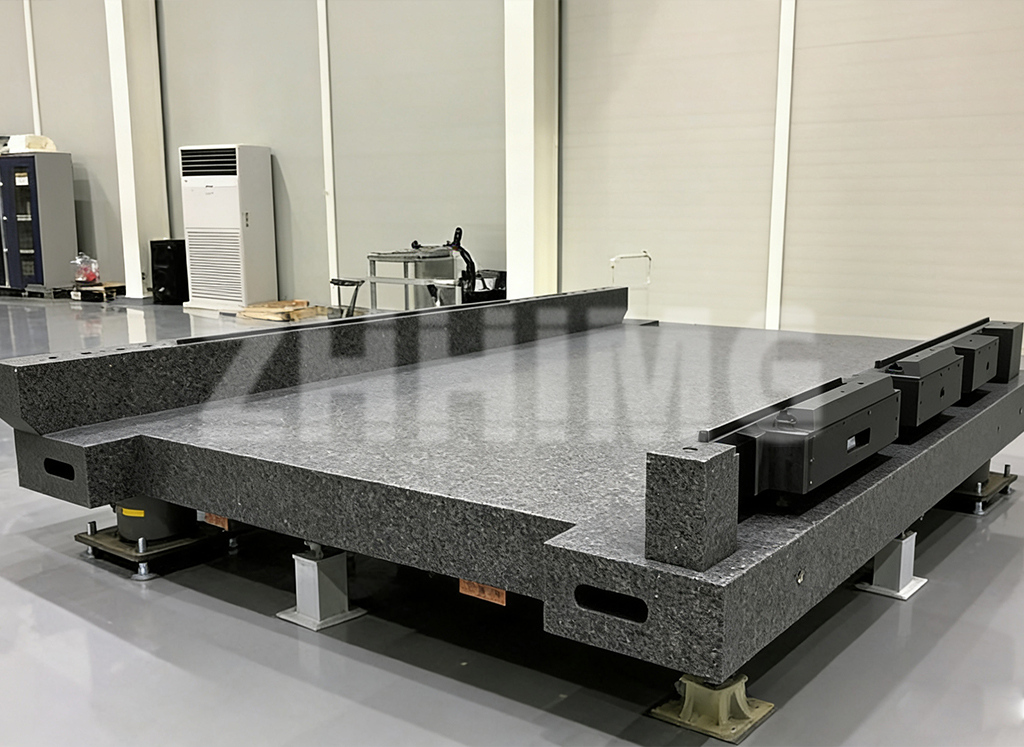
V. Core Industry Differentiation: Upgrade from Passive Temperature Resistance to Active Precision Stabilization
Most stone bases in the industry only rely on the material’s inherent low expansion to achieve passive temperature resistance, which is a temporary solution. They are prone to precision failure under complex industrial temperature scenarios.
ZHHIMG completely reconstructs anti-drift logic and builds a four-dimensional anti-drift system: material thermal inertia stabilizes substrate, stress-free structure stabilizes shape, air film buffers temperature, intelligent temperature variation compensates. It upgrades traditional stone bases from passively enduring temperature fluctuations to actively counteracting temperature drift, truly achieving zero precision drift under long-term operation, multi-condition switching and wide-temperature environments for ultra-precision equipment.
Conclusion
The temperature stability of granite air bearing bases is the underlying core capability of ultra-precision manufacturing. Temperature drift essentially arises from uneven thermal field, unbalanced stress and uncontrollable deformation. ZHHIMG adopts brand-new technical logic to comprehensively solve temperature-induced precision problems from four dimensions: material physical properties, structural design, air float principle and metrology compensation. It provides core base support with long-term stability, high consistency and low drift for semiconductor equipment, ultra-precision inspection, laser processing and high-end automation platforms, and redefines the temperature stability standard of ultra-precision bases in the industry.
Post time: Oct-09-2026