
Ultra-precision machines are becoming more demanding, not less. Semiconductor inspection systems, optical measuring equipment, laser platforms, high-resolution motion stages, coordinate measuring machines, and advanced automation cells are expected to move faster while maintaining tighter geometric control.
That expectation changes the role of the machine structure.
A base, bridge, column, or support frame is no longer just a load-bearing part hidden beneath the motion system. It is a functional reference element. Its thermal behavior, vibration response, stiffness, surface geometry, mounting interfaces, and long-term stability can directly affect the usable accuracy of the complete machine.
Precision granite components are therefore becoming a preferred foundation for many ultra-precision machines in 2026. This does not mean granite is the correct answer for every design. Cast iron, mineral casting, UHPC, ceramic, aluminum, and carbon-fiber structures all have valid roles. Granite is increasingly selected where a machine builder needs a stable reference structure with controlled thermal response, natural damping, corrosion resistance, and precision-finished surfaces.
The Structure Is Part of the Error Budget
When a machine operates at micron or sub-micron scale, small structural changes become significant.
A linear stage may have high-resolution encoders and carefully tuned servo control. An optical sensor may resolve extremely small features. A laser system may use advanced beam delivery and focus control. None of these capabilities can fully compensate for a base that moves, vibrates, twists, or changes shape with local temperature variation.
The machine structure influences several common error sources:
- Straightness and flatness of guideway mounting surfaces
- Squareness between horizontal and vertical axes
- Thermal movement of rail seats, encoder scales, and fixtures
- Vibration transmission from motors, pumps, operators, and the facility floor
- Settling time after acceleration, deceleration, or direction reversal
- Long-term stability of mechanical reference datums
- Repeatability of assembly after transport, service, or component replacement
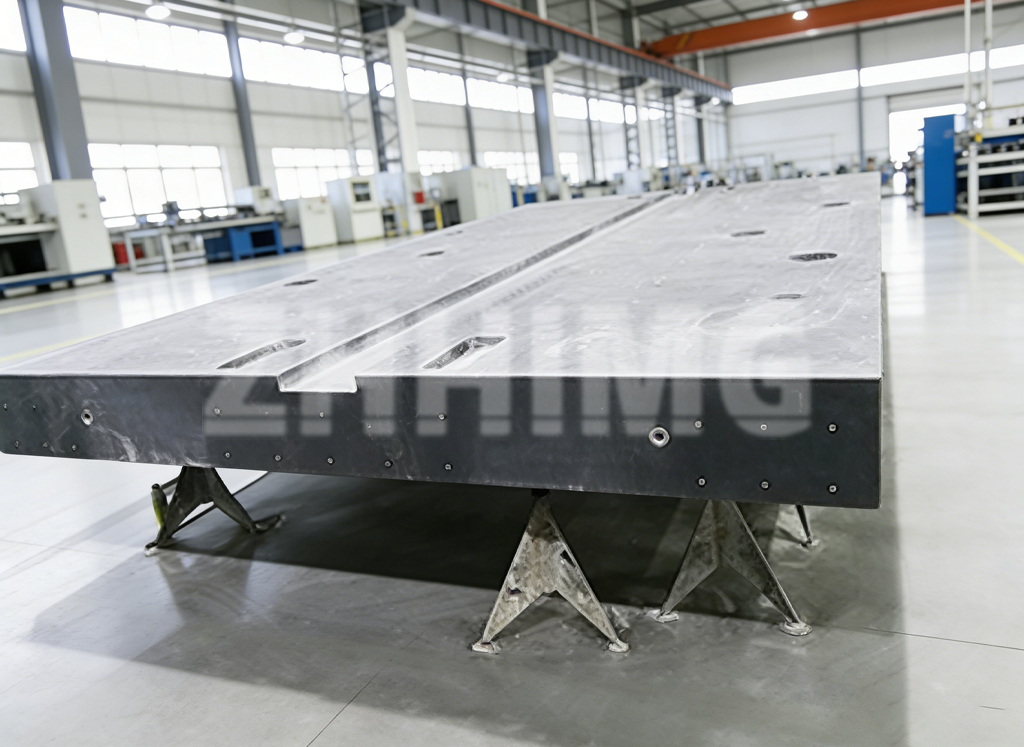
Granite components are useful because they can combine structural mass with precision reference geometry. A granite base may include lapped mounting planes, drilled holes, threaded inserts, air-bearing interfaces, guideway locations, optical supports, cable passages, and custom assembly features within a common datum structure.
Special-machine builders use precision granite bases and custom granite assemblies in measuring equipment, laser machinery, semiconductor systems, optical inspection equipment, and high-accuracy motion platforms.
Thermal Stability Has Become More Important
Temperature remains one of the most persistent sources of measurement drift.
Motors, bearings, electronics, lighting, coolant, vacuum systems, compressed air, nearby machines, and changing ambient conditions can create uneven heat input. The resulting thermal gradients may alter the relationship between machine axes, optics, sensors, fixtures, and workpieces.
Natural granite has comparatively low thermal conductivity, so it does not transfer short-term temperature changes through a large structure as quickly as a typical metal frame. This slower response can help a machine maintain more stable geometry during normal operational variation. Granite also has a relatively low coefficient of thermal expansion compared with common structural metals, although actual values vary by stone composition and should be evaluated from material-specific data.
For ultra-precision equipment, the important point is not that granite eliminates thermal movement. It does not. The practical advantage is that it can reduce rapid structural response and provide a more stable platform for environmental control and thermal compensation strategies.
Precision-granite suppliers commonly identify limited thermal expansion and low thermal conductivity as important factors in the use of granite for precision measuring and machining equipment. In CMM and inspection applications, base stability is particularly important because deformation, vibration, and environmental changes can influence the reliability of measured results.
Natural Vibration Damping Supports Faster Motion
Machine designers are also under pressure to increase throughput. Faster axis acceleration, short settling times, frequent reversals, and high-speed scanning can all excite vibration in the machine frame.
A structural material must have adequate stiffness to limit deflection, but stiffness alone is not enough. Damping determines how quickly vibration energy is dissipated after the structure has been disturbed.
Natural granite provides useful internal damping compared with many conventional metal structures. Its mass and mineral composition can help suppress vibration transmitted from the floor or generated by motion systems. This is relevant for CMM bases, air-bearing stages, AOI equipment, laser measurement systems, precision CNC machines, and semiconductor inspection platforms.
The benefit is especially noticeable in systems where a stable measurement reference must be maintained immediately after a fast motion sequence. A poorly damped structure may continue oscillating after an axis stops, increasing settling time before the next measurement, exposure, scan, or machining operation.
Granite should not be evaluated in isolation. Guideway design, moving mass, motor selection, cable routing, base support, floor characteristics, and controller tuning all influence actual machine dynamics. A well-engineered granite structure gives the designer a more stable starting point, not an automatic guarantee of system performance.
Custom Interfaces Matter
The growth of ultra-precision equipment has increased demand for custom granite components rather than only standard surface plates and straightedges.
A modern granite machine base may need threaded inserts for rails, locating holes for bearing blocks, precision pockets for linear motors, mounting surfaces for scales, air-bearing pads, vacuum channels, cable routes, optical mounting points, and lifting features. These interfaces must be designed as part of the overall error budget.
For example, a machine may require excellent base flatness, but the relevant performance parameter may actually be the straightness and parallelism of the two rail mounting planes. A high-quality granite block without controlled rail interfaces will not deliver the intended machine geometry. The same principle applies to bridge columns, vertical reference surfaces, and mounted inspection fixtures.
At ZHHIMG®, custom projects can combine precision granite bases, granite bridge structures, granite air-bearing components, granite measuring tools, and machined mounting interfaces. The practical engineering discussion normally covers more than outside dimensions. It should include the component load path, supported mass, installation method, environmental temperature, insert arrangement, machining tolerances, inspection requirements, export handling, and final assembly sequence.
This detail-oriented approach is important because ultra-precision performance often depends on the interfaces between components rather than on a single material property.
Long-Term Stability and Maintenance
A precision machine is expected to maintain performance after installation, not merely pass an acceptance test at shipment.
Granite does not corrode in the same way as exposed steel or cast iron. It is non-magnetic, electrically insulating, and resistant to many common shop contaminants. These characteristics can simplify maintenance in clean inspection areas, optical systems, and applications where corrosion products or magnetic effects are undesirable.
Surface protection is still necessary. Granite measuring surfaces should be kept clean, protected from impact, properly supported, and periodically checked. Mounting bolts must be tightened according to the specified torque. Heavy point loads near unsupported edges should be avoided. When highly accurate geometry is required, calibration should be traceable and aligned with the actual use condition.
Granite is also not always the preferred material for moving structures. In applications where low moving mass is the primary concern, carbon fiber, aluminum, ceramic, or hybrid designs may be more suitable. A common solution is to use a granite base as the stationary reference while lighter materials are used for the moving beam or stage.
A Foundation for Better Machine Design
Precision granite components are becoming more common in ultra-precision machines because machine builders need stable geometry under real operating conditions, not only impressive component specifications.
Their value comes from a combination of thermal stability, vibration damping, corrosion resistance, non-magnetic behavior, precision surface finishing, and flexible custom machining. Granite is particularly effective when used as part of a complete engineering strategy that includes controlled interfaces, stable support, environmental management, traceable inspection, and proper machine assembly.
For engineering purchasers, the best question is not simply, “Is granite better than metal?” It is: “Which structural material and interface design will keep this machine within its required accuracy over time?” For many high-precision systems in 2026, precision granite is an increasingly practical answer.
Post time: Aug-13-2026