
Semiconductor fabrication is one of the most technologically advanced processes humans have developed — lithography systems position wafers with nanometer-level accuracy, and inspection tools detect defects smaller than a virus. Given that level of sophistication, it can be surprising to learn that many of these systems are still built on a base material that predates recorded history: granite.
The Problem Granite Solves
Every high-precision motion system — a lithography stage, a wafer inspection platform, a CMM, an XY table — needs something to sit on that will not move, flex, vibrate, or drift while it operates. The base isn’t a passive structural element; it’s part of the measurement chain. If the base deforms by even a fraction of a micron under thermal or mechanical load, that error propagates directly into the final measurement or the final wafer pattern.
Metal bases, while strong, have several disadvantages for this role: they conduct heat quickly (which can create thermal gradients across the structure), they have internal stresses from casting or machining that can relax slowly over time, and they transmit vibration relatively efficiently. Granite, by contrast, offers a combination of properties that’s difficult to replicate synthetically at comparable cost:
- High internal damping — granite absorbs vibration rather than transmitting it, which matters enormously in a fab environment where equipment on the floor above or beside a tool can introduce ambient vibration.
- Low, predictable thermal expansion — granite’s crystalline structure responds to temperature changes more uniformly than most metals, reducing the risk of localized distortion.
- Long-term dimensional stability — unlike cast metal, granite has no internal stress from a manufacturing process that can relax and cause slow warping years after installation.
Where Granite Shows Up in Fab Equipment
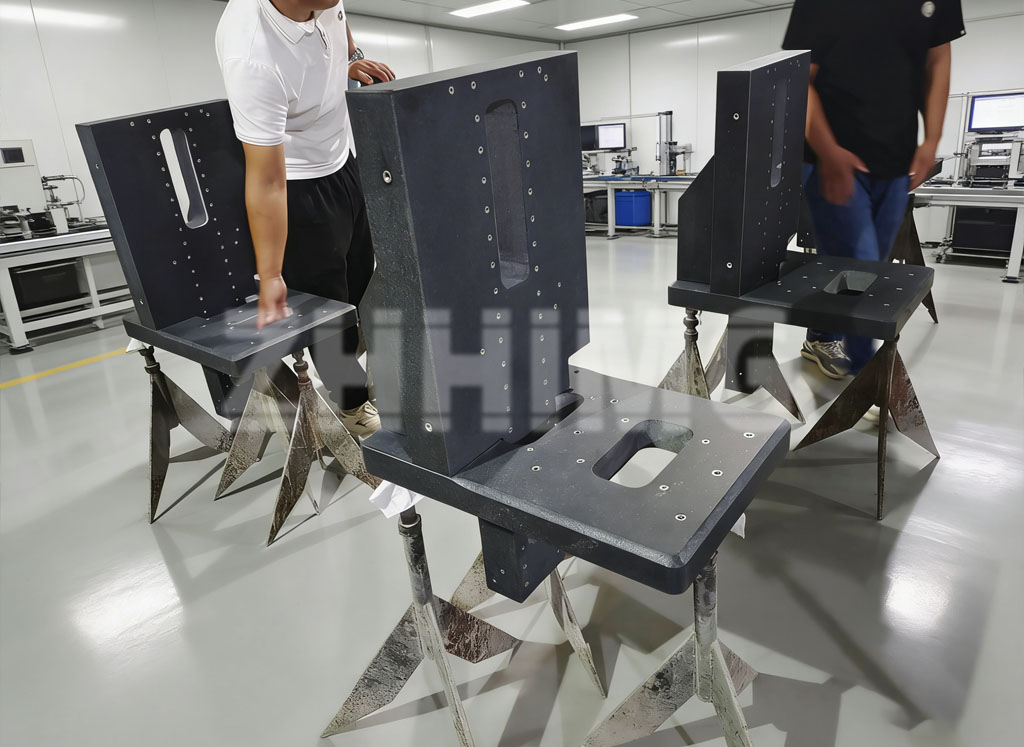
Granite bases and components appear throughout semiconductor and electronics manufacturing equipment, including:
- Wafer inspection and metrology platforms
- Optical AOI (automated optical inspection) systems
- CMM (coordinate measuring machine) bases
- Linear motor stages and XY positioning tables
- PCB drilling and via-forming equipment
- Laser processing systems (including femtosecond and picosecond laser platforms)
- Industrial CT and X-ray inspection equipment
In most of these applications, the granite isn’t decorative or incidental — it’s engineered. Bases are precision-ground and lapped to flatness tolerances in the micron or sub-micron range, sometimes finished by hand by skilled technicians who can judge material removal by feel to within a few microns, a skill that typically takes decades to develop and is difficult to fully replace with automation even today.
Granite Air Bearings
A more specialized application is the granite air bearing, used in ultra-precision positioning systems where even the microscopic friction of mechanical bearings is too much. Air bearings float a moving component on a thin film of pressurized air over a granite way or platform, eliminating mechanical contact and the wear, friction, and stick-slip behavior that comes with it. The granite surface in these systems needs to be flat and smooth to an extremely tight tolerance, since any surface irregularity translates directly into positioning error.
Environmental Controls Around the Equipment
The granite base is only one part of the stability equation. In practice, the surrounding environment matters just as much: temperature-controlled rooms (often held within a fraction of a degree), vibration-isolated flooring, and sometimes dedicated anti-vibration trenches around the perimeter of a room are used to prevent external vibration from reaching the equipment at all. High-end metrology and cleanroom facilities frequently combine granite structural components with these environmental controls as a complete system, rather than relying on the material alone.
A Quiet but Essential Material
Granite doesn’t get much attention in conversations about semiconductor technology — the spotlight tends to go to lithography optics, wafer chemistry, and control software. But as feature sizes continue to shrink and tolerances continue to tighten, the passive stability of the structure underneath the active system becomes, if anything, more important, not less. It’s one of the few materials where “ancient” and “state-of-the-art” genuinely coexist in the same application.
ZHHIMG (Zhonghui Group) supplies precision granite components, granite air bearings, and granite measuring instruments used in semiconductor, metrology, and precision motion equipment.
Post time: Jul-30-2026