
In semiconductor equipment, temperature is part of the machine’s accuracy budget.
A wafer-inspection platform, AOI system, laser metrology tool, precision XY stage, industrial CT system, or optical measuring machine may operate inside a controlled facility. Even so, the structure supporting the motion system is exposed to small thermal disturbances throughout the working day. Motors generate heat. Illumination systems warm local surfaces. Electronics, vacuum equipment, compressed air, operators, airflow, and nearby process tools all contribute to changing conditions.
At sub-micron scale, a small temperature difference across a machine base can become a measurable alignment shift.
Precision granite components are widely used in semiconductor equipment because they offer a stable structural reference with relatively low thermal expansion, low thermal conductivity, useful vibration damping, and long-term dimensional stability. Granite does not eliminate thermal drift. It helps reduce the structural response to thermal change, giving engineers a more manageable foundation for machine design, environmental control, and compensation strategies.
Thermal Drift Is a System Issue
Thermal drift occurs when the geometry of a machine changes as its temperature changes.
A uniform temperature rise can cause a structure to expand in a relatively predictable manner. The more difficult problems arise when heat is not evenly distributed. A linear motor may warm one rail support. An illumination module may heat one side of an optical bridge. A cable carrier can conduct heat along one axis. Localized airflow may cool one corner of a granite base while the rest of the machine remains warmer.
These gradients can create bending, pitch, yaw, roll, squareness, and scale-reference errors. In a semiconductor inspection system, the practical result may be reduced overlay accuracy, inconsistent wafer positioning, image blur, measurement drift, repeatability loss, or longer stabilization time between measurement cycles.
Research into high-precision positioning systems shows that environmental temperature variation and internally generated heat can cause position drift measured in hundreds of nanometers per minute in sensitive applications. The actual result depends on machine architecture, materials, measuring range, sensor layout, environmental control, and the location of heat sources. Thermal stability must therefore be addressed across the whole machine, not only at the probe, camera, encoder, or software-compensation level.
Why Granite Responds Differently
Natural granite is a dense, hard mineral material with a relatively low coefficient of thermal expansion and low thermal conductivity compared with common structural metals.
The coefficient of thermal expansion describes the amount by which a material changes dimension as its temperature changes. High-quality precision granite is commonly reported within an approximate range of 4.6–8.0 × 10⁻⁶/°C, although the actual value depends on mineral composition and quarry source. Cast iron and steel are commonly closer to 10–13 × 10⁻⁶/°C.
In practical terms, a 1,000 mm granite component exposed to a uniform 1°C temperature increase may change by roughly 4.6–8.0 µm in length. A comparable steel structure may change by approximately 11–13 µm. These figures should be used only as general engineering guidance. Actual machine error depends on the relative movement between rails, scales, fixtures, sensors, and workpieces—not only on the expansion of one structural part.
Granite’s low thermal conductivity also matters. It does not transfer localized heat as quickly as metal. This slower response can reduce rapid structural distortion when a machine experiences short-duration heat input. The structure has more time to approach equilibrium, which may reduce the impact of temporary temperature disturbances.
Natural granite is recognized for limited expansion, low thermal conductivity, vibration suppression, and dimensional stability in machine bases for measuring equipment, semiconductor equipment, laser systems, and other specialized machinery.
Stable Datums for Semiconductor Equipment
Semiconductor machines usually depend on a common mechanical reference.
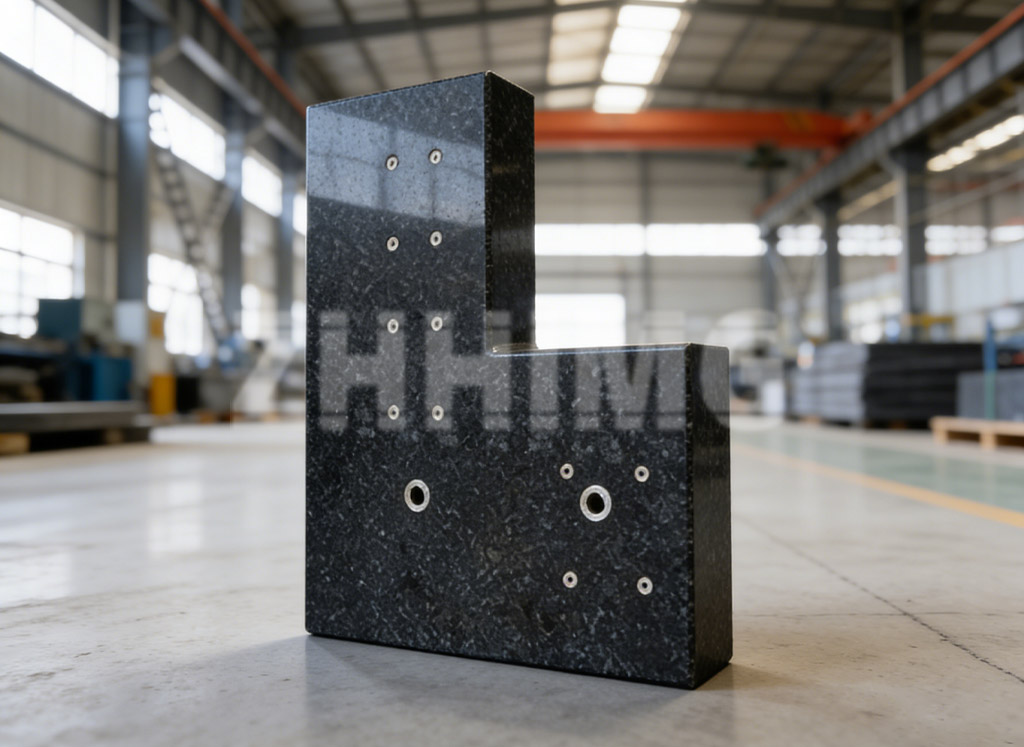
A granite machine base may carry linear guide rails, air bearings, linear motors, encoder scales, wafer chucks, camera supports, optical heads, probes, and calibration artifacts. A granite bridge or column may support vertical motion or optical alignment. The stability of each mounting surface affects the relationship among all installed components.
A precision granite assembly can support:
- Wafer inspection and defect-review systems
- AOI and vision-measurement equipment
- Semiconductor test and handling platforms
- Lithography support equipment
- Laser inspection and laser-alignment systems
- High-resolution XY and multi-axis motion stages
- Industrial CT, X-ray, and optical inspection machines
- Air-bearing metrology platforms
The granite component must be designed around these interfaces. Overall flatness alone is not enough. Rail-seat straightness, parallelism between guideway planes, position of threaded inserts, squareness of vertical faces, mounting-surface condition, and support-point location can all influence final machine behavior.
For semiconductor equipment, the granite structure should be specified together with the stage and measurement system rather than treated as a simple support part selected late in the project.
Heat Sources Still Need Control
A granite base does not make active thermal management unnecessary.
Granite can reduce thermal sensitivity, but local heat must still be controlled. Semiconductor and metrology systems benefit from several practical measures:
- Separate motor heat from critical measurement datums where possible.
- Use symmetrical drive arrangements to reduce one-sided heating.
- Manage cooling lines, cable routes, and electrical enclosures.
- Monitor component temperature as well as room-air temperature.
- Allow granite, workpieces, fixtures, sensors, and stages to stabilize before critical measurements.
- Shield structural components from direct airflow, sunlight, and uneven radiant heat.
- Validate thermal compensation against the real geometry of the installed machine.
A granite base performs best when the entire machine is designed to minimize unnecessary thermal gradients. The goal is not only to maintain a nominal room temperature. The goal is to maintain a stable thermal relationship between the granite reference structure, motion axes, encoders, sensor head, and inspected wafer or component.
Semiconductor and optical test equipment commonly uses granite bases because vibration, temperature changes, and apparently small structural deflection can affect systems operating at sub-micron resolution.
Material and Manufacturing Control
Not all granite has identical physical behavior.
The material should be selected for suitable density, uniformity, stability, and consistent physical properties. For high-value semiconductor equipment, the manufacturer should be able to discuss stone selection, material inspection, machining methods, insert design, lapping process, measurement conditions, calibration approach, and export packaging.
At ZHHIMG®, custom precision granite components include machine bases, guideway supports, bridge structures, granite air-bearing elements, measuring platforms, and integrated assemblies. For semiconductor projects, the engineering discussion usually goes beyond external dimensions. It should include travel length, moving mass, rail type, motor location, encoder position, insert layout, cleanroom requirements, operating temperature range, support arrangement, and inspection criteria.
A granite base can have excellent material properties but still create alignment difficulties if its inserts are incorrectly positioned, its rail interfaces are insufficiently controlled, or the installed stage creates uneven thermal loading. Precision comes from the full combination of material, machining, inspection, assembly, and environmental control.
Thermal Stability Supports Reliability
Precision granite components are valuable in semiconductor equipment because they reduce one of the most persistent risks in precision systems: structural movement caused by temperature change.
Their relatively low expansion, low heat-transfer rate, vibration damping, corrosion resistance, and stable reference surfaces make them well suited to stationary machine structures. They help machine builders manage thermal drift, but they do not replace sound thermal design, cleanroom control, accurate assembly, traceable calibration, or regular verification.
For global purchasers, the most useful specification is not simply “granite base.” It is a complete technical requirement covering material selection, critical datum surfaces, thermal environment, motion interfaces, inspection methods, and acceptance criteria. When these factors are controlled together, precision granite can provide a dependable thermal foundation for semiconductor equipment.
Post time: Aug-17-2026