
When selecting granite bases, many precision equipment integrators often have one concern: if the equipment operates under conditions with large day-night temperature differences or alternating cold and heat, will the base produce precision drift as temperature changes repeatedly? Outdoor semiconductor test equipment, vehicle-mounted precision inspection platforms and measuring tooling for environmental tests all face the challenge of alternating high and low temperatures. Many ordinary stone platforms expand and contract repeatedly under such working conditions, directly leading to positioning deviation and inaccurate detection. Leveraging the material advantages of high-density black granite and aging treatment processes, ZHHIMG® optimizes product solutions for temperature alternating scenarios and restrains reference changes caused by thermal cycling from the material source.
The essence of precision drift triggered by temperature alternation lies in geometric deformation resulting from thermal expansion and contraction. When the ambient temperature fluctuates sharply, temperature gradients form inside the material. The expansion or shrinkage varies in different regions, causing the base to bend and twist and shifting the reference plane. Marble features abundant pores and uneven texture with poor thermal stability. Its deformation accumulates continuously under thermal cycling, and it is hard to restore precision after multiple cold-heat alternations. ZHHIMG® adopts exclusive black granite blanks with compact texture and uniform mineral composition. Boasting an ultra-low coefficient of thermal expansion, the material greatly reduces deformation during temperature rise and fall compared with common stone, naturally resisting dimensional changes brought by cold and heat alternation.
Nevertheless, relying merely on the low expansion property of the base material is insufficient to cope with severe high-low temperature cycles. Residual stress inside the blank will be gradually released under repeated temperature stimulation, slowly deforming the base and inducing irreversible precision drift. ZHHIMG® carries out multi-stage stress aging treatment for all granite bases to fully release residual internal stress of stone before finish machining. After stabilization via aging treatment, the internal stress of the base reaches a balanced state. Even after multiple heating and cooling cycles, continuous deformation will not occur due to stress release. Only recoverable elastic micro-deformation appears, and the reference plane can be restored once the temperature returns to normal.
In terms of structural design, ZHHIMG® optimizes the structural layout of bases for alternating high-low temperature working conditions to mitigate twisting effects caused by temperature gradients. For large-size bases, wall thickness, weight-reducing slots and mounting holes are reasonably designed to avoid inconsistent heat absorption and dissipation due to drastic local thickness differences. If customers’ equipment needs to work under a wide temperature difference range, the technical team will evaluate thermal gradient impacts in advance and adjust support point positions of the base. This prevents additional stress generated when support constraints limit free thermal expansion and contraction of stone under temperature changes. Many customers tend to overlook that unreasonable fastening and locking methods will restrict normal thermal expansion and contraction of the base, artificially generating stress and inducing precision drift. ZHHIMG® avoids such risks in the solution design phase. 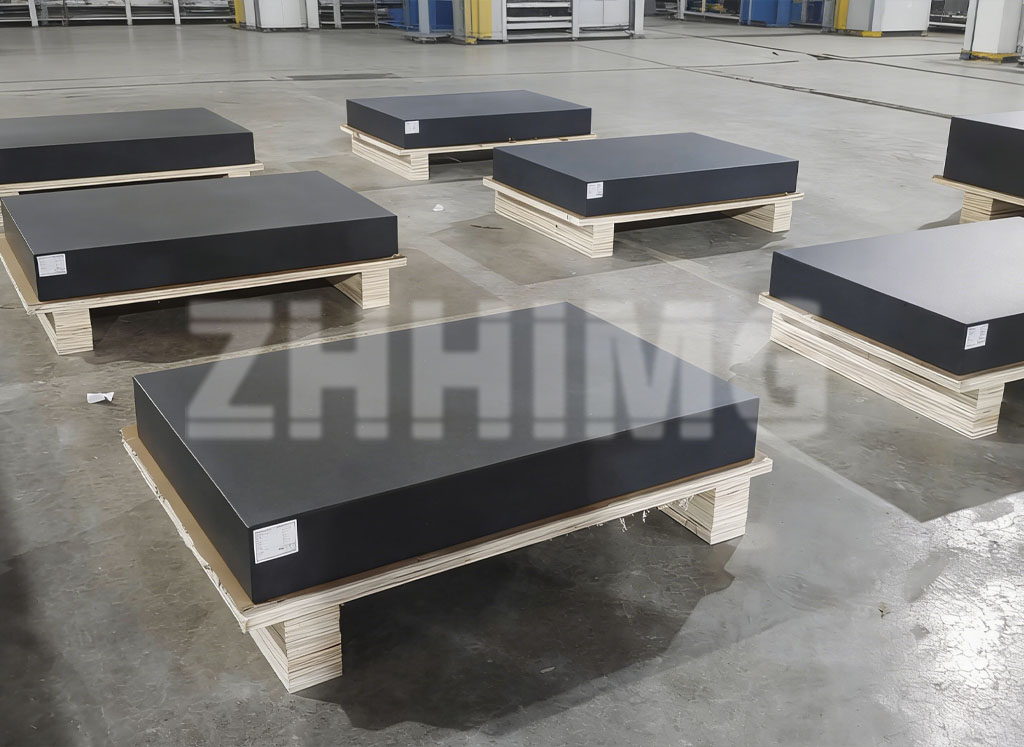
Even with high-performance granite, the base is not completely immune to temperature impacts. Instant minor deformation will still occur if extreme temperature difference arises in a short time or local heat sources blow directly onto the base surface. Upon delivery, ZHHIMG® provides customers with reference temperature operating limits and installation guidance, distinguishing reversible elastic deformation from permanent precision drift. Meanwhile, complete geometric accuracy test reports are delivered with products. The test data is traceable to provincial and national metrology institutes, allowing customers to compare reference plane changes before and after high-low temperature tests and quantitatively assess base stability. This solution has been widely applied to bases for environmental chambers, outdoor precision monitoring equipment and scientific cold-heat cycle experimental platforms.
To sum up, ZHHIMG® granite bases made of properly selected materials with stress stabilization treatment will not develop permanent precision drift under conventional alternating high and low temperature environments, and only slight reversible thermoelastic deformation occurs. Extreme rapid local temperature difference will bring temporary reference offset. As long as structural and installation schemes are optimized according to actual temperature ranges in the solution design stage, granite bases can serve as stable benchmarks for precision equipment under cold-heat alternating working conditions for a long time, meeting application requirements in optical inspection, precision positioning, metrology testing and other scenarios.
Post time: Sep-23-2026