
Ultra-high-performance concrete has spent most of its history in bridges and architectural structures, not machine shops. That’s changing, gradually, as machine builders look for base materials that can be cast into large, complex geometries without the size and weight penalties of solid granite or the thermal responsiveness problems of cast iron. UHPC didn’t emerge from the precision manufacturing world, but it’s finding a genuine niche in it, particularly for large-format machine beds where a combination of high compressive strength and structural damping matters more than nanometer-level flatness.
What Makes UHPC Different From Ordinary Concrete
Standard concrete and UHPC share a name but behave quite differently under load. UHPC uses a much finer aggregate blend, a lower water-to-cement ratio, and typically incorporates steel or synthetic fiber reinforcement distributed through the matrix rather than relying solely on rebar. The result is compressive strength that can run several times higher than conventional concrete, along with a denser, less porous internal structure. That density matters for precision applications the same way it matters for granite: lower porosity means less moisture absorption, and less moisture absorption means fewer of the slow dimensional shifts that come from a material soaking up ambient humidity unevenly across its surface.
Fiber reinforcement changes the failure behavior too. Ordinary concrete tends to crack and fail relatively abruptly under excessive load. UHPC’s fiber matrix allows it to absorb more energy before failure and resist crack propagation even if a hairline crack does form, which is a meaningful difference for a structure that’s going to carry cyclic loading from a moving machine axis for years.
Why Damping Matters as Much as Stiffness
Machine builders often default to comparing materials on stiffness alone, since stiffness is easy to specify and easy to test. But a perfectly stiff structure that transmits every bit of cutting vibration or motor resonance straight through to the tool tip or measurement point isn’t necessarily the better choice. Damping capacity, how much vibrational energy a material absorbs rather than transmits, matters just as much for machines doing high-speed cutting or simultaneous in-process measurement.
UHPC’s internal structure, dense aggregate bound in a cementitious matrix with distributed fiber reinforcement, gives it damping characteristics that sit closer to mineral casting than to cast iron. Cast iron’s crystalline, largely homogeneous structure transmits vibration more readily; the composite nature of UHPC interrupts that transmission path in a way similar to how mineral casting’s polymer matrix does, though through a different chemistry. For a large machine bed carrying a spindle or a heavy moving gantry, that damping characteristic reduces the vibration reaching the cutting zone or the measurement probe without requiring the structure to also be the stiffest possible option available.
Where UHPC Fits Relative to Granite and Metal
It’s worth being direct about where UHPC does and doesn’t outperform the alternatives, because the honest answer is application-dependent rather than universal. Solid granite still holds the edge for reference-grade dimensional stability and long-term creep resistance in the tightest tolerance applications, surface plates and CMM bases in particular, where UHPC has not displaced it and likely won’t for that specific use case. Cast iron remains more familiar to machine builders, easier to modify post-installation with conventional tooling, and often cheaper at smaller scale.
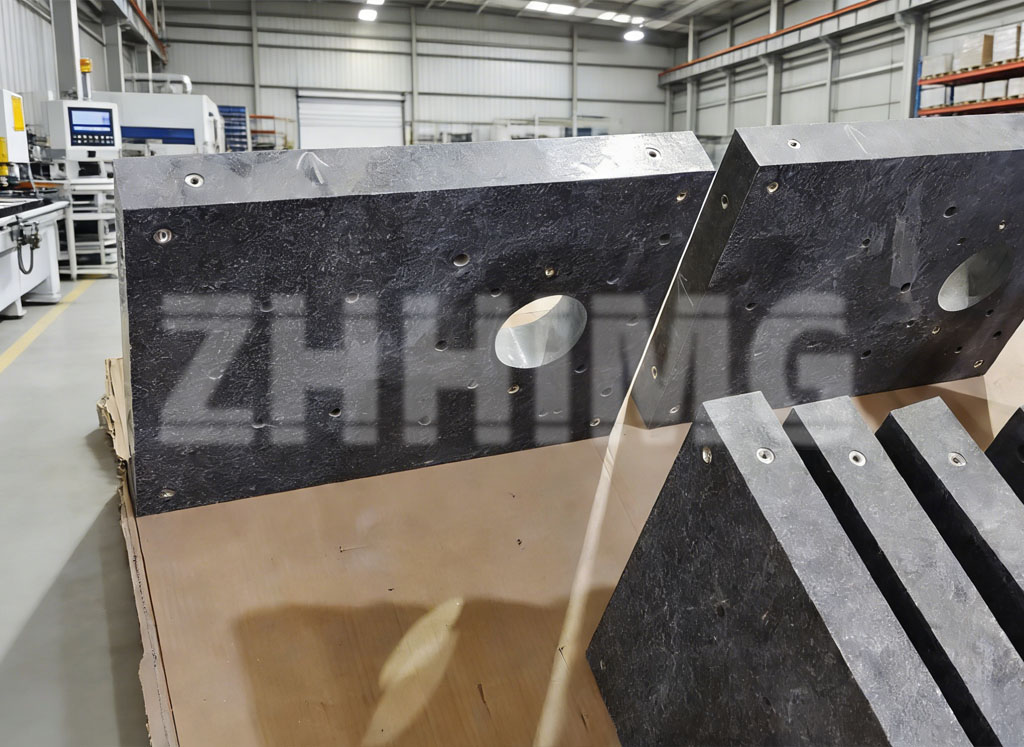
UHPC’s advantage shows up specifically in large-format structures where casting complex geometry directly, rather than machining it from solid stock, saves substantial time and material. A large machine bed with internal ribbing, mounting bosses, and cable routing built into the casting avoids a significant amount of the subtractive machining that a solid granite or cast-metal equivalent would require, while still delivering strength and damping performance suited to demanding cutting or high-load applications. That casting flexibility is part of why UHPC sits in our production lineup alongside conventional granite, mineral casting, and metal options — it addresses a structural need that neither pure granite nor cast iron fills as efficiently for large, geometrically complex beds.
What This Means for a Buyer Specifying a Machine Bed
The practical question for an engineering team isn’t which material is best in the abstract, it’s which material properties actually matter for the specific structure being designed. A reference surface plate needs granite’s dimensional stability above nearly everything else. A large machine bed carrying significant cutting loads, where geometry is complex and damping matters as much as raw stiffness, is a more natural fit for UHPC or mineral casting than for machined solid stone. Buyers evaluating a new base material for a large structure should ask suppliers for actual damping and compressive strength data specific to their UHPC formulation, not industry-general figures, since UHPC mix design varies enough between manufacturers that generic numbers won’t reliably predict a specific supplier’s material performance.
A Grounded View, Not a Universal Claim
UHPC isn’t a replacement for granite in every precision application, and treating it as one would oversell what the material actually does well. What it offers is a genuine option for large, complex machine structures where casting flexibility, strength, and vibration damping matter more than achieving the tightest possible dimensional tolerance. For that category of structure, it’s a material worth putting on the table alongside cast iron and mineral casting rather than defaulting to whichever material a shop has historically used out of habit.
Post time: Aug-28-2026