
In the high-stakes world of semiconductor manufacturing, precision is not merely a goal; it is the currency of survival. As chips shrink to nanometer scales, the machinery responsible for their creation—lithography steppers, wafer scanners, and metrology tools—must operate with unwavering stability. For two decades, our company has stood at the forefront of this industry, providing the foundational bedrock for these marvels of engineering: high-grade precision granite components.
However, the journey of our partnership with a leading global semiconductor equipment manufacturer (OEM) reveals that our value extends beyond simply supplying stone. It is a story of how deep engineering expertise and custom material solutions can solve complex operational bottlenecks. This case study details how we collaborated with this client to address a critical pain point—excessive calibration time—and achieved a staggering 40% reduction, enhancing their throughput and reliability.
The Challenge: The High Cost of Drift and Downtime
Our client, a top-tier supplier of wafer fabrication equipment, faced a persistent challenge with their latest generation of high-throughput metrology tools. These machines, designed to inspect wafers for microscopic defects, relied on complex motion systems to position sensors with nanometer accuracy.
The Pain Point: Calibration Time
Despite the sophistication of their electronics and software, the machines were suffering from “drift.” As the factory environment fluctuated in temperature and the machines generated internal heat, the structural frames of the equipment would expand and contract minutely.
Despite the sophistication of their electronics and software, the machines were suffering from “drift.” As the factory environment fluctuated in temperature and the machines generated internal heat, the structural frames of the equipment would expand and contract minutely.
- The Consequence: To maintain accuracy, the machines had to perform a “homing” or calibration cycle every 4 hours.
- The Duration: Each calibration cycle took approximately 25 minutes.
- The Impact: In an industry where “Overall Equipment Effectiveness” (OEE) is king, losing 25 minutes of production time every 4 hours was unacceptable. It resulted in significant throughput losses and frustrated end-users (chip foundries) who demanded 24/7 uptime.
The client’s engineering team suspected that the root cause lay in the structural stability of the machine base and the moving gantries, which were constructed from a composite metal alloy. They needed a solution that offered superior thermal stability without requiring a complete redesign of their motion control architecture.
The Physics of the Problem: Why Metal Was the Limit
To understand why the client was facing these calibration issues, we had to look at the material science. The original equipment design utilized welded steel and cast iron for the structural base. While these materials are strong, they possess two distinct disadvantages in high-precision applications:
- High Coefficient of Thermal Expansion: Steel expands roughly twice as much as granite for the same temperature change. Even a 1°C shift in the cleanroom could cause the metal frame to distort enough to throw off the machine’s alignment, triggering the need for recalibration.
- Internal Stress: Welded structures contain residual stresses from the fabrication process. Over time, these stresses relieve themselves, causing the frame to “creep” or warp slightly, further contributing to alignment errors.
The client needed a material that was thermally inert, dimensionally stable, and capable of absorbing the vibrations generated by the high-speed motors. They needed precision granite components.
The Solution: Custom-Engineered Granite Architecture
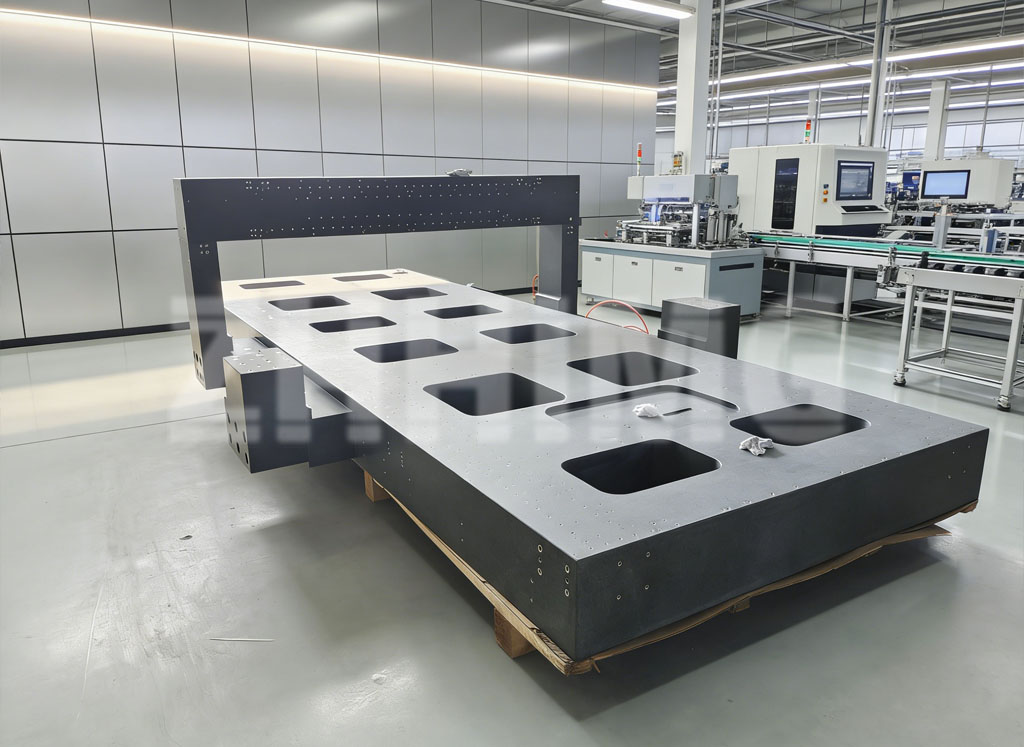
Leveraging our 20 years of experience in the industry, our engineering team proposed a comprehensive retrofit and redesign of the machine’s structural core. We didn’t just supply a block of stone; we engineered a system.
Material Selection: “Black Galaxy” Granite
We selected a premium grade of natural granite, specifically chosen for its fine grain structure and high density. This material offered:
We selected a premium grade of natural granite, specifically chosen for its fine grain structure and high density. This material offered:
- Low Thermal Expansion: Approximately 5.4 × 10⁻⁶/°C, significantly lower than steel.
- High Damping Capacity: Granite absorbs vibration 10 times better than cast iron, ensuring that motor noise did not interfere with sensitive measurements.
Design Innovation: The “Stress-Free” Geometry
One of the biggest risks in using granite is the weight and the difficulty of machining. Our team utilized advanced CAD modeling to optimize the geometry of the base. We designed internal ribbing structures that maximized stiffness while minimizing mass.
One of the biggest risks in using granite is the weight and the difficulty of machining. Our team utilized advanced CAD modeling to optimize the geometry of the base. We designed internal ribbing structures that maximized stiffness while minimizing mass.
Furthermore, we implemented a “kinematic coupling” design. Instead of bolting the granite directly to the steel chassis (which would transfer stress), we used a three-point mounting system with adjustable leveling pads. This ensured that the granite remained in a state of pure equilibrium, free from external forces that could cause distortion.
The Manufacturing Process
Creating these components required micron-level manufacturing capabilities:
Creating these components required micron-level manufacturing capabilities:
- CNC Precision Machining: We used diamond-tipped tools to machine the granite to tolerances of ±5 microns.
- Lapping and Polishing: The guideways, where the linear motors would travel, were hand-lapped to achieve a surface finish of less than 0.5 microns Ra. This ultra-smooth surface reduced friction and stick-slip phenomena, further enhancing motion stability.
Implementation: From Prototype to Production
The transition was phased to minimize risk. We first supplied a set of prototype granite bases for the client’s R&D facility.
Phase 1: Validation
The client installed the granite base into a test unit. The results were immediate. The thermal drift was reduced by over 60% compared to the steel baseline. The machine held its alignment for significantly longer periods.
The client installed the granite base into a test unit. The results were immediate. The thermal drift was reduced by over 60% compared to the steel baseline. The machine held its alignment for significantly longer periods.
Phase 2: Integration
With the material validated, we worked with their software team to adjust the machine’s compensation algorithms. Because the granite base was so stable, the software no longer needed to apply aggressive correction factors, which were previously a source of computational lag.
With the material validated, we worked with their software team to adjust the machine’s compensation algorithms. Because the granite base was so stable, the software no longer needed to apply aggressive correction factors, which were previously a source of computational lag.
Phase 3: Full Deployment
We established a dedicated production line to supply the granite components for their mass production units. Our quality control ensured that every single base shipped was identical, allowing the OEM to scale their manufacturing without variance.
We established a dedicated production line to supply the granite components for their mass production units. Our quality control ensured that every single base shipped was identical, allowing the OEM to scale their manufacturing without variance.
The Results: A 40% Reduction in Calibration Time
After six months of field deployment in customer fabs, the data confirmed the success of the project. The switch to precision granite components delivered quantifiable, high-impact results.
Quantitative Improvements
| Metric | Previous (Steel Base) | New (Granite Base) | Improvement |
|---|---|---|---|
| Calibration Frequency | Every 4 hours | Every 8 hours | 50% Less Frequent |
| Calibration Duration | 25 minutes | 15 minutes | 40% Faster |
| Machine Uptime | 92% | 96.5% | +4.5% Availability |
| Throughput | 100 wafers/hour | 104 wafers/hour | +4% Output |
The “40%” Breakdown
The headline achievement—a 40% reduction in calibration time—was achieved through two mechanisms:
The headline achievement—a 40% reduction in calibration time—was achieved through two mechanisms:
- Faster Settling Time: Because the granite damped vibrations so effectively, the sensors could stabilize and take readings much faster during the calibration routine. The machine didn’t have to “wait” for vibrations to die down.
- Reduced Iterations: The steel bases often required multiple calibration passes to converge on an accurate alignment due to thermal drift during the process. The granite base was stable enough that the calibration succeeded on the first pass.
Qualitative Benefits
Beyond the raw numbers, the client reported significant secondary benefits:
Beyond the raw numbers, the client reported significant secondary benefits:
- Improved Yield: The stability of the granite reduced measurement noise, allowing the detection of smaller defects, which improved the overall yield for the chip manufacturers.
- Lower Maintenance: Granite does not rust or corrode. The client noted a reduction in maintenance calls related to base corrosion or structural warping.
- Customer Satisfaction: The end-users (fabs) reported higher reliability, strengthening the OEM’s reputation in the market.
Conclusion: The Strategic Value of Precision Granite
This case study illustrates that semiconductor equipment calibration is not just a software challenge; it is a structural one. By addressing the root cause of instability—the machine base material—we were able to unlock performance gains that software alone could not achieve.
For 20 years, we have helped manufacturers push the boundaries of what is possible. By delivering precision granite components that serve as the ultimate foundation for motion and measurement, we enable our clients to achieve higher speeds, tighter tolerances, and greater efficiency.
Post time: Apr-20-2026