
In the precision manufacturing and high-tech machinery sectors, the foundation of your equipment can directly influence the performance, stability, and lifespan of your machines. Granite machine bases have emerged as a preferred solution for many manufacturers due to their exceptional rigidity, vibration damping, and thermal stability. However, when sourcing a custom granite machine base, it is crucial to ensure that specific specifications meet your application requirements.
This article outlines five critical specs to verify when sourcing a custom granite machine base, helping engineers, procurement specialists, and operations managers make informed decisions and avoid costly mistakes.
Why Granite Machine Bases Are Essential
Granite is a natural stone with unique physical properties that make it ideal for supporting precision machinery:
- High rigidity: Prevents deformation under load.
- Excellent vibration damping: Reduces machine chatter and improves measurement accuracy.
- Thermal stability: Minimal expansion with temperature fluctuations.
- Corrosion resistance: Resists rust, chemicals, and moisture better than metals.
For precision equipment like CNC machines, laser cutters, coordinate measuring machines (CMMs), and metrology instruments, a stable foundation is vital. A poorly selected or low-quality machine base can lead to inaccurate results, frequent recalibration, and increased downtime.
1. Flatness and Surface Accuracy
Flatness is the most critical specification when sourcing a granite machine base. Even minor deviations can affect the alignment and performance of your machinery.
Key considerations:
- Grade of flatness: Granite machine bases are typically classified by grade, such as AA, A, or B, depending on the precision required. For ultra-precision applications, an AA grade flatness is recommended.
- Measurement methods: Flatness should be verified using laser interferometry, CMMs, or precision straightedges.
- Tolerance ranges: Understand the tolerance limits of the granite base. For example, some applications may require ±0.005 mm over the entire surface.
Why it matters:
A base with inadequate flatness can lead to misalignment, excessive wear on machine components, and poor machining tolerances. Always confirm that your supplier provides documentation verifying flatness to avoid surprises.
2. Material Density and Composition
Granite is not a single material but a natural stone composed of varying minerals. The density and mineral composition influence its vibration damping, strength, and overall stability.
Critical points to verify:
- Density range: High-density granite (typically 2.6–2.8 g/cm³) is preferable for machine bases because it reduces vibrations and provides greater mass for stability.
- Mineral consistency: Uniform mineral composition ensures predictable mechanical properties. Inhomogeneous granite may lead to localized weaknesses or uneven wear.
- Moisture and porosity: Low porosity prevents water absorption, which could lead to micro-cracks or dimensional changes over time.
Why it matters:
A granite base with inadequate density or inconsistent composition can fail to provide the vibration damping and rigidity required for high-precision machinery, affecting overall production quality.
3. Dimensional Stability
Dimensional stability refers to a granite base’s ability to maintain its shape under load, temperature changes, and long-term use.
Key checks include:
- Thermal expansion coefficient: Granite typically has a low coefficient (~4–7 × 10⁻⁶ /°C), but it varies by type. For precision applications, minimal thermal expansion ensures accurate machine alignment.
- Load capacity: Ensure the base can support both static and dynamic loads without significant deflection. Manufacturers often provide load deflection curves.
- Long-term creep resistance: Granite generally resists creep better than metals, but extremely heavy or uneven loads can cause subtle deformation over decades.
Why it matters:
Machines installed on unstable bases will experience alignment drift, poor repeatability, and increased maintenance costs. For sensitive machining or metrology applications, even minor instability can impact product quality.
4. Surface Treatment and Finish
The surface finish of a granite machine base is crucial, especially for mounting equipment and ensuring proper contact with machine feet or fixtures.
Things to check:
- Polishing and grinding: Precision machining ensures flatness and smoothness.
- Surface roughness: A typical specification is Ra 0.2–0.5 μm, depending on application.
- Protective coatings: Some granite bases are treated with sealing agents to prevent stains, moisture absorption, and chemical damage.
Why it matters:
An uneven or rough surface can lead to misalignment, vibrations, or wear on mounting hardware. Verifying the surface finish ensures reliable machine installation and optimal performance.
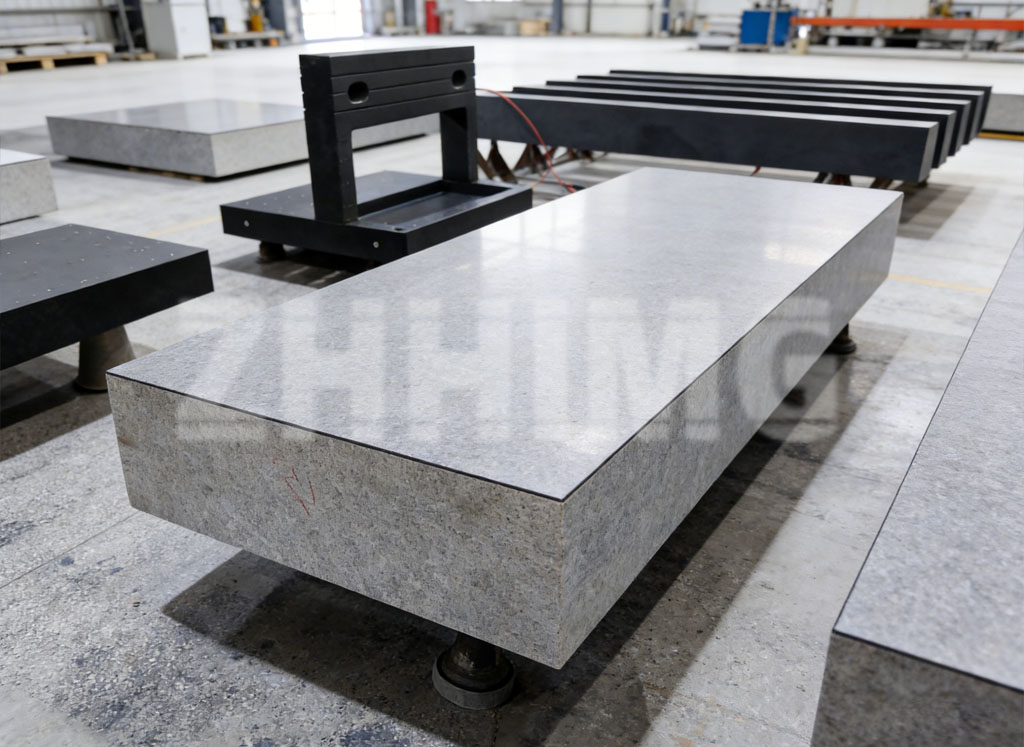
5. Customization Options
When sourcing a custom granite machine base, flexibility in design and customization can significantly impact its suitability for your application.
Important factors to verify:
- Mounting hole patterns: Confirm that your supplier can drill holes to your specifications for machine fixtures.
- Slots and grooves: Some applications require T-slots or channels for clamps, fixtures, or cable routing.
- Size limitations: Ensure the supplier can provide a granite base in your required dimensions. Extremely large bases may require specialized transport and handling.
- Edge treatments and chamfers: Smooth edges reduce the risk of chipping and improve operator safety.
Why it matters:
Customization ensures that the granite base integrates seamlessly with your machinery and production process, maximizing efficiency and reducing installation time.
Additional Considerations When Sourcing
Beyond the five critical specs, several additional factors influence your sourcing decision:
- Supplier Experience
Choose suppliers with proven experience in precision granite manufacturing. Industry certifications, prior projects, and customer testimonials can indicate reliability. - Quality Assurance
Ensure that the supplier conducts thorough QA checks, including flatness verification, density testing, and load simulations. Documentation should be provided. - Logistics and Handling
Granite is heavy and fragile. Verify that the supplier can safely transport and install the base, especially for large or custom sizes. - Lead Time and Cost
Custom granite bases require precision manufacturing and curing. Balance lead time and budget against your quality requirements. Cutting corners can compromise performance.
Applications of Custom Granite Machine Bases
Granite machine bases are widely used across industries that demand high precision and stability:
- CNC machining: Reduces vibrations for smoother cutting and higher accuracy.
- Laser cutting and engraving: Provides a stable platform to maintain precise beam alignment.
- Coordinate measuring machines (CMMs): Ensures accurate metrology measurements.
- Electronics assembly: Supports delicate inspection equipment without introducing vibrations.
- Optics and photonics: Critical for alignment-sensitive devices and laser systems.
Each application requires careful consideration of the specs discussed above to ensure maximum performance.
Common Mistakes to Avoid
When sourcing custom granite bases, buyers often make mistakes that lead to poor performance or increased costs:
- Ignoring flatness verification – Accepting generic specifications can result in alignment issues.
- Overlooking density and composition – Not all granite is created equal; low-density stone may vibrate excessively.
- Neglecting thermal effects – Temperature fluctuations can affect sensitive machines.
- Assuming all suppliers offer the same customization – Verify hole patterns, slots, and finishing options before ordering.
- Underestimating logistics challenges – Large granite bases require careful handling to avoid damage during transit.
Avoiding these pitfalls ensures that your investment in a custom granite machine base pays off over the long term.
Conclusion
Sourcing a custom granite machine base is a critical decision in high-precision manufacturing. By focusing on the five critical specs—flatness, material density, dimensional stability, surface finish, and customization options—procurement specialists and engineers can ensure optimal machine performance and longevity.
Granite’s natural properties make it an ideal choice for applications where stability, vibration damping, and thermal resistance are essential. Coupled with careful verification of material and supplier capabilities, a well-chosen granite base can significantly improve machine accuracy, reduce maintenance, and enhance overall production efficiency.
When sourcing, always prioritize verified specifications, reliable suppliers, and long-term stability. In precision manufacturing, a strong foundation is not just desirable—it’s indispensable.
Post time: May-06-2026