
In the relentless pursuit of manufacturing excellence, where tolerances are measured in microns and quality is non-negotiable, the foundation of precision often lies in the most fundamental tools. At the heart of every quality control laboratory, machine shop, and assembly line lies a critical decision: the choice of the reference plane. For decades, the industry has relied on two primary materials to serve as the bedrock of accuracy: natural granite and high-grade cast iron. These Durable Measurement Platforms are not merely passive surfaces; they are the active guardians of quality, ensuring that every component produced meets the stringent specifications demanded by modern engineering.
As industries evolve, from the massive scale of heavy machinery manufacturing to the microscopic precision of semiconductor fabrication, the demand for stable, accurate, and long-lasting measurement bases has never been greater. This article explores the distinct roles of granite and cast iron in the modern industrial landscape, analyzing their material properties, their applications in High-Precision Measurement, and why they remain the ideal choice for supporting the world’s heaviest and most complex machinery.
The Material Science of Stability: Granite vs. Cast Iron
To understand the enduring popularity of these two materials, one must look to the physics of their atomic structures. Both granite and cast iron offer unique advantages that make them suitable for precision metrology, yet they achieve stability through different mechanisms.
Natural Granite: The Inert Standard
Granite, specifically high-quality black granite (often sourced from quarries known for fine-grained consistency), is prized for its dimensional stability. Having been formed over millions of years under immense heat and pressure, the internal stresses within the stone are virtually non-existent. This natural aging process means that a precision granite platform will not warp or twist over time.
Granite, specifically high-quality black granite (often sourced from quarries known for fine-grained consistency), is prized for its dimensional stability. Having been formed over millions of years under immense heat and pressure, the internal stresses within the stone are virtually non-existent. This natural aging process means that a precision granite platform will not warp or twist over time.
One of the most significant advantages of granite is its low coefficient of thermal expansion. In a workshop environment where temperatures can fluctuate, steel or iron might expand or contract, altering the flatness of the surface. Granite, however, remains remarkably constant. Furthermore, as a non-metallic material, it is immune to rust and corrosion. In environments where coolants, oils, or humidity are prevalent, a granite surface will not pit or degrade, ensuring a long service life. It is also non-magnetic, making it the only choice for measuring components that are sensitive to magnetic fields, such as those found in electronics or medical imaging devices.
Cast Iron: The Rigid Workhorse
While granite offers stability through inertness, cast iron offers strength through rigidity. Cast Iron Platforms are renowned for their high load-bearing capacity. The internal microstructure of cast iron, characterized by graphite flakes within a ferrite or pearlite matrix, gives it exceptional damping properties. This means that cast iron is incredibly effective at absorbing and dissipating vibrations.
While granite offers stability through inertness, cast iron offers strength through rigidity. Cast Iron Platforms are renowned for their high load-bearing capacity. The internal microstructure of cast iron, characterized by graphite flakes within a ferrite or pearlite matrix, gives it exceptional damping properties. This means that cast iron is incredibly effective at absorbing and dissipating vibrations.
In the context of Heavy Machinery, where a large engine block or a turbine blade might be placed on the measurement table, the rigidity of cast iron is indispensable. It can support immense weight without flexing, ensuring that the measurement is not compromised by the deflection of the platform itself. Modern metallurgy has advanced cast iron significantly; alloys such as Meehanite and high-grade gray iron (HT300) offer improved hardness and wear resistance, bridging the gap between traditional iron and modern composite materials.
High-Precision Measurement: The Role of Surface Plates
The surface plate is the primary datum for all precision measurement. Whether it is a simple inspection of a machined part or a complex calibration of a robotic arm, the accuracy of the result is only as good as the flatness of the plate.
For high-precision applications, the surface finish and flatness tolerance are critical. Granite plates are typically lapped to a mirror finish, achieving roughness values that allow for frictionless movement of measuring instruments. This is crucial when using electronic levels or autocollimators, where even the slightest drag can affect the reading. The hardness of granite also means it is resistant to scratching. If a metal part is dropped on a granite plate, it is more likely to damage the part than the plate, preserving the integrity of the reference surface.
However, cast iron plates hold their own in dynamic measurement environments. The “wringing” effect—a molecular attraction that allows gauge blocks to stick together—can be achieved on high-quality iron plates, a feature often utilized in calibration laboratories. Additionally, the surface of a cast iron plate can be resurfaced or “re-scraped” if it becomes worn, extending its lifespan significantly. This reparability makes cast iron a cost-effective choice for busy workshops where the platform is subject to heavy daily use.
Ideal for Heavy Machinery: Structural Integrity and Load Bearing
When we move from the inspection room to the factory floor, the requirements for measurement platforms shift from pure flatness to structural integrity. This is where the “Heavy Machinery” aspect of our title comes into play.
Supporting the Giants of Industry
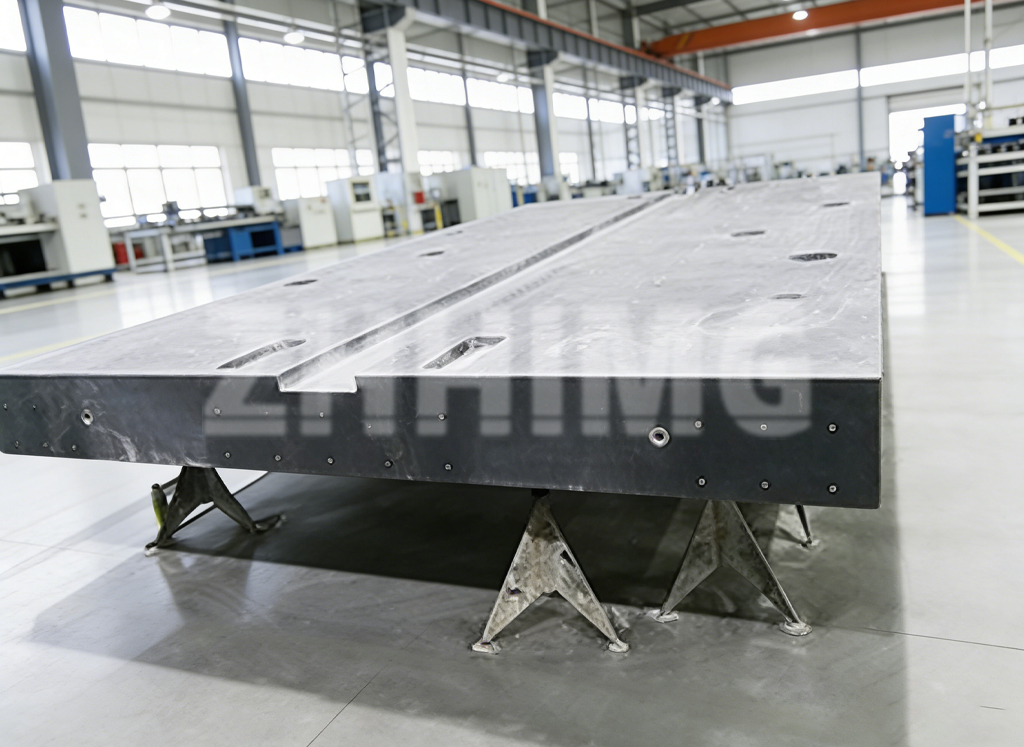
In the aerospace and energy sectors, manufacturers deal with components that can weigh several tons. A wind turbine gearbox or a jet engine casing requires a measurement platform that is not only flat but also structurally sound enough to bear the load without permanent deformation. Here, Cast Iron Platforms often take the lead. The compressive strength of high-grade cast iron allows for the construction of massive tables with intricate ribbing structures (often honeycomb or box-rib designs) that maximize stiffness while minimizing weight.
In the aerospace and energy sectors, manufacturers deal with components that can weigh several tons. A wind turbine gearbox or a jet engine casing requires a measurement platform that is not only flat but also structurally sound enough to bear the load without permanent deformation. Here, Cast Iron Platforms often take the lead. The compressive strength of high-grade cast iron allows for the construction of massive tables with intricate ribbing structures (often honeycomb or box-rib designs) that maximize stiffness while minimizing weight.
These platforms often serve as the base for Coordinate Measuring Machines (CMMs). In large-scale gantry CMMs, the granite or iron base must remain perfectly stable while the machine head moves at high speeds. The vibration damping properties of cast iron are particularly beneficial here, isolating the measurement probe from the floor vibrations caused by nearby forklifts or stamping presses.
Granite in Motion
Conversely, granite is increasingly being used as a structural component in the moving parts of heavy machinery. Because granite is lighter than steel for the same stiffness, it is often used for the moving bridges of high-speed CMMs. This reduces the moving mass, allowing for higher acceleration and throughput without sacrificing accuracy. The “zero expansion” characteristic of granite ensures that the machine’s geometry remains constant even as the motors generate heat during operation.
Conversely, granite is increasingly being used as a structural component in the moving parts of heavy machinery. Because granite is lighter than steel for the same stiffness, it is often used for the moving bridges of high-speed CMMs. This reduces the moving mass, allowing for higher acceleration and throughput without sacrificing accuracy. The “zero expansion” characteristic of granite ensures that the machine’s geometry remains constant even as the motors generate heat during operation.
Durability: A Long-Term Investment
In the industrial sector, “cheap” often means “expensive” in the long run. Durable Measurement Platforms are a long-term investment. A high-quality granite or cast iron plate, if maintained correctly, can last for decades.
Maintenance and Care
The durability of these platforms is heavily dependent on maintenance. For granite, the primary enemy is physical shock and chemical spills. While granite is hard, it is brittle. A sharp impact can chip the surface, creating a high spot that affects flatness. Therefore, it is standard practice to cover granite plates when not in use and to clean them with non-abrasive cleaners.
The durability of these platforms is heavily dependent on maintenance. For granite, the primary enemy is physical shock and chemical spills. While granite is hard, it is brittle. A sharp impact can chip the surface, creating a high spot that affects flatness. Therefore, it is standard practice to cover granite plates when not in use and to clean them with non-abrasive cleaners.
For cast iron, the enemy is oxidation. Despite modern coatings and alloys, iron will rust if left unprotected. A regular regimen of cleaning and applying a thin layer of防锈 oil (anti-rust oil) is essential. However, as noted previously, the surface of an iron plate can be restored. If a granite plate is damaged, it often requires professional re-lapping, which can be costly and time-consuming. If an iron plate is damaged, a skilled technician can often scrape it back to tolerance on-site.
The Economics of Precision
When choosing between granite and cast iron, manufacturers must consider the total cost of ownership. Granite generally commands a higher upfront cost due to the difficulty of machining stone and the scarcity of high-quality raw blocks. However, its lack of maintenance (no oiling required) and immunity to rust can make it cheaper to operate over 20 years. Cast iron has a lower entry price and is easier to repair, making it a favorite for general-purpose machine shops.
When choosing between granite and cast iron, manufacturers must consider the total cost of ownership. Granite generally commands a higher upfront cost due to the difficulty of machining stone and the scarcity of high-quality raw blocks. However, its lack of maintenance (no oiling required) and immunity to rust can make it cheaper to operate over 20 years. Cast iron has a lower entry price and is easier to repair, making it a favorite for general-purpose machine shops.
Future Trends: The Evolution of Measurement Bases
As we look toward the future of manufacturing, the materials we use for measurement are also evolving. We are seeing a trend toward “smart” platforms, where sensors are embedded directly into the granite or iron structure to monitor temperature and vibration in real-time. This data can be fed into the CMM software to compensate for environmental changes, pushing the boundaries of accuracy even further.
Furthermore, the rise of additive manufacturing (3D printing) is beginning to influence the design of cast iron bases. Manufacturers can now print sand molds with complex internal geometries that were previously impossible to cast, resulting in iron bases that are lighter and stiffer than ever before. Similarly, synthetic granite (polymer concrete) is gaining traction for specific applications, offering a moldable alternative to natural stone, though it lacks the natural aging stability of quarried granite.
Conclusion
In the high-stakes world of industrial manufacturing, the choice of a measurement platform is a decision that impacts every aspect of production. Whether one chooses the inert, corrosion-resistant stability of Granite Platforms or the rigid, vibration-damping strength of Cast Iron Platforms, the goal remains the same: the pursuit of absolute truth in measurement.
For heavy machinery and high-precision applications alike, these durable platforms provide the solid ground upon which modern industry stands. They are the silent partners in innovation, ensuring that as our machines become faster and more complex, our ability to measure them remains accurate, reliable, and enduring. As global standards rise, the role of these high-quality bases will only become more critical, proving that in the age of digitalization, the physical foundation of quality is still paramount.
Post time: Apr-30-2026