
In the narrative of modern technological advancement, the spotlight often falls on the dazzling complexity of microchips or the aerodynamic marvels of jet engines. However, beneath these high-profile innovations lies a fundamental, often overlooked element that makes their existence possible: Precision Granite Components. As the manufacturing sector pushes the boundaries of what is physically achievable, the demand for materials that offer absolute stability, rigidity, and vibration damping has skyrocketed. Granite, a material once associated solely with construction and monuments, has been re-engineered into the bedrock of the aerospace and semiconductor industries.
This transformation is not merely a matter of material substitution; it is a strategic necessity. In a world where tolerances are shrinking from microns to nanometers, the “global supply” of high-quality, custom granite parts has become a critical linchpin in the industrial supply chain. From the massive gantries of coordinate measuring machines (CMM) inspecting aircraft wings to the delicate stages of EUV lithography machines etching circuits onto silicon wafers, precision granite is the silent guardian of accuracy. This article explores the pivotal role of these components, the technical nuances of their application, and the dynamics of a global market that relies on these stone structures to build the future.
The Material Science of Stability
To understand why granite is indispensable to high-tech industries, one must first appreciate its unique physical properties. In the realm of precision engineering, “stability” is the ultimate currency. Metals, while strong, are subject to thermal expansion and contraction. A steel beam heated by a few degrees can expand enough to ruin a precision measurement or misalign a laser beam. Granite, specifically high-quality black granite (often sourced from regions like Jinan in China or specific quarries in Europe), possesses a naturally low coefficient of thermal expansion. This means it remains dimensionally stable even when ambient temperatures fluctuate, providing a constant reference plane in an otherwise variable environment.
Furthermore, granite is non-magnetic and immune to corrosion. In the semiconductor industry, where magnetic fields can disrupt the path of electrons or ions, the non-magnetic nature of granite is not just a benefit—it is a requirement. Similarly, in workshops where coolants and harsh chemicals are used, granite’s resistance to rust and chemical attack ensures a long service life with minimal maintenance. Its fine-grained, crystalline structure also offers superior vibration damping characteristics. It absorbs mechanical shocks and dissipates energy, preventing external vibrations from reaching the sensitive workpiece or measurement probe. This “quietness” is essential for achieving the surface finishes and geometric accuracies demanded by modern engineering.
Aerospace: Scaling New Heights with Stone
The aerospace industry represents one of the most demanding sectors for precision manufacturing. The components used in aircraft—turbine blades, fuselage panels, landing gear—must be manufactured to exacting standards to ensure safety and performance. Here, Custom Granite Parts play a dual role: as structural elements in manufacturing equipment and as the foundation for quality control.
Metrology and Inspection
The sheer size of aerospace components necessitates large-scale measurement solutions. A granite base for a CMM used to inspect a jet engine casing must be massive, yet perfectly flat. Any deviation in the granite’s flatness would be interpreted by the machine as an error in the part, potentially leading to the rejection of expensive, high-value components. Manufacturers utilize large-format granite surface plates and custom granite bridges to provide the stable datum required for these inspections. The ability of granite to maintain its geometry over decades ensures that the data collected today is comparable to data collected ten years from now, a crucial factor for long-term aircraft maintenance and certification.
Structural Components in Manufacturing
Beyond inspection, granite is increasingly used in the actual manufacturing of aerospace parts. High-speed machining centers and composite layup machines often employ granite guideways and bases. The high stiffness-to-weight ratio of granite allows these machines to move rapidly and precisely without flexing. For example, in the drilling of carbon fiber reinforced polymers (CFRP), vibration is the enemy, causing delamination and tool wear. Granite structures dampen these vibrations at the source, resulting in cleaner holes and longer tool life. As aerospace manufacturers strive for “lights-out” manufacturing—fully automated production lines running without human intervention—the reliability of granite components ensures that these systems can run continuously without drifting out of tolerance.
Semiconductors: The Nanometer Challenge
If aerospace is about scale, the semiconductor industry is about the infinitesimal. The fabrication of integrated circuits (ICs) involves processes that operate at the atomic level. In this domain, Precision Granite Components are not just helpful; they are the enablers of Moore’s Law.
Lithography and Wafer Handling
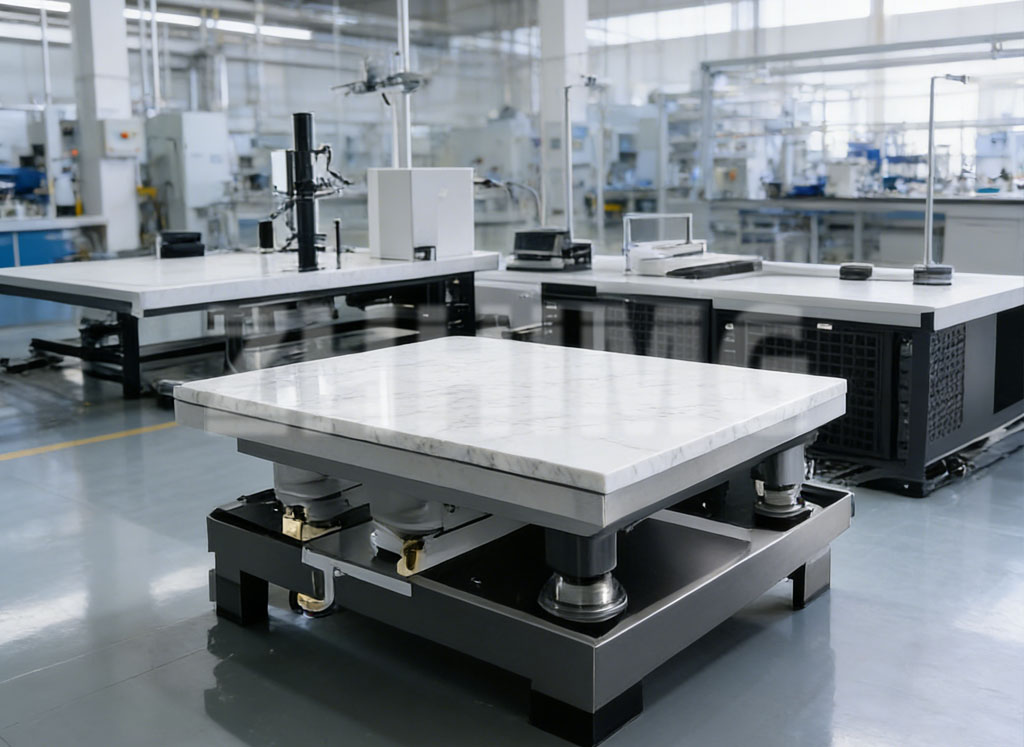
The heart of a semiconductor fab is the lithography machine, which projects circuit patterns onto silicon wafers. These machines require stages that can move at high speeds with nanometer-level precision. Granite stages provide the necessary rigidity and thermal stability to ensure that the mask and the wafer are perfectly aligned during exposure. Even a microscopic vibration or a thermal shift of 0.1°C could ruin a batch of chips worth thousands of dollars. Consequently, the semiconductor industry relies heavily on high-purity, high-density granite that is free from internal stresses and impurities.
Cleanroom Compatibility
Semiconductor manufacturing takes place in ultra-clean environments (Class 1 or Class 10 cleanrooms). Granite is naturally non-porous and does not shed particles, making it an ideal material for these sterile settings. Custom granite parts, such as wafer chucks, alignment stages, and optical mounts, are machined to such high tolerances that they effectively become part of the machine’s optical system. As chip architectures shrink to 3nm and below, the demand for “zero-drift” materials will only intensify, securing granite’s place in the high-tech supply chain.
The Rise of Advanced Ceramics: A Complementary Force
While granite remains the dominant material for large structural components, the industry is also witnessing the rise of advanced ceramics. Materials like silicon carbide (SiC), alumina, and zirconia are being increasingly integrated into the supply chain, often working in tandem with granite.
When to Choose Ceramic
Ceramics offer even higher hardness and stiffness than granite, along with superior wear resistance. In applications where a component is subject to constant friction or requires extreme lightness, ceramics are the preferred choice. For instance, in high-speed robotic arms within a semiconductor fab, a ceramic end-effector might be used for its lightness and lack of particle generation, while the base of the robot remains granite for stability.
Hybrid Solutions
The “Global Supply Solution” for precision components is no longer a binary choice between stone and metal. It is a sophisticated ecosystem where granite provides the macro-stability and ceramics provide the micro-precision. Manufacturers are now capable of bonding these materials or designing systems that leverage the strengths of both. For example, a granite base might be topped with a ceramic plate to provide a surface that is both thermally stable and incredibly hard-wearing. This material convergence allows engineers to design machines that are faster, more accurate, and more durable than ever before.
Navigating the Global Supply Chain
The production of Precision Granite Components is a specialized art form that requires a blend of geological expertise and high-tech manufacturing. The global supply chain for these parts is complex, involving quarrying, aging, machining, and calibration.
Sourcing and Quality Control
Not all granite is created equal. High-quality “Jinan Blue” granite from China, for instance, is prized for its uniformity and lack of quartz inclusions, which can cause instability. Leading manufacturers, such as those in the Shandong province (e.g., Zhonghui), have established rigorous standards for material selection. They often source raw blocks that have been naturally aged for years to relieve internal stresses before any machining begins. This “pre-aging” process is critical; without it, a precision component could warp over time, rendering it useless.
Customization and OEM Capabilities
The demand for Custom Granite Parts means that suppliers must be agile. A standard surface plate is a commodity, but a complex, hollowed-out granite structure with embedded steel inserts for a specific machine tool is a bespoke engineering project. Global supply partners must possess advanced CNC capabilities to mill, drill, and grind these hard materials into complex geometries. They must also offer comprehensive calibration services, providing certificates traceable to international standards (ISO, DIN, ASME). For international buyers, the ability of a supplier to handle the entire lifecycle—from raw block to finished, calibrated, and packaged export product—is the defining factor in a successful partnership.
Logistics and Packaging
Shipping precision granite is a logistical challenge. A granite bridge for a CMM is heavy, brittle, and sensitive to shock. Export-ready packaging involves multi-layer protection, including moisture barriers, shock absorbers, and rigid wooden crates designed to isolate the contents from the harsh environment of ocean freight. The best suppliers treat the logistics of their product with the same care as the manufacturing, ensuring that the precision achieved in the factory is preserved until the component reaches the customer’s floor.
Future Trends: Intelligence in Stone
As we look toward the future, the role of granite in aerospace and semiconductors will continue to evolve. We are seeing the emergence of “smart” granite components, where sensors are embedded directly into the stone to monitor temperature, vibration, and structural health in real-time. This integration of IoT (Internet of Things) technology transforms a passive stone block into an active data source, feeding information into the factory’s central control system.
Furthermore, as the aerospace industry moves towards larger, single-piece structures to reduce weight and assembly time, the inspection platforms required to measure them will grow in size and complexity. Similarly, as semiconductors approach the physical limits of silicon, the stability of the manufacturing equipment will become the limiting factor in miniaturization. In both cases, the humble block of granite will remain the ultimate solution.
In conclusion, the global supply of Precision Granite Components is a vital, albeit quiet, pillar of the modern industrial economy. By bridging the gap between natural geological stability and human engineering ingenuity, these components provide the solid foundation upon which the aerospace and semiconductor industries build their most ambitious dreams. For manufacturers seeking a competitive edge, the choice of a reliable, high-quality granite supplier is not just a procurement decision—it is a strategic investment in the very accuracy of their production.
Post time: Apr-30-2026