
The Global Standard for Precision: Export-Ready Metrology Solutions
In the interconnected landscape of modern industrial trade, the demand for high-precision measurement tools knows no borders. As manufacturing hubs in Asia, Europe, and the Americas become increasingly integrated, the requirement for Export-Ready Granite Measuring Instruments has surged. These instruments are not merely tools; they are the universal language of quality control, ensuring that a component machined in one continent fits perfectly into an assembly on another. The term “export-ready” implies a level of quality, packaging, and certification that meets rigorous international standards, such as DIN, ISO, and ASME. It signifies that the measuring device is prepared to withstand the rigors of global logistics while maintaining its micron-level accuracy upon arrival.
Granite and ceramic materials have become the cornerstone of this global trade in precision. Unlike traditional cast iron, which is susceptible to rust, magnetic interference, and thermal expansion, natural stone and advanced ceramics offer unparalleled stability. For international buyers, sourcing these materials is a strategic decision. It ensures that the fundamental baseline of their manufacturing process—the surface plate or the height gauge base—is immune to the environmental variances that often plague global supply chains. Whether it is the dense, fine-grained “Jinan Blue” granite from China or high-tech ceramic composites, these materials provide the consistency required for Precision Manufacturing on a global scale.
The rise of export-ready instrumentation also reflects a maturation in the supply chain. Manufacturers are no longer just selling a block of stone; they are providing a complete metrological solution. This includes comprehensive calibration certificates that are traceable to national standards, robust packaging designed to prevent even the slightest shock during sea freight, and user support that transcends language barriers. As industries like aerospace, automotive, and semiconductor fabrication demand tighter tolerances, the role of these export-quality granite and ceramic tools becomes increasingly critical. They are the silent guardians of quality, ensuring that “Made in [Country]” is a badge of honor and precision.
Granite vs. Ceramic: The Material Science of Accuracy
When selecting Measuring Devices for high-stakes applications, the choice of material is paramount. The industry is currently witnessing a dynamic interplay between traditional natural granite and modern engineered ceramics. Both materials offer distinct advantages, and understanding their properties is essential for any procurement specialist or quality engineer.
Natural Granite: The Proven Performer
Granite has been the industry standard for decades, and for good reason. High-quality granite, such as the black granite sourced from specific geological formations, possesses a unique crystalline structure that is incredibly stable. It has a low coefficient of thermal expansion, meaning it does not expand or contract significantly with temperature changes. This is crucial for Precision Manufacturing, where a temperature shift of even one degree can alter measurements. Furthermore, granite is non-magnetic and immune to corrosion. In a humid workshop environment, a cast iron plate might rust, ruining its surface and accuracy. A granite plate, however, remains pristine.
Granite has been the industry standard for decades, and for good reason. High-quality granite, such as the black granite sourced from specific geological formations, possesses a unique crystalline structure that is incredibly stable. It has a low coefficient of thermal expansion, meaning it does not expand or contract significantly with temperature changes. This is crucial for Precision Manufacturing, where a temperature shift of even one degree can alter measurements. Furthermore, granite is non-magnetic and immune to corrosion. In a humid workshop environment, a cast iron plate might rust, ruining its surface and accuracy. A granite plate, however, remains pristine.
The density of granite also plays a vital role in its performance. High-density granite (often exceeding 3000 kg/m³) offers excellent vibration damping properties. In the microscopic world of precision measurement, external vibrations from nearby machinery can distort readings. Granite acts as a natural shock absorber, dissipating this energy and providing a quiet, stable platform for measurement. The surface of a precision granite plate is lapped to a mirror finish, achieving roughness values as low as Ra 0.02μm. This smoothness ensures that there is no friction when moving a measuring probe or a workpiece, allowing for consistent, repeatable results.
Ceramic Measuring Instruments: The Future of Hardness
While granite is the traditional choice, Ceramic Measuring Instruments are gaining traction in the export market, particularly for applications requiring extreme hardness and wear resistance. Engineered ceramics, often composed of alumina or zirconia, are sintered at high temperatures to create a material that is harder than steel and significantly more wear-resistant than granite.
While granite is the traditional choice, Ceramic Measuring Instruments are gaining traction in the export market, particularly for applications requiring extreme hardness and wear resistance. Engineered ceramics, often composed of alumina or zirconia, are sintered at high temperatures to create a material that is harder than steel and significantly more wear-resistant than granite.
Ceramics are ideal for environments where the measuring tool is subject to constant friction or abrasive contact. For instance, in high-volume production lines where parts are constantly slid across a surface plate, a ceramic plate will maintain its flatness far longer than other materials. Additionally, ceramics can be engineered to have specific thermal properties, sometimes offering even lower thermal expansion than granite. They are also chemically inert, making them resistant to coolants, oils, and acids that might be present in a machining environment. While generally more expensive than granite, the longevity and durability of ceramic instruments make them a cost-effective solution for the most demanding industrial applications.
The Spectrum of Precision: Surface Plates and Beyond
The category of Surface Plates encompasses a wide range of products, from simple inspection tables to complex, integrated metrology systems. In the export market, versatility is key. Manufacturers are increasingly called upon to produce not just standard rectangular plates, but also custom-shaped components that integrate directly into production machinery.
The Foundation: Inspection Surface Plates
The most recognizable product in this category is the inspection surface plate. These are used as the primary reference plane for all precision measurement. Available in various grades—from workshop grade (Grade B) to laboratory grade (Grade 00 or AAA)—these plates must be protected and maintained with the utmost care. Export-ready plates come with a detailed calibration map, showing the flatness deviation at every point on the surface. This transparency allows quality managers to understand the exact capabilities of their tool and to compensate for any minute deviations in ultra-high-precision work.
The most recognizable product in this category is the inspection surface plate. These are used as the primary reference plane for all precision measurement. Available in various grades—from workshop grade (Grade B) to laboratory grade (Grade 00 or AAA)—these plates must be protected and maintained with the utmost care. Export-ready plates come with a detailed calibration map, showing the flatness deviation at every point on the surface. This transparency allows quality managers to understand the exact capabilities of their tool and to compensate for any minute deviations in ultra-high-precision work.
Integrated Granite Components
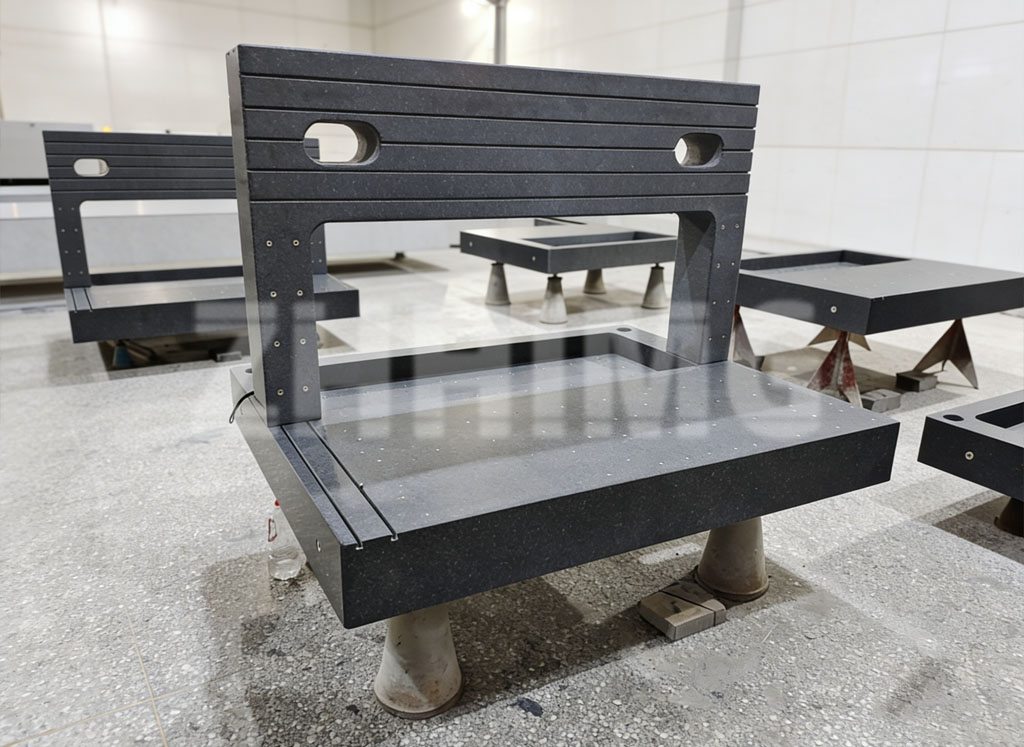
Beyond the standalone plate, there is a growing demand for granite as a structural component in Measuring Devices. Coordinate Measuring Machines (CMMs), optical comparators, and laser scanners often utilize granite bases, bridges, and guideways. The rigidity of granite allows these machines to move at high speeds without flexing, while its damping characteristics ensure that the measuring probe does not vibrate during contact. Export-ready granite components for these machines require complex machining—drilling, tapping, and embedding metal inserts—while maintaining strict geometric tolerances.
Beyond the standalone plate, there is a growing demand for granite as a structural component in Measuring Devices. Coordinate Measuring Machines (CMMs), optical comparators, and laser scanners often utilize granite bases, bridges, and guideways. The rigidity of granite allows these machines to move at high speeds without flexing, while its damping characteristics ensure that the measuring probe does not vibrate during contact. Export-ready granite components for these machines require complex machining—drilling, tapping, and embedding metal inserts—while maintaining strict geometric tolerances.
Specialized Tools: Straight Edges, Squares, and V-Blocks
The ecosystem of granite measuring tools extends to a variety of specialized instruments. Granite straight edges are used to check the straightness of machine ways. Granite squares provide a perfect 90-degree reference for checking perpendicularity. V-blocks hold cylindrical parts for inspection. In the export market, these tools are often sold in sets, housed in protective wooden or plastic cases with foam inserts to ensure they arrive in perfect condition. The precision of these tools is often measured in microns per meter, a standard that requires masterful craftsmanship to achieve.
The ecosystem of granite measuring tools extends to a variety of specialized instruments. Granite straight edges are used to check the straightness of machine ways. Granite squares provide a perfect 90-degree reference for checking perpendicularity. V-blocks hold cylindrical parts for inspection. In the export market, these tools are often sold in sets, housed in protective wooden or plastic cases with foam inserts to ensure they arrive in perfect condition. The precision of these tools is often measured in microns per meter, a standard that requires masterful craftsmanship to achieve.
Navigating the Export Landscape: Quality, Logistics, and Standards
Sourcing Export-Ready Granite Measuring Instruments involves more than just selecting a product from a catalog. It requires a partnership with a manufacturer who understands the complexities of international trade and the specific requirements of the global metrology community.
Adherence to International Standards
The credibility of a measuring instrument lies in its certification. Top-tier manufacturers adhere to a variety of international standards, including DIN 876 (Germany), ASME B89.3.1 (USA), and GB/T (China). Compliance with these standards ensures that a granite plate purchased from a supplier in one country can be used interchangeably with equipment in another. For export-ready products, the calibration certificate is a critical document. It must be traceable to national metrology institutes, providing a chain of custody that validates the accuracy of the tool. Some manufacturers go a step further, offering “digital twins” or electronic data files that accompany the physical tool, allowing for seamless integration into digital quality management systems.
The credibility of a measuring instrument lies in its certification. Top-tier manufacturers adhere to a variety of international standards, including DIN 876 (Germany), ASME B89.3.1 (USA), and GB/T (China). Compliance with these standards ensures that a granite plate purchased from a supplier in one country can be used interchangeably with equipment in another. For export-ready products, the calibration certificate is a critical document. It must be traceable to national metrology institutes, providing a chain of custody that validates the accuracy of the tool. Some manufacturers go a step further, offering “digital twins” or electronic data files that accompany the physical tool, allowing for seamless integration into digital quality management systems.
Packaging and Logistics
Granite is heavy and brittle. Shipping a one-ton surface plate across the ocean without damaging it is a significant logistical challenge. Export-ready manufacturers invest heavily in specialized packaging. This typically involves a multi-layer approach: a protective coating on the stone to prevent moisture ingress, a rigid internal frame to prevent flexing, and a heavy-duty wooden crate that is fumigated and stamped for international travel. The goal is to isolate the instrument from the shocks and vibrations of the shipping process. Advanced manufacturers may even include shock recorders inside the crate, allowing the recipient to verify that the shipment was handled correctly upon arrival.
Granite is heavy and brittle. Shipping a one-ton surface plate across the ocean without damaging it is a significant logistical challenge. Export-ready manufacturers invest heavily in specialized packaging. This typically involves a multi-layer approach: a protective coating on the stone to prevent moisture ingress, a rigid internal frame to prevent flexing, and a heavy-duty wooden crate that is fumigated and stamped for international travel. The goal is to isolate the instrument from the shocks and vibrations of the shipping process. Advanced manufacturers may even include shock recorders inside the crate, allowing the recipient to verify that the shipment was handled correctly upon arrival.
Customization and OEM Services
The global market is diverse, and so are its needs. Manufacturers serving the export market must be agile, offering Original Equipment Manufacturer (OEM) services that allow international brands to sell granite tools under their own name. This extends to custom engraving, specific color finishes, and the integration of proprietary features. For example, a European machine builder might require a granite base with a specific mounting pattern that differs from standard catalog items. The ability to rapidly prototype and manufacture these custom solutions is a key competitive advantage in the export sector.
The global market is diverse, and so are its needs. Manufacturers serving the export market must be agile, offering Original Equipment Manufacturer (OEM) services that allow international brands to sell granite tools under their own name. This extends to custom engraving, specific color finishes, and the integration of proprietary features. For example, a European machine builder might require a granite base with a specific mounting pattern that differs from standard catalog items. The ability to rapidly prototype and manufacture these custom solutions is a key competitive advantage in the export sector.
Applications Driving the Market: From Semiconductors to Heavy Industry
The demand for Precision Manufacturing tools is driven by a variety of end-user industries, each with its own unique challenges and requirements.
Semiconductor and Electronics
In the semiconductor industry, precision is measured in nanometers. The manufacturing of integrated circuits requires a stable environment free from vibration and thermal drift. Granite and ceramic measuring instruments are used extensively in wafer inspection and lithography alignment. The non-magnetic properties of these materials are particularly important here, as magnetic fields can interfere with the electron beams used in chip fabrication. As the demand for smaller, more powerful chips grows, so does the need for ultra-high-precision granite stages and bases.
In the semiconductor industry, precision is measured in nanometers. The manufacturing of integrated circuits requires a stable environment free from vibration and thermal drift. Granite and ceramic measuring instruments are used extensively in wafer inspection and lithography alignment. The non-magnetic properties of these materials are particularly important here, as magnetic fields can interfere with the electron beams used in chip fabrication. As the demand for smaller, more powerful chips grows, so does the need for ultra-high-precision granite stages and bases.
Aerospace and Automotive
These industries deal with large, complex geometries. A turbine blade for a jet engine or a chassis component for a car must be measured with extreme accuracy to ensure safety and performance. Large-format granite surface plates and custom granite fixtures are essential for these measurements. In the automotive sector, the shift towards electric vehicles has introduced new measurement challenges, particularly regarding battery packs and electric motors. Granite measuring tables provide the stability needed to inspect these large, often delicate components.
These industries deal with large, complex geometries. A turbine blade for a jet engine or a chassis component for a car must be measured with extreme accuracy to ensure safety and performance. Large-format granite surface plates and custom granite fixtures are essential for these measurements. In the automotive sector, the shift towards electric vehicles has introduced new measurement challenges, particularly regarding battery packs and electric motors. Granite measuring tables provide the stability needed to inspect these large, often delicate components.
Medical and Optical
The medical device industry requires components that are not only precise but also clean and easy to sterilize. The non-porous nature of high-quality granite and ceramic makes it ideal for these environments. From the molds used to manufacture contact lenses to the components of surgical robots, the precision of the manufacturing process is directly linked to the quality of the measuring tools used.
The medical device industry requires components that are not only precise but also clean and easy to sterilize. The non-porous nature of high-quality granite and ceramic makes it ideal for these environments. From the molds used to manufacture contact lenses to the components of surgical robots, the precision of the manufacturing process is directly linked to the quality of the measuring tools used.
Conclusion: The Enduring Value of Stone and Ceramic in a Digital Age
As we move further into the era of Industry 4.0, where digital sensors and AI-driven analytics dominate the conversation, it is easy to overlook the physical foundations of precision. However, the reality is that every digital measurement must be grounded in a physical reality that is stable and accurate. Export-Ready Granite Measuring Instruments and Ceramic Measuring Instruments provide this foundation.
They are the “zero point” of the manufacturing world. No matter how advanced a sensor becomes, it must be calibrated against a known standard. Granite and ceramic surface plates offer that standard with a permanence and reliability that few other materials can match. For global manufacturers, investing in high-quality, export-ready measuring devices is an investment in the integrity of their entire production process. It ensures that their products are built on a foundation of truth, accuracy, and durability, capable of withstanding the test of time and the rigors of the global market.
Post time: Apr-30-2026