
In the world of high-precision manufacturing, measurement accuracy is the foundation upon which quality is built. As tolerances tighten to microns and sub-micron levels, the choice of measurement tools becomes increasingly critical. Traditional steel instruments, while familiar and cost-effective, often fall short in demanding environments where temperature fluctuations, magnetic interference, chemical exposure, and long-term stability are concerns.
Enter ceramic and granite measuring tools—advanced metrology solutions that address the fundamental limitations of steel while delivering superior performance in critical applications. From semiconductor fabrication to aerospace component inspection, these materials have become the preferred choice for engineers and quality professionals who cannot compromise on measurement integrity.
This article examines five key advantages that make ceramic and granite measuring tools indispensable in modern precision manufacturing, helping you understand when and why to specify these advanced materials for your metrology applications.
Advantage 1: Superior Thermal Stability and Dimensional Consistency
The Thermal Challenge in Precision Measurement
Temperature is one of the most significant variables affecting measurement accuracy. Even minor temperature fluctuations can introduce measurable dimensional changes in steel instruments, compromising measurement reliability in precision environments.
Steel’s Thermal Limitations:
- Coefficient of Thermal Expansion (CTE): 11-13 µm/m·°C
- A 1°C temperature change produces approximately 0.011-0.013mm/m dimensional deviation
- Thermal gradients can induce warping and internal stress
- Requires strict environmental control or compensation systems
Ceramic’s Thermal Performance:
- Zirconia (ZrO₂) CTE: 4-10 × 10⁻⁶/°C (approximately 1/3 that of steel)
- Alumina (Al₂O₃) CTE: 7-8 × 10⁻⁶/°C
- Maintains dimensional stability in high-temperature environments up to 1000°C
- Low thermal conductivity reduces thermal gradient effects
Granite’s Thermal Characteristics:
- CTE: 4.5-9 × 10⁻⁶/°C (significantly lower than steel)
- High thermal inertia reduces sensitivity to short-term temperature fluctuations
- Isotropic structure ensures consistent behavior in all directions
- Near-zero expansion characteristics under controlled conditions
Real-World Impact
For precision manufacturing facilities, this thermal stability translates directly into measurement confidence. A 1,000mm ceramic gauge block experiencing a 5°C temperature change will expand by only 0.020-0.050mm, while an equivalent steel block would expand by 0.055-0.065mm—a difference that can be critical in micron-tolerance applications.
This advantage is particularly significant in:
- Semiconductor manufacturing, where sub-micron precision is essential
- Aerospace component inspection, where large measurements require thermal stability
- Automotive powertrain production, where temperature variations are common
- Calibration laboratories, where measurement traceability depends on stability
Ceramic gage blocks, in particular, exhibit near-zero thermal phase shift, meaning they return to their original dimensions after thermal cycling without hysteresis effects. This characteristic makes them ideal for calibration applications where repeatable accuracy is paramount.
Advantage 2: Exceptional Wear Resistance and Extended Service Life
Material Hardness Comparison
Wear resistance directly impacts the long-term accuracy and economic value of measuring tools. Both ceramic and granite significantly outperform steel in this critical parameter.
| Material | Vickers Hardness (HV) | Relative Wear Resistance |
|---|---|---|
| Hardened Steel | 600-800 | Baseline |
| Carbide | 1,200-1,400 | 3-4× steel |
| Zirconia Ceramic | 1,200-1,350 | 10× steel |
| Alumina Ceramic | 1,400-1,500 | 15× steel |
| Granite | 6-7 (Mohs scale) | Excellent |
Ceramic Measuring Tools: Wear Performance
Ceramic measuring tools demonstrate exceptional wear resistance that translates into extended service life and reduced maintenance costs:
Key Performance Metrics:
- Service life: 10-15 years (compared to 3-5 years for steel)
- Wear depth after 10,000 cycles: <0.3 µm (ceramic) vs >1.2 µm (steel)
- Calibration interval extension: 2-3× longer than steel equivalents
- Surface degradation: Minimal even after extended use in abrasive environments
The high hardness of zirconia and alumina ceramics effectively resists wear while maintaining surface integrity. Unlike steel, ceramic surfaces do not develop burrs from scratches or impacts, preserving measurement accuracy even when minor surface damage occurs.
Granite Measuring Tools: Long-Term Stability
Granite squares, surface plates, and straight edges offer unique wear characteristics:
Wear Resistance Properties:
- Naturally high surface hardness prevents wear from repeated contact
- Wear occurs linearly over time, enabling accurate calibration compensation
- Surface roughness achievable: Ra 0.05-0.4 µm
- Maintains flatness within 0.5 µm/m² for 15+ years
Unlike steel, which can experience uneven wear patterns that compromise accuracy, granite wears uniformly. This predictable wear behavior allows quality managers to plan maintenance schedules with confidence and extend equipment lifecycles.
Economic Impact
While ceramic and granite tools typically require 30-50% higher initial investment than steel alternatives, the extended service life delivers significant total cost of ownership benefits:
- Reduced replacement frequency: 10-15 year lifespan vs. 3-5 years for steel
- Lower calibration costs: Extended intervals reduce calibration expenses by 40-60%
- Decreased downtime: Fewer replacements and calibrations mean more production time
- Consistent accuracy: Reduced scrap and rework from measurement drift
Advantage 3: Non-Magnetic and Electrically Insulating Properties
The Magnetic Interference Problem
In many precision manufacturing environments, magnetic fields pose a significant challenge to accurate measurement. Electric motors, magnetic fixtures, induction heating systems, and even the measured components themselves can create magnetic interference that affects steel measuring tools.
Steel’s Magnetic Vulnerabilities:
- Ferromagnetic properties cause attraction to magnetic sources
- Becomes magnetized over time, attracting ferrous debris
- Magnetic fields can induce measurement errors
- Unsuitable for use near motors, transformers, or magnetic assemblies
Ceramic: The Non-Magnetic Solution
Advanced ceramic measuring tools offer complete magnetic immunity:
Key Properties:
- Magnetic permeability: <0.001 (virtually zero)
- Electrical resistivity: >10¹⁴ Ω·cm
- Dielectric strength: >10 kV/mm
- Antistatic behavior: Does not attract dust or particles
These properties make ceramic gage blocks, pin gauges, and measuring instruments ideal for:
- Electric motor and generator manufacturing: Undisturbed measurement near stators and rotors
- Electronics and semiconductor production: Safe use near sensitive electronic components
- Aerospace applications: Compatibility with radar and navigation systems
- Medical device manufacturing: No magnetic interference with implants or instruments
- Research laboratories: Reliable measurement near MRI, NMR, and other magnetic equipment
Granite: Natural Magnetic Immunity
Granite measuring tools share the non-magnetic advantage:
Benefits in Magnetic Environments:
- Naturally non-magnetic and non-conductive
- Does not interfere with magnetic measurement systems
- Safe for use in electromagnetic testing environments
- Ideal for cleanroom and semiconductor applications
This combination of non-magnetic and non-conductive properties makes granite surface plates and squares essential in environments where magnetic interference could compromise measurement accuracy or where electrical isolation is required.
Cleanroom and Contamination Control
The non-magnetic nature of both ceramic and granite tools provides an additional benefit in clean environments: they do not attract ferrous particles and debris. This characteristic is critical in:
- Semiconductor fabs, where particle contamination can destroy wafers
- Optical manufacturing, where surface contamination affects lens quality
- Medical device production, where sterility and cleanliness are paramount
- Aerospace component fabrication, where foreign object debris (FOD) is a safety concern
Advantage 4: Superior Chemical and Corrosion Resistance
The Corrosion Challenge
Steel measuring tools are inherently vulnerable to corrosion and chemical degradation. Even with protective coatings and careful maintenance, exposure to humidity, coolants, cutting fluids, and atmospheric contaminants can compromise accuracy over time.
Steel’s Chemical Vulnerabilities:
- Susceptible to rust and oxidation
- Requires protective oil films or coatings
- Degrades in humid or corrosive environments
- Chemical exposure can damage measurement surfaces
- Coolant and cutting fluid contact accelerates deterioration
Ceramic: Chemical Inertness
Advanced ceramics offer exceptional chemical resistance that eliminates corrosion concerns:
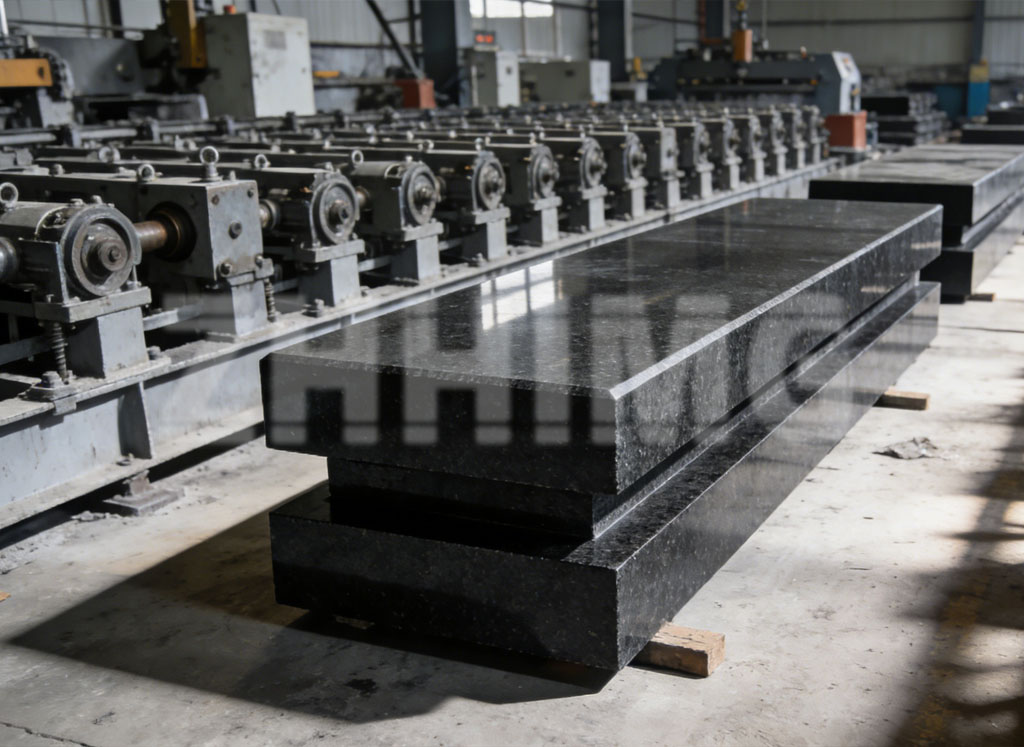
Chemical Resistance Properties:
- pH stability range: 1-14 (compatible with strong acids and bases)
- Corrosion resistance: Excellent performance in acidic, alkaline, and solvent environments
- Moisture resistance: Zero water absorption, no swelling or degradation
- Chemical compatibility: Resistant to coolants, hydraulic fluids, cutting oils, and process chemicals
This chemical stability enables ceramic measuring tools to maintain accuracy in environments where steel would quickly degrade:
Industrial Applications:
- Chemical processing plants: Exposure to aggressive process chemicals
- Medical and pharmaceutical manufacturing: Compatibility with sterilization and cleaning agents
- Food and beverage production: Resistance to cleaning chemicals and sanitizers
- Marine and offshore applications: Resistance to saltwater and atmospheric corrosion
- Metal finishing operations: Compatibility with plating solutions and pickling acids
Granite: Natural Corrosion Resistance
Granite shares the corrosion resistance advantage with ceramic:
Environmental Resistance:
- Naturally resistant to rust and oxidation
- No protective coatings required
- Stable in humid environments
- Resistant to most chemicals and solvents
Unlike steel, granite does not require oil films, protective cases, or climate-controlled storage. This simplifies maintenance and reduces handling requirements while ensuring measurement accuracy is maintained over extended periods.
Maintenance Simplification
The chemical resistance of ceramic and granite tools significantly reduces maintenance requirements:
| Maintenance Task | Steel | Ceramic/Granite |
|---|---|---|
| Rust prevention | Required (oil/grease) | Not required |
| Corrosion inspection | Regular checks needed | Not required |
| Climate-controlled storage | Recommended | Standard storage acceptable |
| Cleaning after chemical exposure | Immediate cleaning required | Standard cleaning sufficient |
| Protective coating renewal | Periodic reapplication | Not applicable |
This maintenance advantage translates into reduced labor costs, simplified quality procedures, and consistent measurement performance regardless of environmental conditions.
Advantage 5: Superior Vibration Damping and Environmental Stability
Vibration as a Measurement Challenge
Environmental vibration—from nearby machinery, foot traffic, HVAC systems, and building resonance—can introduce measurement errors that are difficult to detect but significantly impact results. This is particularly critical for precision measurement applications where sub-micron accuracy is required.
Steel’s Vibration Characteristics:
- Low inherent damping capacity (damping ratio ≈ 0.001)
- Vibrations propagate and resonate through the structure
- Requires auxiliary damping systems for precision applications
- Susceptible to harmonic amplification
Granite: Exceptional Vibration Damping
Granite is one of the most effective vibration damping materials available for precision metrology:
Damping Performance:
- Natural damping ratio: 0.012-0.015 (10-15× better than cast iron)
- Vibration attenuation: 95% at 50-500Hz frequencies
- Internal crystalline structure dissipates mechanical energy
- Grain boundaries convert vibration energy to heat
This exceptional damping performance makes granite surface plates, squares, and machine bases ideal for:
Critical Applications:
- Coordinate Measuring Machines (CMMs): Stable measurement platforms
- Optical alignment systems: Vibration-free positioning
- Semiconductor lithography: Nanometer-level precision
- Precision grinding and machining: Reduced tool chatter and improved surface finish
- Metrology laboratories: Consistent measurement conditions
Granite Squares: Precision with Stability
Granite squares exemplify the material’s advantages in precision measurement:
Key Benefits:
- Dimensional stability under temperature variation
- Superior vibration damping during alignment tasks
- Non-magnetic and corrosion-resistant
- Long-term accuracy without recalibration
- Available in precision grades meeting ISO and ASME standards
For machine tool alignment, guideway installation, and perpendicularity verification, granite squares provide accuracy that steel cannot match in demanding environments.
Environmental Stability Comparison
Both ceramic and granite offer environmental stability advantages beyond vibration damping:
| Environmental Factor | Steel | Ceramic | Granite |
|---|---|---|---|
| Temperature fluctuation | Significant impact | Minimal impact | Minimal impact |
| Humidity variation | Rust risk | No effect | No effect |
| Chemical exposure | Degradation risk | Excellent resistance | Excellent resistance |
| Magnetic interference | Affected | Immune | Immune |
| Long-term dimensional stability | Gradual drift | Excellent stability | Excellent stability |
| Maintenance requirements | High | Low | Low |
Selecting the Right Material for Your Application
When to Choose Ceramic Measuring Tools
Ceramic measuring tools are ideal for applications requiring:
- High-frequency measurement in production environments
- Use near magnetic fields or electronic components
- Exposure to chemicals, coolants, or corrosive environments
- Long calibration intervals and extended service life
- Non-conductive measurement references
Recommended ceramic applications:
- Gage blocks for calibration laboratories
- Pin gauges for high-volume inspection
- Measurement near electric motors and transformers
- Medical device and pharmaceutical manufacturing
- Semiconductor and electronics production
When to Choose Granite Measuring Tools
Granite measuring tools excel in applications requiring:
- Large reference surfaces and stable platforms
- Superior vibration damping characteristics
- Long-term dimensional stability
- Non-magnetic, corrosion-resistant references
- Heavy-duty industrial environments
Recommended granite applications:
- Surface plates for inspection and calibration
- Squares for machine alignment
- Straight edges for flatness verification
- Machine bases for precision equipment
- CMM structures and metrology frames
Integration Strategies
Many precision manufacturing operations benefit from combining ceramic and granite tools:
- Ceramic gage blocks for dimensional calibration standards
- Granite surface plates for stable measurement platforms
- Ceramic pin gauges for high-wear inspection applications
- Granite squares for machine tool alignment and verification
- Both materials for magnetic-free, corrosion-resistant measurement systems
Conclusion
The five key advantages of ceramic and granite measuring tools—superior thermal stability, exceptional wear resistance, non-magnetic properties, chemical resistance, and vibration damping—address fundamental limitations of steel in precision manufacturing environments. As tolerances continue to tighten and quality requirements increase, these advanced materials have become essential rather than optional for achieving measurement excellence.
For engineers, quality managers, and procurement specialists evaluating metrology solutions, the evidence is clear: ceramic and granite measuring tools deliver superior accuracy, longer service life, and lower total cost of ownership compared to steel alternatives. While initial investment may be higher, the combination of extended service intervals, reduced maintenance, and consistent measurement performance delivers compelling return on investment.
In high-precision manufacturing, measurement accuracy defines product quality. The choice of measuring tools is, therefore, a choice about the standards you maintain and the quality you deliver. Ceramic and granite measuring tools represent the current state of the art—materials engineered for the demands of modern precision manufacturing.
The question is not whether these advanced materials offer advantages over steel. The question is whether your precision manufacturing operation can afford to rely on anything less.
Post time: Apr-17-2026