
In the world of precision manufacturing, where tolerances are measured in microns and the difference between success and failure can be thinner than a human hair, vibration has emerged as one of the most persistent and costly challenges facing CNC machining operations today. As industries push the boundaries of what’s possible in aerospace, medical device manufacturing, and semiconductor fabrication, the question of how to eliminate unwanted vibration has become inseparable from the question of precision itself—and increasingly, manufacturers are discovering that the answer begins with the machine base, and more importantly, who supplies it.
The Hidden Cost of Vibration in Modern Manufacturing
Vibration in CNC machining is not merely an annoyance to be tolerated; it is a precision killer that strikes at the very heart of manufacturing quality. When a CNC machine experiences excessive vibration during operation, the consequences ripple through every aspect of the production process. Surface finish quality degrades, leaving visible chatter marks on precision components that should be mirror-smooth. Tool life diminishes dramatically as cutting edges experience micro-impacts thousands of times per second. Perhaps most critically for industries where failure is not an option, dimensional accuracy suffers, with parts drifting out of tolerance in ways that may not become apparent until catastrophic failure occurs in the field.
The sources of vibration in CNC machining are numerous and often interconnected. Spindle runout, where the rotating axis wobbles slightly off-center, creates periodic forces that compound with every revolution. Imbalanced cutting tools generate centrifugal forces that increase exponentially with speed. Inadequate workpiece clamping allows components to resonate like tuning forks under the influence of cutting forces. Even the machine’s foundation—the literal ground upon which it stands—can transmit environmental vibrations from nearby equipment, foot traffic, or building infrastructure directly into the cutting zone.
For manufacturers of CNC machining metal parts, particularly in high-value sectors like aerospace and medical devices, the cost of vibration-related quality issues extends far beyond the immediate expense of scrap and rework. When a batch of precision components fails inspection due to surface defects or dimensional drift, the consequences include delayed deliveries, eroded customer confidence, and in worst-case scenarios, lost contracts that took years to secure.
Traditional Approaches and Their Limitations
Manufacturers have developed numerous strategies to combat vibration over the decades, ranging from process adjustments to equipment modifications. Operators learn to recognize the distinctive sound of chatter and respond by reducing spindle speeds, decreasing depths of cut, or changing feed rates. While these adjustments can sometimes stabilize a problematic operation, they come at a cost: reduced productivity, longer cycle times, and the constant need for operator intervention.
More sophisticated approaches include dynamic vibration absorbers tuned to specific frequencies, specialized tool holders designed to damp oscillation, and advanced cutting strategies that vary spindle speed continuously to avoid resonance peaks. Yet even with all these interventions, many manufacturers find themselves fighting the same battles repeatedly, never quite achieving the stable, predictable process they need for consistent high-precision production.
What many of these approaches have in common is that they treat vibration as a problem to be managed after it occurs, rather than addressing the root cause. This is where the choice of machine base material—and critically, the choice of machine base supplier—becomes decisive.
The Material Revolution: Why Granite Changes Everything
For decades, cast iron has been the default material for machine bases, valued for its ability to be cast into complex shapes and its relatively high stiffness. Steel bases offer similar characteristics with the advantage of welded construction for larger structures. Both materials, however, share fundamental limitations when it comes to precision machining: internal stresses that can cause gradual warping over time, relatively poor vibration damping characteristics, and significant thermal expansion that causes dimensional drift as shop temperatures fluctuate.
Enter granite—not as a new material, but as a rediscovered solution that offers precisely what precision machining demands. Natural granite has been forming deep within the earth for millions of years, a process that has relieved it of all internal stresses. When a granite base is machined to its final dimensions, it stays that way for decades, providing a reference plane that remains flat and true regardless of time or thermal cycling.
The vibration damping characteristics of granite represent perhaps its most dramatic advantage. Research has consistently shown that granite can dampen vibrations five to ten times more effectively than cast iron, and even more dramatically compared to welded steel structures. This is not merely a matter of amplitude reduction; granite’s internal structure dissipates vibrational energy more quickly, preventing the buildup of resonant oscillations that cause chatter and surface defects.
For CNC machining metal parts, this superior damping translates directly into better surface finishes, longer tool life, and the ability to run more aggressive cutting parameters without sacrificing quality. Manufacturers who have switched to granite bases report repeatability improvements that take their operations from marginal to exceptional, with some achieving sub-five-micron consistency that simply wasn’t possible with traditional bases.
Thermal Stability: The Dimensional Anchor
Precision machining does not happen in a vacuum; it happens in manufacturing facilities where temperatures rise and fall with the seasons, the time of day, and the heat generated by the machining process itself. Every material responds to temperature changes by expanding or contracting, but the magnitude of this response varies dramatically.
Cast iron has a coefficient of thermal expansion that is nearly twice that of granite. This means that a machine base made from cast iron will expand and contract significantly more than an equivalent granite base when subjected to the same temperature changes. For precision work where tolerances are measured in microns, this thermal growth can exceed the tolerance band entirely.
Beyond the rate of expansion, granite also responds to temperature changes much more slowly than metals—a property measured by thermal diffusivity. When a workshop warms up during a sunny afternoon, a granite base heats up gradually, buying time before dimensional changes become significant. By contrast, a cast iron base responds almost immediately, potentially introducing errors that operators cannot predict or compensate for.
This thermal inertia is particularly valuable for manufacturers who cannot afford the expense of environmentally controlled cleanrooms. A granite-based machine can maintain its accuracy through normal temperature fluctuations that would throw a metal-based machine significantly off calibration, reducing the need for constant adjustment and re-qualification.
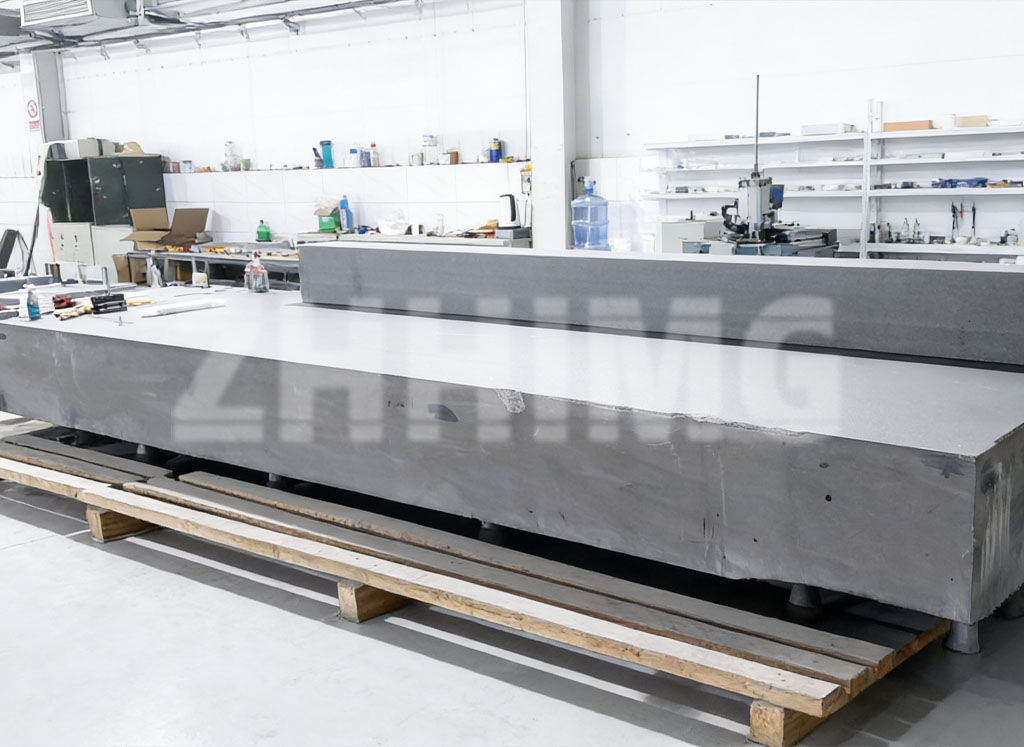
Finding the Right Machine Base Supplier: A Strategic Decision
Given the critical importance of the machine base to overall system performance, the choice of supplier becomes a decision with long-term implications that extend far beyond the initial purchase price. Not all granite is created equal, and not all suppliers possess the expertise and quality systems necessary to deliver bases that will perform consistently over decades of service.
A qualified machine base supplier brings more than raw material to the table. They bring geological expertise—the ability to select granite from quarries that produce material with the right density, uniformity, and absence of defects for precision applications. They bring manufacturing capability—the CNC machining centers and grinding equipment necessary to achieve flatness tolerances measured in microns per meter. They bring quality assurance—the measurement systems and calibration procedures that verify each base meets specification before it ships.
The best suppliers also bring application expertise—the understanding of how different machine configurations, load patterns, and operating environments affect base performance. They can advise on optimal base dimensions, mounting configurations, and integration with the machine structure. They can provide documentation that supports quality system requirements and traceability demands.
For manufacturers of CNC machining metal parts, the supplier relationship should be viewed as a partnership rather than a transaction. The right supplier will stand behind their product, providing support for installation, offering guidance for maintenance, and responding quickly if issues arise. They will understand that their base is not just a component but the foundation upon which precision is built.
The Economics of Precision: Beyond Initial Cost
When evaluating machine base options, many procurement decisions focus heavily on initial cost, with granite bases typically commanding a premium over cast iron alternatives. This perspective, however, overlooks the total cost of ownership over the machine’s operational life.
Consider the ongoing costs of vibration management: the operator time spent adjusting parameters to avoid chatter, the shortened tool life that increases consumable costs, the scrap and rework that results from quality failures. Consider the maintenance burden of cast iron bases that may require periodic re-scraping to restore flatness, or the potential for catastrophic failure if internal stresses cause warping that cannot be corrected. Consider the lost opportunity cost of not being able to take on the most demanding precision work because the equipment foundation simply isn’t stable enough.
Against these ongoing costs, the premium for a high-quality granite base from a reputable supplier becomes an investment rather than an expense. Many manufacturers find that the productivity gains and quality improvements delivered by superior vibration damping and thermal stability pay back the base premium within the first years of operation, with decades of additional benefit to follow.
Looking Forward: The Future of Precision Manufacturing
As manufacturing continues its evolution toward tighter tolerances, smaller features, and more exotic materials, the demands on machine tools will only intensify. The tolerances that once seemed impossible have become routine, and the tolerances that now seem at the edge of possibility will become tomorrow’s standard. In this environment, every element of the machining system must be optimized, and there is no element more fundamental than the base.
The advantages of granite—superior vibration damping, exceptional thermal stability, long-term dimensional integrity—align precisely with the trajectory of precision manufacturing. As more manufacturers discover what high-end machine builders have known for years, granite is becoming not an alternative to metal bases but the preferred choice for applications where precision matters.
For manufacturers evaluating their equipment strategy, the message is clear: the machine base is not just a foundation but a determinant of capability. The right machine base supplier brings not just material but expertise, not just product but partnership. In the pursuit of precision, there is no more important decision than what lies beneath it all.
The manufacturers who recognize this—who invest in quality bases from quality suppliers—position themselves to succeed in a competitive landscape where precision is not optional but essential. The manufacturers who don’t will find themselves fighting the same battles with vibration, thermal drift, and dimensional instability, wondering why their best efforts never quite achieve the results their customers demand. The choice, ultimately, is between building on rock or building on sand. In precision manufacturing, that choice makes all the difference.
Post time: Apr-21-2026