
The rapid evolution of high-speed electronics, advanced packaging, and renewable energy storage has pushed traditional structural materials to their physical limits. Steel and cast iron, once the standard for industrial machinery, frequently fail to meet the dynamic demands of modern equipment due to high thermal expansion, magnetic interference, and insufficient vibration damping.
To maintain sub-micron tracking and processing accuracy, equipment designers are transitioning to advanced materials: precision granite, structural ceramics, mineral castings, UHPC, and carbon fiber composites.
The Structural Materials Matrix
Selecting the correct structural material requires balancing specific stiffness, thermal behavior, and processing scale.
| Material Class | Core Properties | Primary Mechanical Advantages | Standard Applications |
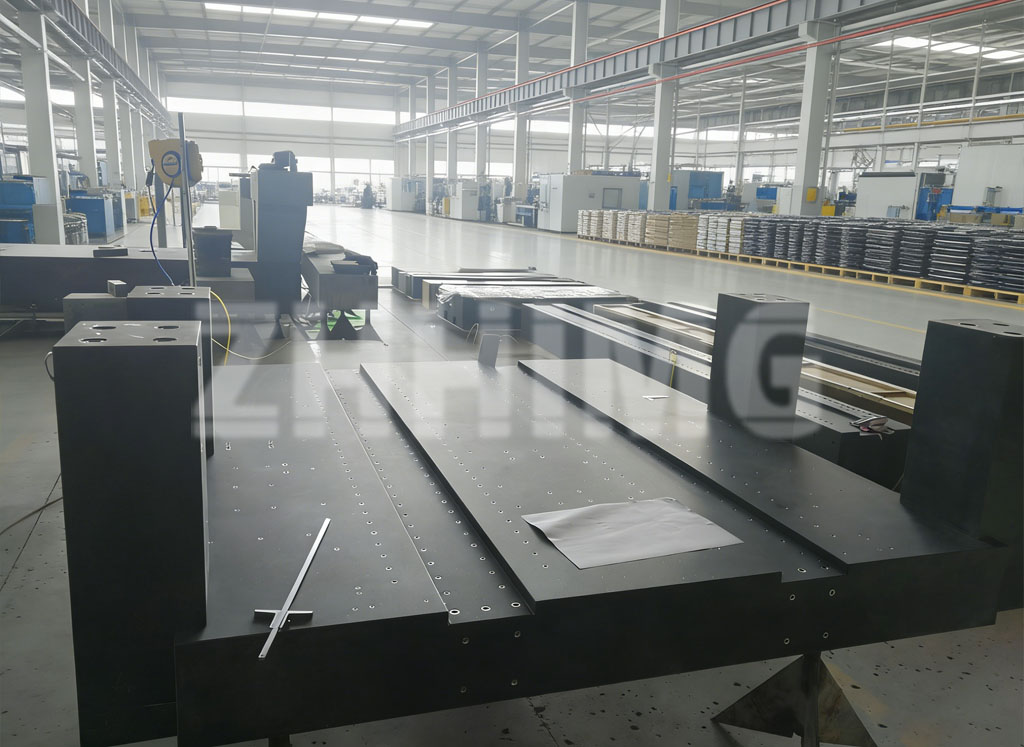
| Precision Granite (ZHHIMG® Black) | Density ≈ 3100 kg/m³, zero internal stress, corrosion-proof. | Excellent long-term geometric permanence; exceptional natural damping. | CMM beds, Semiconductor AOI stages, Laser cutting machine bases. |
| Precision Ceramics (Al2O3, SiC) | Extreme hardness, high modulus of elasticity, low mass. | Maximum structural rigidity with low weight; resists high-temperature wear. | Semiconductor end-effectors, high-speed air bearing guideways. |
| Mineral Casting / UHPC | Synthetic resin/polymer concrete compound, molded to shape. | Superior vibration damping (10x better than cast iron); integrates internal conduits. | High-speed CNC machine tool columns, linear motor structural beds. |
| Carbon Fiber Composites | Ultra-low density, high tensile strength-to-weight ratio. | Minimizes structural inertia for high-acceleration gantries. | Precision 3D printing beams, high-speed optical scanning bridges. |
Precision Granite in Semiconductor and Optical Metrology
Due to its exceptional stability, precision granite components serve as the foundational standard for multi-axis positioning systems.
-
Automated Optical Inspection (AOI) & X-Ray CT Equipment: High-speed scanning axes generate significant inertial forces. A high-density (3100 kg/m³) granite base absorbs these dynamic impulses instantly, preventing image blur and scanning artifacts.
-
Granite Air Bearings & XY Tables: Air bearings float on a thin film of compressed air (5 – 15μm). The mating granite surface must be lapped to a nanometer profile to prevent friction contact, ensuring smooth, wear-free motion.
-
Perovskite Solar Coating Systems: The deposition of thin-film perovskite solar cells requires absolute planar uniformity across wide spans. Large-scale granite beds (capable of single-piece configurations up to 20 m in length) provide the required geometric flat reference.
Precision Ceramics for Extreme Rigidity
Where granite provides mass and stability, technical ceramics like alumina (Al2O3) and silicon carbide (SiC) provide lightweight rigidity. In semiconductor handling and wafer inspection, structural arms must move at high frequencies without flexing or shedding particles. Precision ceramic components maintain dimensional stability under high thermal loads and are completely non-magnetic, making them critical for electron-beam and lithography cleanrooms.
Mineral Casting and Ultra-High Performance Concrete (UHPC)
For complex machine structures requiring integrated fluid channels, electrical conduits, and intricate geometries, traditional machining can be cost-prohibitive. Mineral casting and UHPC Precision casting allow engineers to mold high-damping structural beds to near-net shape.
This material dampens high-frequency harmonic vibrations from high-speed spindles, extending cutting tool life and improving surface finish quality in precision CNC machining.
High-Acceleration Carbon Fiber Beams
In high-speed precision 3D printing and industrial gantry systems, minimizing moving mass is critical to reducing cycle times. Carbon fiber precision beams and bridges provide the necessary stiffness to eliminate dynamic sagging during directional shifts, while keeping weight to a fraction of equivalent metal components.
Conclusion
Modern ultra-precision engineering has moved beyond the era of cast iron. Designing next-generation semiconductor fabrication, metrology, and cleanroom automation equipment requires selecting advanced materials optimized for specific dynamic roles. By matching precision granite foundations with structural ceramic components, stable mineral castings, and carbon fiber gantry beams, OEM designers can achieve unprecedented levels of throughput and nanometer accuracy.
Post time: Jun-15-2026