
For procurement directors at Fortune 500 industrial firms, sourcing large-scale precision components involves managing substantial risk. When purchasing critical machine foundations—such as granite beds for multi-axis CNC machines, carbon fiber precision beams, or mineral castings—a single quality failure can delay multi-million dollar equipment deployments.
To mitigate this risk, global procurement teams evaluate suppliers based on two core criteria: comprehensive international certifications and strict alignment with global metrology standards.
The Quadruple-Compliance Framework: Why Combined ISO and CE Certification Matters
Many component manufacturers operate with partial certifications, often holding only an ISO 9001 designation. For high-stakes industries like semiconductor manufacturing and aerospace metrology, partial compliance is insufficient. A truly dependable supplier must operate under an integrated, audited framework:
-
ISO 9001 (Quality Management System): Ensures that every step of manufacture, from raw black granite blocks to final hand-lapping, follows a documented, repeatable process.
-
ISO 14001 (Environmental Management System): Guarantees sustainable sourcing and eco-conscious processing of natural stone and industrial minerals, fulfilling corporate sustainability mandates.
-
ISO 45001 (Occupational Health and Safety Management): Protects the workforce operating heavy machinery. In processing single-piece components weighing up to 100 tons, rigorous safety protocols prevent operational disruptions.
-
CE Marking (Conformité Européenne): Validates that all integrated electrical systems, silent cranes, and processing machinery comply with European Union health, safety, and environmental protection requirements.
Operating as a fully certified supplier across all four frameworks demonstrates an institutional commitment to operational reliability and risk reduction.
Cross-Border Metrology Standardization
A common point of failure in international procurement is misaligned geometric dimensioning and tolerancing (GD&T) standards. A precision granite surface plate or guide rail manufactured in Asia must seamlessly match the inspection standards of an assembly plant in Stuttgart or Tokyo.
Technicians and quality control engineers must be fully trained and audited in international metrology criteria:
-
German Standards (DIN): Comprehensive alignment with DIN 876 (specifying surface plate flatness grades from Grade 00 to Grade 2), DIN 875 (squares), and DIN 650 (T-slots).
-
American Standards (ASME & Federal Spec): Compliance with Federal Specification GGG-P-463c-78 for granite surface plates and relevant ASME GD&T protocols.
-
Japanese and British Standards: Absolute conformance to JIS and BS 817:1983 testing metrics.
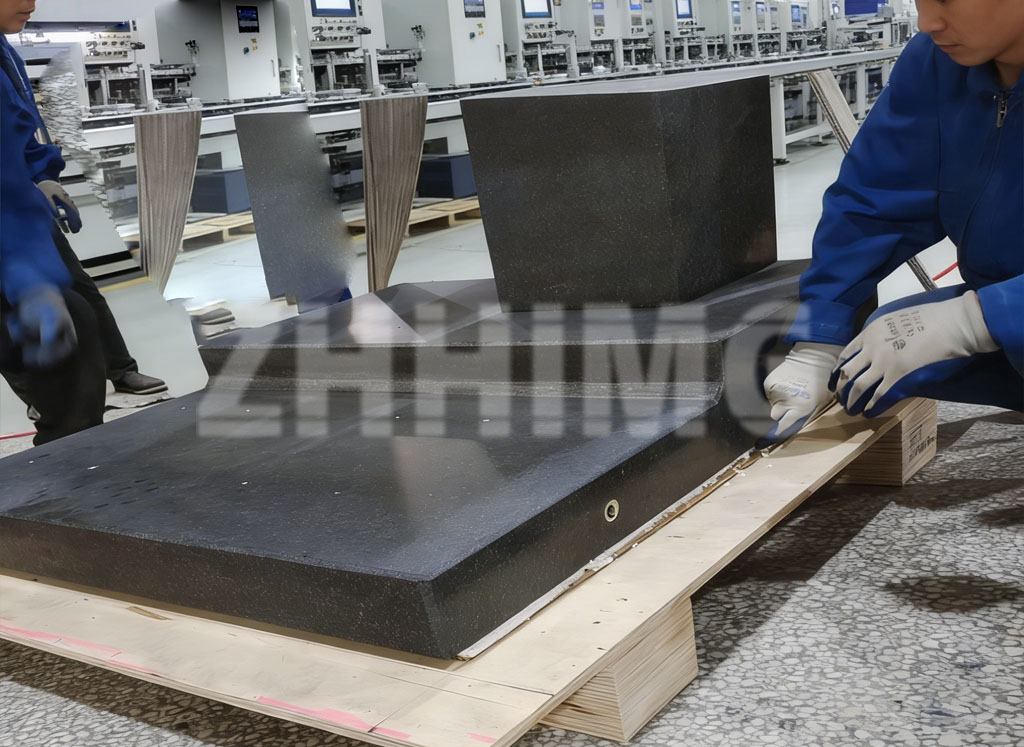
Intellectual Property Protection in International Trade
When outsourcing custom precision structures, protecting proprietary blueprints and system designs is paramount. Working with a supplier that has an established, internationally recognized intellectual property footprint is essential.
Securing international trademarks and over 20 distinct patents through authorized agencies like the CCPIT Patent and Trademark Law Office across the EU, the United States, and Southeast Asia proves that a manufacturer operates legitimately within the global legal framework, protecting client designs from IP leakage.
Global Logistics Infrastructure and Capacity
A supplier’s geographic and physical capacity dictates their ability to fulfill international contracts.
-
Port Proximity: Facilities located near major deep-water shipping hubs, such as Qingdao Port, significantly reduce inland transit transit times and lower the risk of shipping damage to sensitive granite structures.
-
Scale of Production: A massive production footprint (e.g., two factories spanning 200,000 m² with a dedicated 20,000 m² material yard) ensures a reliable supply of raw stone. Four dedicated production lines capable of outputting thousands of precision components monthly protect global buyers from supply bottlenecks.
By verifying these compliance and logistical metrics, procurement professionals can confidently secure manufacturing partners capable of delivering high-tonnage, ultra-precision components on schedule.
Post time: Jun-15-2026