
The production of ultra-precision structural components requires more than advanced CNC machinery. Without strict isolation from ambient seismic and industrial vibration, achieving sub-micron geometric tolerances is impossible. Every passing vehicle, nearby overhead crane, and climate control compressor introduces micro-seismic waves that can ruin the lapping and calibration of precision granite bases, air bearings, and ceramic components.
To mitigate this, industrial facilities must treat the manufacturing floor as an integrated component of the metrology system.
The Physics of Foundation Rigidization
Standard industrial concrete floors are typically 150 mm to 300 mm thick. While sufficient for standard logistics and heavy assembly, they are entirely inadequate for nanometer-level manufacturing. Under dynamic loads, standard flooring acts like a diaphragm, transmitting low-frequency floor vibrations directly into the workpieces.
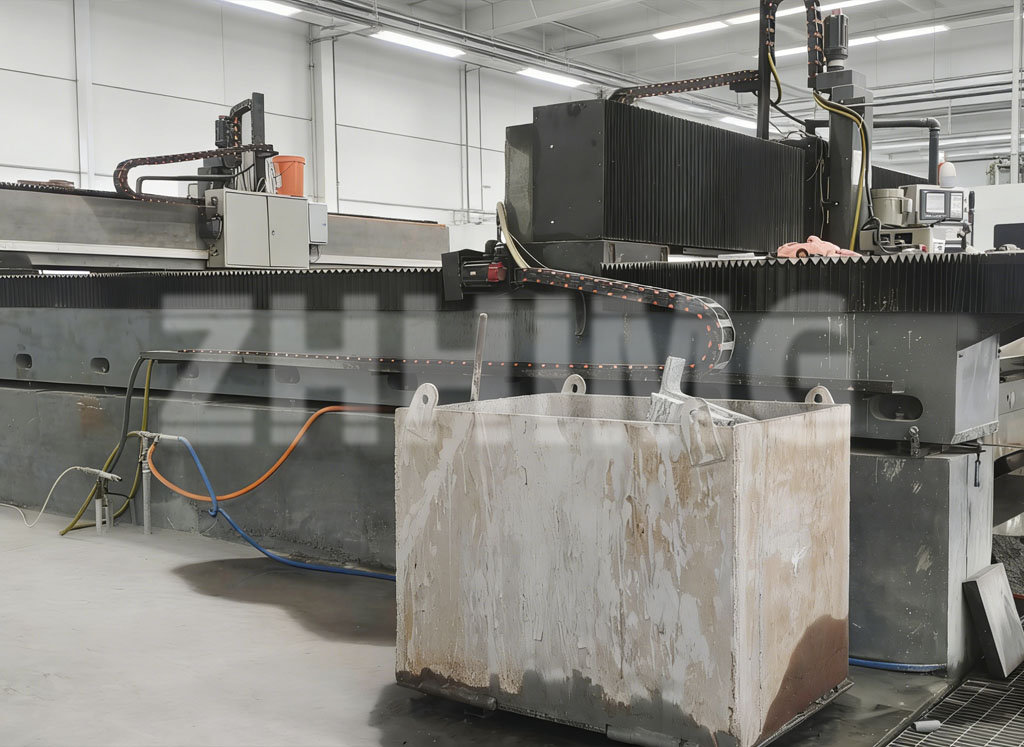
To eliminate this vector of error, advanced production environments implement a multi-layered infrastructure strategy:
-
Ultra-Thick Military-Grade Foundations: Pouring reinforced concrete to a minimum depth of 1000 mm provides a massive inertial block. This mass dampens low-frequency waves (1 – 10 Hz) before they reach the machinery.
-
Perimeter Isolation Trenches: Cutting dedicated vibration-isolation ditches around production zones—with precise dimensions such as 500 mm width and 2000 mm depth—physically decouples the precision manufacturing zone from the rest of the facility. These trenches are filled with specialized energy-absorbing elastomeric materials to attenuate lateral shockwaves.
-
Acoustic and Mechanical Silencing: Overhead cranes and gantry hoists are a major source of low-frequency noise and structural vibration. Utilizing custom acoustic-insulated, silent-running overhead travel systems prevents acoustic pressure waves from destabilizing sensitive electronic levels and laser interferometers during measurement cycles.
Environmental Synchronization: Temperature and Humidity
Thermal expansion is the single largest contributor to geometric error in precision granite and ceramic manufacturing. A temperature shift of just 0.5 ℃ can cause a 5000 mm granite bed to flex beyond allowable tolerances.
To achieve consistent accuracy, the processing and assembly environment must adhere to strict parameters:
-
Total Environmental Enclosure: Manufacturing should occur within large-scale, enclosed cleanrooms (e.g., 10,000㎡) where temperature is locked at 20℃ ± 0.2℃ and relative humidity is tightly regulated.
-
Air Velocity Management: Laminar airflow systems must be designed to avoid direct, high-velocity air drafts on the granite surfaces, preventing localized thermal gradients.
-
Semiconductor Cleanroom Simulation: Final assembly of multi-axis granite gantries, linear motor stages, and ultra-precision air bearings requires specialized, dust-free environments that mimic the end-user’s semiconductor fab. This ensures that no particulate contamination interferes with air-bearing gaps, which typically measure between 5μm and 15μm.
Summary
Ultra-precision manufacturing cannot exist in a standard industrial environment. The stability of the factory floor, the structural isolation of the foundations, and the absolute control of cleanroom thermodynamics form the baseline of metrological capability. Investing in massive inertial foundations and perimeter isolation is the only proven method to ensure that sub-micron manufacturing remains stable, repeatable, and traceable.
Post time: Jun-15-2026