
The core beam of high-speed gantry equipment is subjected to years of high-speed slide reciprocation, acceleration & deceleration shocks and alternating loads. Many machines pass precision inspection at commissioning, yet their reference drifts gradually after a period of operation and requires frequent shutdown for calibration. Such problems mostly stem from slow release of residual stress inside components. Unlike simple static placement, bulk aging treatment is a complete process developed by ZHHIMG for long-span granite beams. Systematic stress relief is performed on the entire beam to maintain stable geometry and lasting dimensional precision under years of high-frequency reciprocating working conditions.
1. Distinguish Conventional Static Storage From Bulk Aging; It Is Not Simply Storage
Many fabricators understand aging for granite components merely as “placing workpieces in a constant-temperature workshop for a period”. This simple static rest only releases a small amount of surface stress and cannot address deep-seated machining stress accumulated within the cross-section of long beams.
ZHHIMG bulk aging is a full-component control process for systematic stress balancing of the entire beam. The aging sequence runs through rough machining, semi-finishing and embedded assembly stages. After each material removal and sleeve insertion, the beam is placed under constant temperature with supports tailored to its mechanical characteristics for holistic relaxation. Its core goal is to fully release stress at different depths inside the stone rather than only at the surface. Long-span beams feature large cross-sections and heavy mass with uneven internal stress distribution. Only bulk aging can balance stress across the whole beam and prevent trapped local stress from deforming the beam gradually after machine installation.
2. Support Layout During Bulk Aging Ensures Natural Stress Relaxation
Support configuration during aging directly determines the real effect of stress release. Improper support points introduce additional bending moment from the beam’s self-weight, artificially suppressing internal stress. Although precision appears stable temporarily, latent stress will be unleashed once the beam is mounted under different support conditions, resulting in beam bending and torsion.
During bulk aging, ZHHIMG customizes multi-point support schemes for each long-span granite beam. Supports are arranged in low bending-moment zones to keep the beam in a naturally relaxed state without extra forced bending. The material of support blocks and flatness of contact surfaces are strictly controlled to avoid local indentation and new stress. Stress is released synchronously across all regions of the whole beam without local stress masked by self-weight. Straightness and torsion are continuously monitored during aging. The bulk aging phase is only completed when collected data remains stable for consecutive days.
3. Interleave Bulk Aging Within Machining Processes to Release Stress Gradually
Granite itself contains no casting stress, yet cutting, grooving, grinding and embedding introduce new machining stress. Conducting aging after all machining is finished locks massive stress inside the component and makes stress release extremely difficult.
ZHHIMG interleaves bulk aging throughout the full production workflow. After rough machining with substantial stone removal, the first round of bulk aging is carried out to release primary stress from heavy stock removal. After semi-finish grinding, the second bulk aging eliminates secondary stress from semi-finishing. After embedded sleeve assembly, another bulk aging cycle releases local assembly stress caused by metal insert embedding. Multiple rounds of progressive bulk aging release stress generated by different processes step by step and prevent stress accumulation inside finished components. Final fine grinding of reference surfaces takes place after all aging procedures, directly trimming minor deformation formed during aging. The delivered finished beam already reaches a stress-stable state.
4. Adapt to High-Speed Reciprocating Alternating Loads and Resist Deformation Induced by Dynamic Stress
Working loads on gantry beams are not static fixed loads. As the slide travels back and forth, load positions keep shifting, and repeated inertial shocks continuously disturb internal stress inside the stone. If residual stress remains within the component, alternating loads will accelerate stress release and slowly deform the beam, shifting the reference of guide rails and linear scales.
ZHHIMG granite beams treated by bulk aging feature a balanced internal stress field. Under long-term high-speed reciprocating motion and frequent acceleration-deceleration shocks, large-scale stress release will not be triggered by alternating loads. Even after years of continuous operation, key geometric indicators including beam straightness, parallelism and torsion remain stable without gradual deformation over runtime. For semiconductor inspection and laser precision machining equipment requiring stable continuous operation for many years, this greatly reduces machine downtime for calibration. 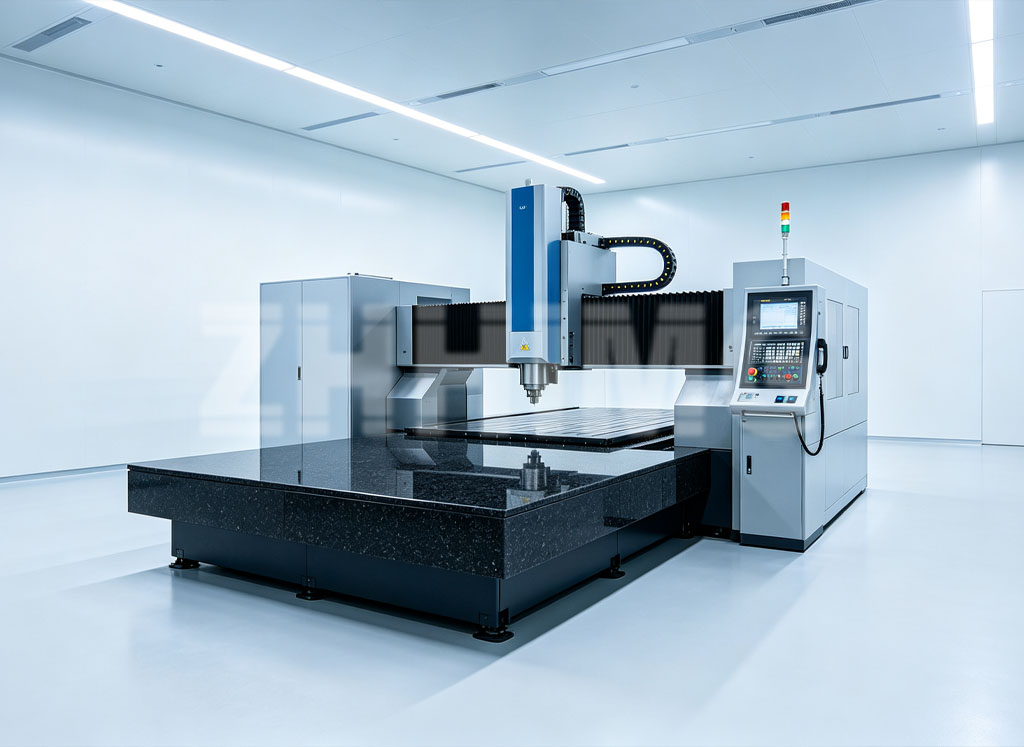
5. Counteract Superposition Effect of Ambient Temperature Variation to Further Reinforce Dimensional Stability
Workshop environments have day-night temperature differences and local temperature rise from machine heat generation. Temperature gradients create additional thermal stress inside components. If residual stress exists in the workpiece, temperature fluctuation amplifies stress release trends and accelerates deformation.
With balanced internal stress, bulk-aged granite beams avoid deformation induced by superposition of temperature fluctuation and original residual stress. Combined with granite’s ultra-low thermal expansion coefficient, it suppresses dual risks: thermal deformation and stress-release deformation under slight temperature swings. Even after stress relief, metallic beams retain high thermal expansion coefficients and inevitably suffer stretching, shrinking and bending from temperature changes. In contrast, bulk-aged granite beams achieve dual guarantees: intrinsic thermal stability of the material and stabilized internal stress, securing long-term dimensional precision.
6. Finished-Part Validation Tests to Confirm Qualified Bulk Aging
Completion of bulk aging does not mark the end of the process. Special validation tests must verify stable stress status. ZHHIMG performs flip retesting on beams after aging: repositioning support points and measuring geometric data at multiple positions using laser interferometers and high-precision electronic levels after a resting period.
Inadequate bulk aging will lead to obvious geometry changes once support conditions are altered. A beam is approved only after repeated flipping and retesting with consistent straightness and torsion data. Only validated beams proceed to final fine grinding and factory inspection. This prevents workpieces with incomplete stress relief from entering machine assembly and eliminates hidden risks of slow deformation after customer installation.
Conclusion
Long-term dimensional failure of long-span granite beams usually originates from residual stress trapped during machining, which releases gradually under alternating loads and temperature changes. Bulk aging treatment is not simple static storage; it is a complete stress-balancing process featuring multi-stage cycles, customized supports and continuous monitoring for the whole beam. ZHHIMG fully releases and balances internal stress via interleaved multi-round bulk aging, tailored support schemes and finished-part flip verification. When installed on high-speed gantry equipment for years of reciprocating operation, the beam maintains stable geometry, reduces reference drift and cuts machine maintenance costs, providing a long-term reliable mounting reference for precision transmission systems.
Post time: Oct-10-2026