
Long-span granite beams serve as core load-bearing components for high-speed gantry equipment. A large volume of stone material is removed during machining processes such as cutting, rough grinding and grooving, which builds up internal processing stress on the surface and inside the material. Poor internal stress control will lead to gradual stress release during storage, transportation or machine operation, causing beam bending and torsion and impairing the reference straightness for guide rails and linear scales. Many clients mistakenly believe granite is inherently stress-free and ignore secondary stress induced by machining, which eventually results in reference drift after delivery. Drawing on years of experience manufacturing long-span granite components, ZHHIMG introduces a full-chain solution for internal stress control of long-span precision granite beams, covering process sequence, temperature-controlled aging, machining strategy and inspection validation.
1. Understand Sources of Granite Machining Stress, Distinct From Casting Stress in Metals
Natural granite raw material has undergone geological aging over hundreds of millions of years and contains no casting residual stress found in cast iron. However, during mechanical processing, cutting by diamond tools and grinding by abrasive wheels create mechanical compression and friction heat. Crystals on the stone surface are squeezed and slipped, forming surface residual stress. Especially for long beams with weight-reduction cavities and large-section cutting, massive material removal breaks the original internal force balance and triggers stress redistribution.
Such processing stress is latent and will not manifest immediately. When subjected to ambient temperature fluctuations, vibration disturbance or long-term alternating loads, stress releases slowly and alters the geometric shape of the beam. Stress magnitude is strongly correlated with cutting parameters, single cutting allowance and machining sequence, which explains why long-span components are far harder to control than small granite parts.
2. Gradient Aging in Stages to Release Accumulated Processing Stress Layer by Layer
Heavy cutting in one go generates concentrated massive stress. ZHHIMG adopts a process route of staged machining plus graded static aging, instead of machining directly to final dimensions in one pass.
In the rough machining stage, basic cutting for outer profiles, weight-reduction cavities and pre-reserved embedded holes is completed while leaving appropriate finishing allowance. After roughing, beams are transferred to constant-temperature workshops for prolonged static aging to release primary stress from cutting and heavy stock removal. The constant-temperature environment eliminates additional thermal stress caused by temperature swings and allows crystals inside the stone to slowly rebalance.
After aging, semi-finish grinding is performed, followed by another static aging cycle to release secondary stress introduced by semi-finishing. Final fine grinding of reference surfaces and embedded sleeve assembly are carried out afterwards. Embedding also brings local assembly stress, so a short constant-temperature static aging step is added after embedding to eliminate local stress disturbance. Gradient aging releases stress progressively within the production workflow and prevents continuous stress release after product delivery.
3. Optimize Machining Strategy to Reduce Stress Generation at Source
Relying solely on aging is a passive measure. Optimizing cutting tactics can directly lower stress generation. For long-span beams, ZHHIMG adjusts machining tool paths and adopts symmetric processing schemes, removing material alternately on left-right and top-bottom sides to avoid unilateral stress accumulation caused by bulk stone removal on one side.
Single grinding allowance is controlled to reduce surface compression from grinding wheels and lower residual compressive stress on the granite surface. Meanwhile, grinding cooling conditions are managed to limit temperature rise and prevent thermal stress induced by uneven local temperature. For weight-reduction cavities and deep grooves, layered cutting is applied instead of one-shot through cutting to reduce stress concentration from abrupt section changes.
Many manufacturers pursue efficiency by performing fine grinding right after roughing, sealing large amounts of stress inside the component. Precision may pass inspection in the short term, yet deformation emerges after long service. ZHHIMG balances productivity and stress control in process design, prioritizing long-term dimensional stability.
4. Constant-Temperature Environment for Fine Machining and Stress Stabilization
Temperature fluctuations trigger stone expansion and contraction, interfere with stress release and introduce new thermal stress. The longer the beam, the more obvious deformation caused by temperature gradients.
All static aging, semi-finish grinding and fine grinding of ZHHIMG take place in constant-temperature, constant-humidity and dust-free workshops. Stable workshop temperature minimizes temperature differences across different positions of the beam and ensures stress releases slowly under steady conditions. During static aging, beams are supported evenly at multiple points rather than single-point or narrow-strip support. Improper support will create additional bending stress from the beam’s self-weight, superimposed with original processing stress. This distorts the real stress state and leads to inaccurate aging evaluation. Support points are placed in low bending-moment zones to keep the beam in a naturally relaxed state. 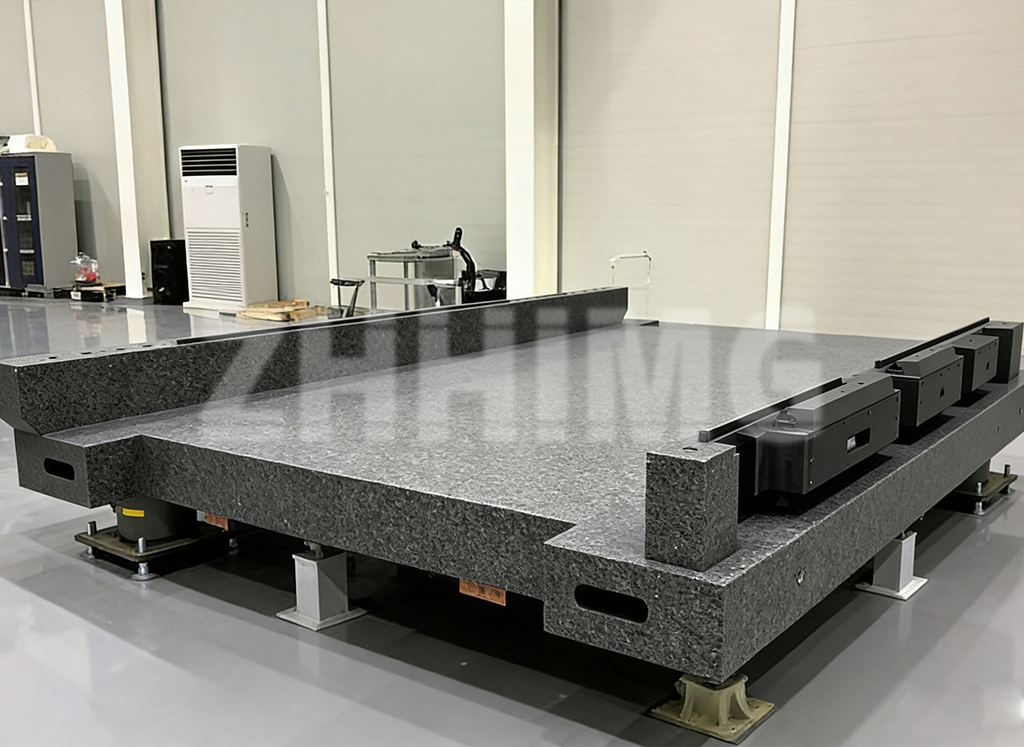
5. Avoid Superposition of Assembly Stress During Embedding
Mounting embedded sleeves for guide rails and linear scales generates local compressive stress on granite. Improper scheduling of embedding will cause assembly stress to overlap with processing stress and raise deformation risks in later stages.
ZHHIMG arranges embedding after rough machining and the first round of aging, before fine finishing. After sleeve insertion, the workpiece undergoes another constant-temperature static aging cycle to release local stress from embedding. Once stress is relieved, final fine grinding of reference surfaces is performed to remove minor deformation introduced by embedding. This process sequence prevents embedding stress from releasing in the finished product and avoids secondary deformation of reference planes.
6. Stress Status Inspection and Deformation Verification to Qualify Workpieces
Internal stress inside granite cannot be observed visually. ZHHIMG implements a finished-product validation mechanism to assess stress release results for long beams. After aging, high-precision electronic levels and laser interferometers are used to measure beam straightness and torsion at multiple points. Then the beam is repositioned on alternative supports and retested after a period of time.
Flip-support testing is an effective verification method. If residual internal stress remains high, the geometric shape of the beam will change significantly once supporting conditions are altered. Workpieces are only approved for the next process when repeated measurement data stays stable. This inspection screens components with excessive stress in advance and prevents slow deformation after customer installation and machine operation.
Conclusion
Internal stress of long-span precision granite beams is not inherent in the stone itself; it mainly originates from cutting, grinding, grooving and embedding assembly. The core principle of stress control is not total stress elimination, but progressive staged release, source-side stress reduction, static stabilization under constant temperature and supporting validation tests. With gradient machining and graded constant-temperature aging processes, paired with symmetric cutting, proper support and flip retesting, ZHHIMG maintains residual processing stress at an extremely low level. This guarantees stable reference geometry of long-span granite beams under long-term high-speed reciprocating operation in gantry equipment and avoids precision drift caused by stress release.
Post time: Oct-10-2026