
The granite beam of high-speed gantry equipment carries linear motors, sliding tables, linear scales and detection modules. When the slide moves back and forth rapidly across the beam span, the load position keeps changing and easily triggers dynamic deflection. Once beam deflection occurs, guide rail parallelism and straightness of grating references shift accordingly, directly causing positioning deviation and machining defects. Many people assume granite’s high rigidity means it cannot bend. However, under large-span and variable-load high-speed reciprocating conditions, stone can still produce tiny elastic deflection. Drawing on mechanical simulation and on-site measurement data from numerous gantry projects, ZHHIMG presents a complete set of solutions to avoid deflection of granite beams under high-speed reciprocating conditions from multiple dimensions: structural design, raw material selection, processing technology and load distribution.
1. Topological Section Optimization Based on Dynamic Load Simulation to Improve Bending Modulus
Static design only calculates loads at fixed points, while high-speed reciprocating motion belongs to moving variable-load working conditions: as the slide travels from one end of the beam to the other, the center of gravity of the load shifts continuously, and the position of maximum bending moment changes in real time with the slide position. Simply thickening the stone will sharply increase self-weight and inertia, which is not the optimal solution.
At the preliminary project stage, ZHHIMG carries out full-machine dynamic simulation to simulate bending moment distribution under full-speed reciprocation and start-stop impact of the slide. It optimizes the beam cross-section profile in a targeted manner. Sufficient solid thickness is retained in regions with concentrated bending moments, and reasonably arranged weight-reduction cavities are opened in non-stressed areas to form a box-type cross-section with high bending resistance. Using high-density granite raw material with a density of approximately 3100kg/m³, it maximizes the section moment of inertia while controlling overall self-weight and reduces deflection caused by unit load to restrain elastic deflection from the source.
Different from simple cuboid stone blocks, the topologically optimized cross-section uniformly disperses stress and prevents bending deformation induced by local stress concentration.
2. Reasonable Layout of Support Points to Shorten Effective Bending Span
Deflection is proportional to the cube of the supporting span, so span is the most sensitive factor affecting bending. Many equipment designers only focus on the total beam length while ignoring the arrangement of supporting fulcrums.
For long-span gantry beams, ZHHIMG collaborates with equipment manufacturers to plan support points and shorten the effective force-bearing span as much as possible. For extra-long beam specifications, split splicing schemes are evaluated with high-precision granite splicing technology. The splicing surfaces are finely ground and stress-matched. After splicing, the overall bending performance is close to an integrated monolithic component, avoiding the huge deflection risk brought by a single ultra-long beam. Meanwhile, rigid support structures are adopted for support seats to prevent deflection of seats themselves from amplifying beam bending. Support points are arranged away from peak bending moment zones to control the bending amplitude caused by moving loads at the micron level.
3. Control Load Center of Gravity to Reduce Additional Overturning Bending Moment
During high-speed reciprocating motion, the slide and motor module not only generate vertical downward pressure. Horizontal inertial force occurs at the instant of acceleration and deceleration, forming an overturning moment that further induces beam bending and torsion. If the module center of gravity is high, the overturning moment will significantly amplify dynamic deflection.
At the beam structural design stage, ZHHIMG reserves low-position mounting reference surfaces, guiding customers to assemble linear motors and slide modules with low center of gravity to reduce overturning moment. Meanwhile, the beam cross-section torsional performance is optimized to satisfy both bending and torsion resistance and suppress torsional deflection caused by rapid slide reversal. Torsional deformation is easily overlooked in many projects. Torsional deflection causes inconsistent heights on both sides of guide rails and brings hard-to-troubleshoot positioning errors. Cross-section optimization of ZHHIMG granite beams covers both bending and torsion resistance indicators.
4. Raw Material Aging and Constant-Temperature Precision Machining to Eliminate Latent Deformation Induced by Residual Stress
Apart from elastic deflection caused by external loads, release of processing residual stress leads to slow permanent deformation. Internal processing stress is generated during stone cutting and rough grinding. If the stress is not released in advance, it will be released gradually under alternating reciprocating loads after equipment commissioning, and the beam will bend slowly over time.
ZHHIMG selects granite substrates that have undergone hundreds of millions of years of natural aging. The raw material itself contains no casting residual stress. After rough machining, beams are statically aged for a long time in constant-temperature workshops to gradually release processing stress from cutting and rough grinding. All fine grinding, reference surface machining and embedded sleeve assembly are completed in constant-temperature, constant-humidity and dust-free workshops to avoid new stress introduced by temperature fluctuation during processing. This ensures no permanent bending caused by stress release under high-speed reciprocating loads after delivery. 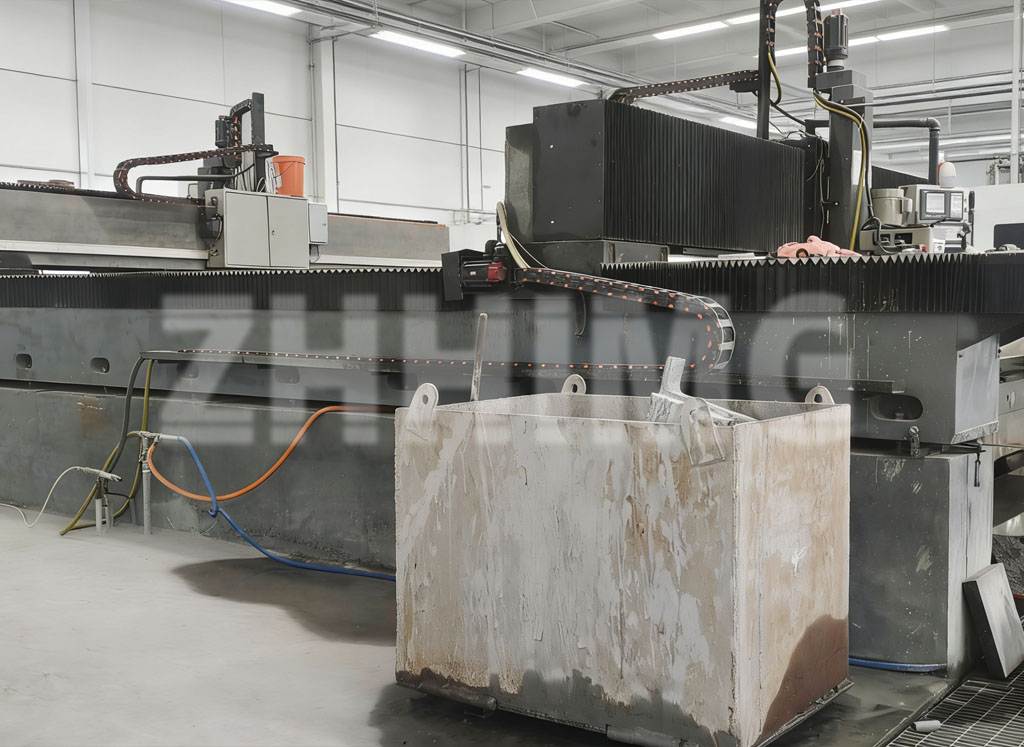
5. Integrated Embedding and Assembly Technology to Prevent Local Load Concentration
Local stress concentration at mounting points of guide rails, gratings and motors may result in local depression or partial beam bending, manifested as reference surface deformation varying with slide position. Direct drilling and bolt locking in ordinary assembly easily create local stress points on stone, and the problem gradually amplifies under high-speed reciprocating vibration.
ZHHIMG adopts mature embedded sleeve technology. Metal sleeves are pre-embedded inside granite beams to evenly distribute loads over a wide area of the stone matrix and avoid local stress concentration caused by point compression of bolts. The embedding process is completed before fine grinding. After embedding, static aging is performed again to eliminate minor stress introduced by embedding. Fine grinding of reference surfaces is carried out after embedding to guarantee flatness of mounting references for guide rails and gratings, preventing local deflection caused by partial pressure from fasteners.
6. Supporting Full-Machine Compensation Scheme to Further Offset Tiny Dynamic Deflection
Even with extreme structural optimization, large-span beams still have micron-level elastic deflection under moving high-speed loads. This is an inherent elastic property of materials and cannot be completely eliminated, yet its impact can be offset via supplementary solutions.
At the factory inspection stage, ZHHIMG uses laser interferometers and high-precision electronic levels to measure the deflection curve of the beam under different slide positions and delivers deflection data to equipment manufacturers. Manufacturers can write this curve into the CNC system for real-time dynamic compensation. When the slide moves to the corresponding position, the system automatically corrects axes to offset positioning errors from tiny deflection. This combined strategy of structural suppression plus software compensation reduces the accuracy impact of deflection down to the nanometer level, meeting stringent requirements of semiconductor, laser micro-machining and other high-precision scenarios.
Conclusion
Deflection of granite beams under high-speed reciprocating conditions originates from moving variable loads, bending span, overturning moment and internal residual stress. ZHHIMG reduces beam deflection amplitude from the source through dynamic load simulation for structural cross-section optimization, rational planning of supporting fulcrums, lowering module center of gravity, together with raw material aging, constant-temperature precision machining and load dispersion embedding technology. Combined with deflection measurement and CNC dynamic compensation, the influence of elastic bending is controlled within allowable limits. The complete solution enables granite beams to maintain flat and stable references for guide rails and gratings in long-span, high-frequency reciprocating high-speed gantry equipment and avoid accuracy loss triggered by deflection.
Post time: Oct-10-2026