
During slide start-stop, rapid direction reversal and scanning motion of high-speed gantry equipment, continuous vibration is generated. Apart from visible large tremors, numerous barely detectable micron-scale micro-vibrations transmit directly to guide rails, linear scales and optical detection assemblies, causing jumping positioning data and uneven machining texture. Metallic components such as cast iron and aluminum alloy show slow vibration decay, and tiny disturbances sustain oscillation. Benefiting from internal friction at mineral grain boundaries, granite beams feature outstanding shock absorption, which rapidly absorbs and dissipates micro-vibration induced by high-speed motion. Based on measured data from many gantry projects, ZHHIMG analyzes the vibration absorption mechanism of granite beams and their engineering value in high-speed machines.
1. Underlying Vibration Absorption Principle of Granite: Grain Boundary Damping, Different From Vibration Decay Mechanism of Metals
Metals transfer vibration through intermolecular forces. After impact, vibration energy has a long decay cycle and residual vibration persists. Natural granite is densely composed of intertwined mineral grains with tiny interfaces between grains. When vibration enters the stone matrix, micro-slip and friction occur between grains, converting kinetic vibration energy into heat and dissipating it quickly — this is the inherent material damping.
This is an innate property of granite without the need for extra shock-absorbing additives. ZHHIMG adopts high-density granite raw material with compact crystal arrangement and superior internal damping. When high-speed reciprocating motion generates high-frequency micro-vibration, vibration energy is rapidly absorbed once inside the beam, preventing continuous propagation along the beam and suppressing the micro-vibration transmission path at the source.
2. Isolate Dynamic Excitation of Slides and Block Micro-Vibration Transmission to Upstream Optical and Detection Units
Dynamic excitation generated by linear motors and slides during acceleration and deceleration of high-speed gantries spreads outward as a vibration source. If the beam has poor vibration absorption, vibration propagates along the beam matrix and disturbs gratings, optical lenses and detection probes mounted on the beam. Such micro-vibration has tiny amplitude yet high frequency, which imposes severe impacts on nano and micron-level detection and machining.
In the structural design phase, ZHHIMG optimizes cross-section profiles through modal simulation combined with material damping characteristics. When the slide generates excitation during high-speed movement, the beam as the load-bearing substrate directly absorbs most micro-vibration energy and cuts off vibration transmission paths, preventing vibration from reaching precision components installed above the beam. Even with continuous high-frequency reciprocation of the slide, gratings and optical parts fixed on the granite reference surface work in a relatively quiet environment, reducing jumping detection data.
3. Absorb Ground-Borne Micro-Vibration From External Environment to Form a Secondary Vibration Barrier
Operation of surrounding machine tools, air compressors and conveying equipment in workshops continuously generates low-frequency ground micro-vibration. Such environmental disturbances transmit through machine bases to beams and easily interfere with precision machining. Metallic beams can only passively bear ground vibration, and vibration penetrates the whole transmission structure.
The high-damping property of granite beams addresses dual disturbances: dynamic vibration generated by the equipment itself and environmental micro-vibration transmitted from outside. With reasonable self-weight, heavy-duty ZHHIMG granite beams rely on large-mass inertia to resist excitation from external micro-vibration while absorbing incoming vibration energy via crystal damping. Self-weight and material shock absorption work together to build a dual-layer vibration barrier and reduce disturbance to motion axes, suitable for production workshops shared by multiple machines. 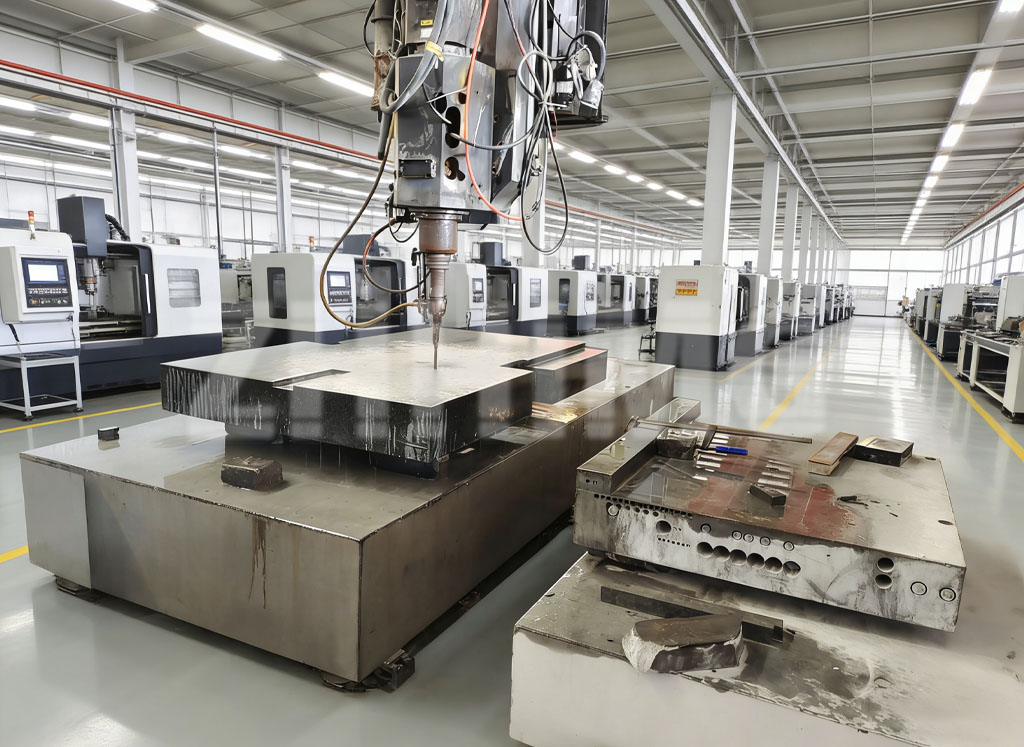
4. High-Speed Short-Stroke Scanning Scenarios: Shorten Settling Time and Boost Machine Cycle Efficiency
In high-frequency short-stroke reciprocating applications such as laser scanning and semiconductor inspection, every slide reversal creates impact vibration. After impact, metallic beams require long waiting time for vibration to fully decay before data acquisition or machining can proceed. This waiting period directly reduces overall productivity.
Granite beams realize fast vibration absorption; micro-vibration decays within an extremely short time. No long settling wait is needed after positioning. Field test data from ZHHIMG projects proves that granite beams greatly shorten settling time under high-frequency scanning conditions. The machine maintains continuous high-speed cycles, raising throughput while eliminating machining texture defects and detection noise caused by micro-vibration. This is one of the core advantages for high-speed precision gantries to select granite beams.
5. Stable Vibration Absorption Performance Without Degradation Over Long Service Life
Polymer vibration damping accessories such as damping pads and adhesive will age and creep under long-term alternating loads, with damping performance declining year by year. Cast iron retains relatively stable material damping, yet stress release induces structural deformation and changes the whole machine’s modal and vibration characteristics.
ZHHIMG granite beam raw material has undergone hundreds of millions of years of geological aging with stable mineral crystal structures and no aging over time. Static aging in constant-temperature workshops eliminates residual machining stress. After years of high-speed reciprocating operation, the crystal interface structure inside the material remains unchanged. Vibration absorption and damping performance stay stable long-term without degradation. The vibration suppression effect maintains the original level throughout the multi-year machine lifecycle, lowering maintenance costs for part replacement and re-calibration.
6. Supporting Processes to Amplify Vibration Absorption Advantages and Avoid Local Vibration Amplification
Material damping is the foundation, while machining and embedding processes affect overall vibration performance. Insufficient rigidity at guide rail and grating mounting points triggers local resonance, offsetting the inherent vibration absorption of granite.
ZHHIMG adopts embedded sleeve technology to evenly distribute fastener loads across the stone matrix. Mounting reference surfaces are nano-finished in constant-temperature workshops, so guide rails and gratings tightly fit onto granite reference planes and reduce local micro-vibration caused by assembly gaps. Meanwhile, structural simulation helps avoid resonance frequency bands and prevents coincidence between high-speed excitation and the beam’s natural frequency, which would otherwise trigger severe resonance. This ensures the full exertion of granite’s vibration absorption capacity.
Conclusion
Micro-vibration in high-speed gantry equipment comes from multiple sources: dynamic impact during slide acceleration and deceleration, plus environmental disturbances from the workshop. With natural internal damping at mineral grain boundaries, granite beams rapidly absorb and dissipate vibration energy and effectively eliminate micro-vibration interference. Leveraging high-density granite raw material, structural modal simulation, precision embedding and constant-temperature machining processes, ZHHIMG fully unlocks the excellent vibration absorption performance of granite beams. In high-speed reciprocating and high-frequency scanning applications, the beams protect gratings and optical assemblies from micro-vibration and guarantee stable machining and inspection precision.
Post time: Oct-10-2026