
In precision engineering and dimensional metrology, the selection of measuring instrument materials is no longer a secondary design decision—it is a core performance determinant. As industries move toward higher automation, faster throughput, and tighter tolerances, the demand for lightweight yet ultra-stable metrology solutions has accelerated significantly. Among the most widely discussed material options today are ceramic measuring instruments and traditional granite gages. Each material offers distinct advantages in weight, stability, and lifecycle cost, and the choice between them increasingly depends on application-specific requirements rather than general preference.
Historically, granite has been the dominant material in precision measurement environments. Its widespread use in surface plates, inspection tables, and reference bases is rooted in its exceptional dimensional stability, vibration damping characteristics, and long-term durability. However, the rise of advanced engineering ceramics—such as alumina-based and silicon carbide-based materials—has introduced a new competitive alternative. These materials are significantly lighter than granite while offering comparable or, in some cases, superior stiffness and thermal performance.
The most immediately noticeable difference between ceramic measuring instruments and granite gages is weight. Granite is dense and heavy, which contributes to its stability but also introduces handling and installation challenges. Large granite precision gages often require specialized lifting equipment and careful foundation preparation, particularly in high-accuracy metrology laboratories. In contrast, engineered ceramics provide a much higher stiffness-to-weight ratio. This allows for lighter structures that are easier to transport, install, and integrate into automated systems. In modern production environments where modularity and flexibility are increasingly important, this weight advantage is becoming a decisive factor.
However, weight alone does not define performance. Stability under mechanical and thermal stress remains the most critical requirement for precision gages. Granite has long been valued for its excellent vibration damping properties. Its internal crystalline structure naturally dissipates vibrational energy, reducing the transmission of external disturbances into the measurement system. This is particularly important in environments with active machinery, where even low-level vibrations can affect measurement repeatability.
Ceramic materials, while not as naturally damping as granite, compensate through extremely high stiffness. This high modulus of elasticity reduces elastic deformation under load, which can improve geometric stability during measurement operations. In high-speed automated inspection systems, this rigidity can be beneficial, especially when combined with modern vibration isolation systems. However, ceramics typically require additional engineering solutions to address damping, whereas granite provides this property inherently.
Thermal behavior is another key differentiator between ceramic measuring instruments and granite gages. Temperature variation is one of the most significant sources of measurement error in precision metrology. Granite exhibits a relatively low coefficient of thermal expansion and responds slowly to environmental temperature changes due to its thermal mass. This makes it highly stable in fluctuating laboratory conditions.
Ceramic materials, depending on composition, can offer even lower thermal expansion coefficients than granite. Advanced ceramics such as silicon carbide are engineered specifically for ultra-stable thermal performance, making them highly suitable for applications where temperature-induced dimensional drift must be minimized. In high-end precision systems, this can translate into improved long-term measurement consistency, particularly in controlled environments where active thermal management is already in place.
Surface stability and wear resistance also play an important role in long-term performance. Granite gages are well known for their resistance to wear, corrosion, and surface degradation. Once lapped to high precision, granite surfaces maintain their flatness over extended periods with minimal maintenance. This makes them ideal for reference applications where long-term stability is more important than dynamic performance.
Ceramic measuring instruments offer even higher hardness and wear resistance than granite. Their surfaces are extremely resistant to scratching and deformation, which allows them to maintain geometric integrity under repeated use. However, ceramics can be more brittle, requiring careful handling to avoid chipping or impact damage. Granite, while also brittle compared to metals, generally exhibits more forgiving failure behavior in industrial environments.
Cost considerations remain a central factor in material selection. Granite is widely available and relatively cost-effective to process, especially for large-scale structures. Its machining techniques are well established, and supply chains are mature. This makes granite gages a cost-efficient solution for a wide range of precision applications, particularly in traditional manufacturing environments.
Ceramic measuring instruments, on the other hand, typically involve higher production costs. The raw materials, sintering processes, and precision machining required for engineering ceramics are more complex and energy-intensive. As a result, ceramic-based precision gages are often positioned in higher-end applications where performance justifies the investment. These include semiconductor manufacturing, aerospace inspection systems, and ultra-precision research environments.
Despite higher initial costs, ceramics can offer lifecycle advantages in certain scenarios. Their superior wear resistance and dimensional stability can reduce recalibration frequency and extend service life in high-duty applications. When evaluated from a total cost of ownership perspective, particarly in automated production lines, ceramics may provide long-term economic benefits despite higher upfront investment.
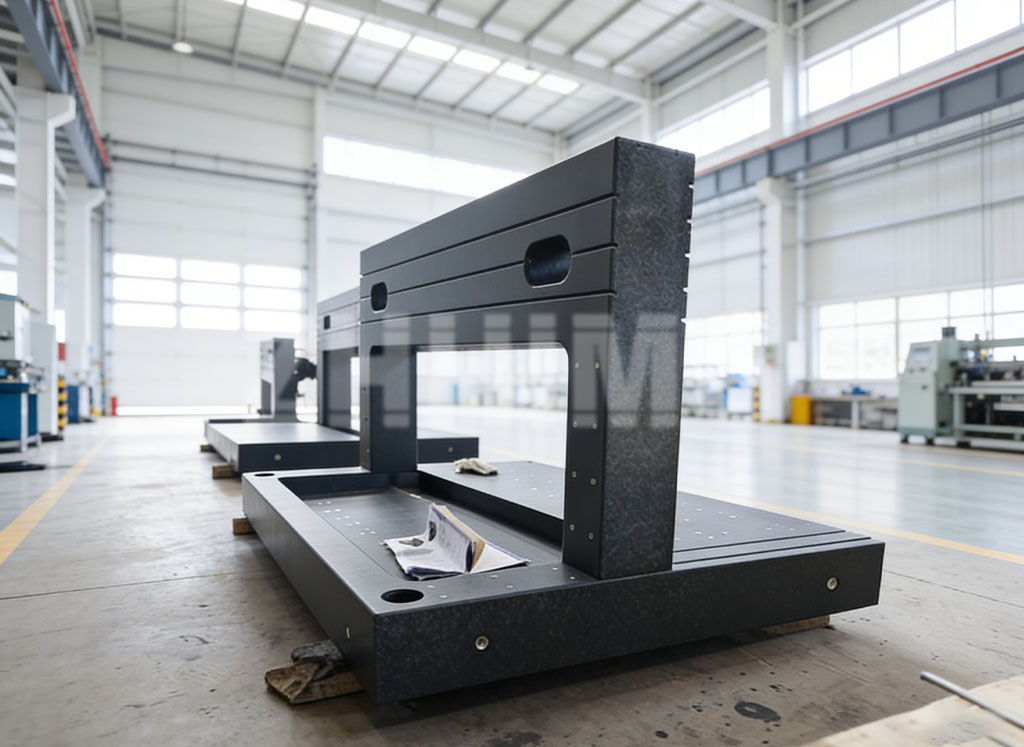
Another important aspect is design flexibility. Granite components are typically machined from natural stone blocks, which imposes certain geometric limitations. While modern CNC grinding and lapping techniques have significantly expanded design possibilities, complex internal structures or thin-walled designs can be challenging. Ceramics, being engineered materials, allow for more controlled manufacturing processes, enabling complex geometries that are difficult to achieve with natural stone. This makes them particularly suitable for integrated precision systems where structural optimization is critical.
In terms of application domains, granite gages continue to dominate in general-purpose metrology environments, calibration laboratories, and industrial inspection stations. Their balance of cost, stability, and durability makes them a reliable foundation for a wide range of measurement tasks. They are especially common in environments where robustness and ease of maintenance are prioritized over extreme performance optimization.
Ceramic measuring instruments are increasingly used in advanced manufacturing sectors where lightweight structures and ultra-high stability are required. In semiconductor wafer inspection, precision optics alignment, and aerospace component validation, ceramics provide a combination of stiffness, thermal stability, and design flexibility that supports next-generation measurement systems. As automation increases and measurement systems become more integrated into production lines, the demand for lightweight high-performance materials continues to grow.
It is also important to consider system-level integration. Modern precision gages are rarely standalone components; they are part of larger measurement ecosystems that include sensors, actuators, and digital control systems. In this context, material selection affects not only mechanical performance but also system responsiveness and integration efficiency. Lighter ceramic structures can improve dynamic performance in automated systems by reducing inertia, while granite structures provide a more passive but highly stable measurement foundation.
Looking forward, the competition between ceramic measuring instruments and granite gages is unlikely to result in one material fully replacing the other. Instead, the industry is moving toward hybrid optimization, where material selection is tailored to specific performance requirements. Granite will continue to be the standard for cost-effective, highly stable, general-purpose precision gages, while ceramics will expand their presence in high-performance, lightweight, and thermally demanding applications.
In conclusion, the comparison between ceramic and granite materials in precision gages is not a simple matter of superiority, but rather a balance of engineering trade-offs. Weight, stability, thermal behavior, cost, and design flexibility all play critical roles in determining suitability. Understanding these factors allows manufacturers and metrology engineers to select the optimal material for their specific application, ensuring that measurement systems achieve the required level of accuracy, reliability, and efficiency in an increasingly demanding industrial landscape.
Post time: Apr-23-2026