
Introduction: The Material Complexity Behind Precision Measurement
In the realm of industrial metrology, material selection is not merely a technical specification—it is a strategic decision that directly impacts measurement accuracy, operational efficiency, and long-term reliability. As manufacturing tolerances tighten from millimeters to microns and even nanometers, the choice between ceramic and granite measuring tools has become a critical consideration for procurement managers, engineers, and technical selection teams worldwide.
This performance showdown examines two of the most advanced materials in modern precision measurement: technical ceramics and natural precision granite. While both materials offer exceptional properties for metrology applications, their performance characteristics, cost structures, and optimal use cases differ significantly. Understanding these differences is essential for making informed investment decisions that align with specific operational requirements and budget constraints.
Material Properties Comparison: Engineering Fundamentals
Ceramic Measuring Tools: Engineered Excellence
Technical ceramics used in precision measurement are synthetic materials—typically alumina (Al₂O₃) or silicon carbide (SiC)—engineered to deliver extreme performance in demanding environments.
Key Properties:
-
Exceptional Hardness: With Vickers hardness reaching HV 1350, ceramic measuring tools significantly outperform steel (HV 800) and approach the hardness of many natural stones. This extreme hardness translates to superior wear resistance and long-term dimensional stability.
-
Near-Zero Thermal Expansion: Advanced ceramic materials can achieve thermal expansion coefficients as low as 3–6×10⁻⁶/°C, with some specialized formulations approaching zero expansion under controlled conditions. This property makes ceramics invaluable in temperature-sensitive measurement environments.
-
Chemical Inertness: Ceramics resist corrosion from acids, alkalis, and most industrial chemicals. They do not rust, conduct electricity, or react with magnetic fields, making them ideal for cleanroom, vacuum, and chemically aggressive environments.
-
Ultra-Smooth Surface Finish: Through precision grinding and polishing, ceramic surfaces can achieve roughness values below Ra 0.1 μm, reducing friction and measurement drag during repetitive operations.
Performance Trade-offs:
While ceramics offer remarkable material properties, they come with inherent limitations. Ceramics are brittle and susceptible to impact damage, requiring careful handling and protective protocols. Their manufacturing process—powder synthesis, sintering, and precision finishing—results in higher unit costs, particularly for large-format components where kiln size constraints apply.
Granite Measuring Tools: Nature’s Engineering Marvel
Precision granite represents a fundamentally different approach to metrology materials. Sourced from geological formations millions of years old, high-density black granite possesses a unique combination of stability and damping characteristics that synthetic materials struggle to replicate.
Key Properties:
-
Natural Dimensional Stability: Formed under extreme geological pressure over millions of years, precision granite has fully released internal stresses. This natural aging process eliminates warping and deformation risks, providing geometric stability that endures for decades.
-
Superior Vibration Damping: Granite’s crystalline microstructure dissipates mechanical energy efficiently, with damping ratios of 0.012–0.015—approximately ten times higher than cast iron. This inherent damping capability reduces measurement errors caused by environmental vibrations, machinery operation, or seismic activity.
-
Low Thermal Expansion: Granite exhibits thermal expansion coefficients around 4.5×10⁻⁶/°C, approximately one-third that of cast iron. Combined with high thermal mass, granite responds slowly and uniformly to temperature changes, minimizing localized distortion during measurement cycles.
-
Non-Magnetic and Corrosion-Resistant: Naturally immune to rust, magnetization, and chemical corrosion, granite operates reliably in humid, chemical-laden, or magnetically sensitive environments without protective coatings or special maintenance.
Manufacturing Advantages:
Unlike ceramics constrained by sintering kiln dimensions, granite can be precision-machined into very large formats. Advanced CNC grinding and lapping processes achieve flatness tolerances of 1–3 μm/m, with hand-finishing techniques enabling sub-micron accuracy for the most demanding applications.
Application Scenarios: Where Each Material Excels
Ceramic Measuring Tools: The Ultra-High-Precision Niche
Ceramic measuring instruments dominate specialized applications where their unique properties deliver measurable performance advantages:
Semiconductor Manufacturing:
- Wafer handling stages and alignment platforms where thermal neutrality and chemical resistance are paramount
- EUV lithography components requiring vacuum compatibility and extreme stiffness-to-weight ratios
- Inspection equipment operating in aggressive chemical environments (CMP, etching, cleaning)
Nanometer-Level Metrology:
- Atomic force microscopy (AFM) and scanning probe platforms where surface smoothness and thermal stability directly impact measurement resolution
- Optical interferometer bases where sub-nanometer stability is required
- Calibration standards for ultra-high-precision instruments
Extreme Environments:
- High-temperature measurement applications where metals would deform or oxidize
- Vacuum chambers and space simulation equipment
- Medical and pharmaceutical cleanrooms where sterility and chemical inertness are mandatory
Real-World Performance:
Leading semiconductor equipment manufacturers report that ceramic-based motion stages achieve positioning repeatability of ±2 nanometers in controlled environments—a level of precision that would be challenging to maintain with alternative materials over extended operation periods.
Leading semiconductor equipment manufacturers report that ceramic-based motion stages achieve positioning repeatability of ±2 nanometers in controlled environments—a level of precision that would be challenging to maintain with alternative materials over extended operation periods.
Granite Measuring Tools: The Industrial Workhorse
Granite’s versatility and reliability make it the dominant material for mainstream precision measurement applications across multiple industries:
Coordinate Measuring Machines (CMMs):
- Structural bases, bridges, and gantries providing stable reference frames for dimensional inspection
- Air-bearing platforms where surface flatness and vibration damping ensure measurement accuracy
- Large-format inspection systems spanning several meters, where granite’s manufacturability and cost-effectiveness are decisive
Precision Manufacturing:
- Machine tool bases and guideways for ultra-precision grinding, milling, and turning centers
- CNC granite components reducing thermal drift errors by 60% compared to polymer-concrete alternatives
- Assembly and inspection tables where flatness retention under load is critical
Metrology Laboratories:
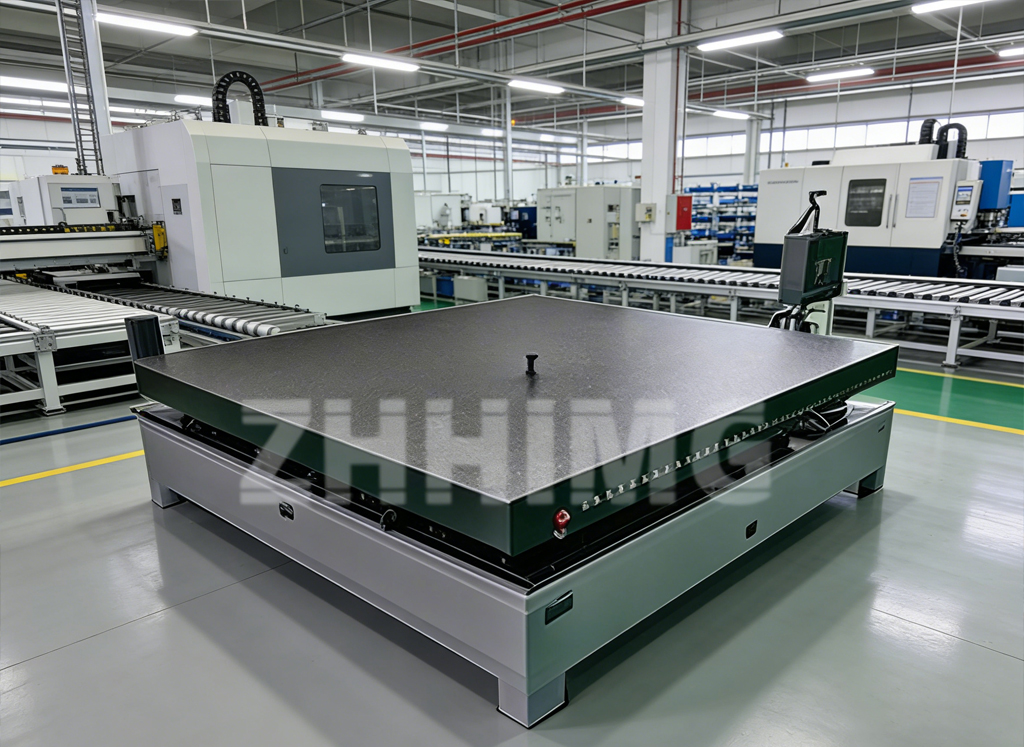
- Surface plates serving as primary reference planes for dimensional inspection
- Calibration benches for precision instruments and gauges
- Optical experiment platforms requiring vibration isolation and thermal neutrality
Aerospace and Automotive:
- Inspection systems for large structural components
- Measurement platforms for engine parts and precision assemblies
- Calibration equipment for safety-critical components
Performance Data:
Industry studies indicate that granite surface plates maintain flatness accuracy within 0.5–1.5 μm/m over service lives exceeding 20 years, with calibration intervals often extended to 12–24 months—significantly longer than metal alternatives requiring more frequent re-machining.
Industry studies indicate that granite surface plates maintain flatness accuracy within 0.5–1.5 μm/m over service lives exceeding 20 years, with calibration intervals often extended to 12–24 months—significantly longer than metal alternatives requiring more frequent re-machining.
Cost and Maintenance: Total Ownership Perspective
Ceramic: High Initial Investment, Low Maintenance Burden
Initial Costs:
Ceramic measuring tools typically command premium prices due to complex manufacturing processes. Large-format ceramic components are particularly expensive, as they require specialized sintering equipment and controlled-environment finishing. A ceramic surface plate of comparable size to granite can cost 2–3 times more initially.
Ceramic measuring tools typically command premium prices due to complex manufacturing processes. Large-format ceramic components are particularly expensive, as they require specialized sintering equipment and controlled-environment finishing. A ceramic surface plate of comparable size to granite can cost 2–3 times more initially.
Maintenance Profile:
- Minimal routine maintenance: ceramics do not rust, corrode, or require protective coatings
- Resistant to staining and chemical contamination
- Long-term dimensional stability reduces recalibration frequency
- Susceptible to chipping or cracking under impact—requires careful handling protocols
- Repair options are limited; damaged components often require complete replacement
Lifecycle Value:
For applications demanding extreme precision and environmental resistance, ceramics deliver strong lifecycle value despite higher upfront costs. Reduced maintenance downtime and extended calibration intervals can offset initial investment over 10–15 year ownership periods.
For applications demanding extreme precision and environmental resistance, ceramics deliver strong lifecycle value despite higher upfront costs. Reduced maintenance downtime and extended calibration intervals can offset initial investment over 10–15 year ownership periods.
Granite: Moderate Initial Cost, Proven Longevity
Initial Costs:
Granite measuring tools offer excellent cost-performance ratios, particularly for large-format applications. Abundant raw material supply and well-established machining processes keep production costs manageable. A standard granite surface plate typically costs 40–60% less than equivalent ceramic alternatives.
Granite measuring tools offer excellent cost-performance ratios, particularly for large-format applications. Abundant raw material supply and well-established machining processes keep production costs manageable. A standard granite surface plate typically costs 40–60% less than equivalent ceramic alternatives.
Maintenance Requirements:
- Low routine maintenance: periodic cleaning with neutral detergents
- No need for rust-prevention oils or protective coatings
- Natural wear resistance ensures flatness retention over decades
- Minor surface damage results in pitting rather than burr formation—often不影响measurement accuracy
- Re-lapping and reconditioning services widely available at reasonable cost
Long-Term Economics:
Granite’s proven longevity—often exceeding 30 years in service—translates to exceptionally low total cost of ownership. Industry data shows granite surface plates maintain accuracy over 20+ year lifespans with minimal intervention, making them among the most cost-effective precision investments available.
Granite’s proven longevity—often exceeding 30 years in service—translates to exceptionally low total cost of ownership. Industry data shows granite surface plates maintain accuracy over 20+ year lifespans with minimal intervention, making them among the most cost-effective precision investments available.
Selection Guide: Decision Framework for Technical Teams
Choosing between ceramic and granite measuring tools requires systematic evaluation of application requirements, environmental conditions, and budget parameters. The following decision framework guides technical selection teams through this critical process.
Primary Selection Criteria
1. Precision Requirements
| Accuracy Level | Recommended Material | Rationale |
|---|---|---|
| Sub-micron (< 1 μm) | Ceramic | Superior thermal stability and surface finish for ultra-high precision |
| Micron-level (1–10 μm) | Either viable | Both materials meet requirements; consider other factors |
| Standard industrial (> 10 μm) | Granite | Cost-effective solution with proven performance |
2. Environmental Conditions
-
Temperature Stability:
- Highly controlled (±0.1°C): Ceramic or granite both suitable
- Moderate variation (±2°C): Granite preferred due to thermal mass advantage
- Uncontrolled or fluctuating: Granite’s slower thermal response provides better stability
-
Vibration Environment:
- High ambient vibration: Granite’s superior damping critical for measurement repeatability
- Isolated foundation: Either material viable
- Dynamic loading conditions: Granite recommended for structural resilience
-
Chemical/Magnetic Exposure:
- Aggressive chemicals: Ceramic excels in chemical inertness
- Magnetic sensitivity: Both materials non-magnetic—selection based on other criteria
- Cleanroom/vacuum: Ceramic often preferred for sterility and outgassing performance
3. Component Size Requirements
- Small to medium components (< 1 meter): Both materials viable; selection based on precision needs and budget
- Large-format applications (> 1 meter): Granite strongly recommended due to manufacturing scalability and cost-effectiveness
- Very large structures (> 3 meters): Granite is the practical choice; ceramic manufacturing constraints limit feasibility
4. Budget Considerations
| Budget Level | Recommended Approach |
|---|---|
| Premium budget, maximum performance | Ceramic for specialized high-precision applications |
| Moderate budget, proven reliability | Granite for mainstream industrial metrology |
| Budget-constrained, essential requirements | Granite surface plates offer exceptional value |
Decision Tree Application
Step 1: Define Precision Threshold
Is sub-micron accuracy required? → Yes: Consider ceramic → No: Proceed to Step 2
Is sub-micron accuracy required? → Yes: Consider ceramic → No: Proceed to Step 2
Step 2: Assess Environmental Demands
Is the environment highly controlled and chemically aggressive? → Yes: Ceramic may be justified → No: Granite likely optimal
Is the environment highly controlled and chemically aggressive? → Yes: Ceramic may be justified → No: Granite likely optimal
Step 3: Evaluate Component Size
Are dimensions > 1 meter? → Yes: Granite recommended for manufacturability → No: Either material viable
Are dimensions > 1 meter? → Yes: Granite recommended for manufacturability → No: Either material viable
Step 4: Budget Alignment
Does the budget accommodate 2–3× premium for ceramic? → Yes: Consider performance benefits → No: Granite provides proven value
Does the budget accommodate 2–3× premium for ceramic? → Yes: Consider performance benefits → No: Granite provides proven value
Expert Perspectives: Industry Insights on Material Selection
Leading metrology engineers and equipment manufacturers offer nuanced perspectives on the ceramic versus granite debate, emphasizing that optimal selection depends on specific application contexts rather than universal material superiority.
Dr. Marcus Chen, Senior Metrology Engineer, Global Semiconductor Manufacturer:
“In semiconductor lithography equipment, we specify ceramic stages for critical alignment functions where thermal neutrality and vacuum compatibility are non-negotiable. However, the bulk of our CMM infrastructure uses granite bases. The materials serve different roles in our precision ecosystem. Attempting to use ceramic throughout would be economically impractical, while relying solely on granite would limit our capabilities in specific high-end applications.”
Sarah Thompson, Quality Assurance Director, Aerospace Component Manufacturer:
“Our inspection department operates 15 coordinate measuring machines, all granite-based. Over 25 years of operation, we’ve found granite delivers the reliability and maintenance simplicity our production environment demands. The initial cost savings compared to ceramic alternatives allowed us to invest in additional capacity. For aerospace dimensional inspection at micron-level tolerances, granite remains our material of choice.”
Professor James Liu, Materials Science Researcher, Precision Engineering Institute:
“The ceramic versus granite comparison often oversimplifies a complex engineering decision. Ceramics excel in specialized niches—nanopositioning, vacuum environments, chemically aggressive processes—where their engineered properties deliver unique value. Granite dominates mainstream precision metrology due to its balanced performance characteristics, manufacturability at scale, and proven long-term stability. Smart engineers specify materials based on application requirements, not material trends.”
Robert Martinez, Procurement Manager, Automotive Tier-1 Supplier:
“Total cost of ownership analysis consistently favors granite for our inspection equipment. Over a 20-year service life, granite surface plates require minimal maintenance and maintain accuracy with annual calibrations. While ceramic alternatives might offer marginally better performance in specific parameters, the cost differential doesn’t align with our precision requirements. We focus supplier selection on granite quality and certification rather than material substitution.”
Performance Comparison Table: Technical Specifications at a Glance
| Property | Granite | Technical Ceramic | Advantage |
|---|---|---|---|
| Hardness (Vickers) | 6–7 Mohs | HV 1350+ | Ceramic |
| Thermal Expansion (×10⁻⁶/°C) | 4.5–6 | 3–6 (specialized: <1) | Comparable |
| Vibration Damping Ratio | 0.012–0.015 | 0.001–0.003 | Granite |
| Thermal Mass | High | Moderate | Granite |
| Corrosion Resistance | Excellent | Excellent | Comparable |
| Magnetic Properties | Non-magnetic | Non-magnetic | Comparable |
| Impact Resistance | Good (chips rather than cracks) | Poor (brittle fracture) | Granite |
| Surface Finish (Ra) | 0.2–0.4 μm | <0.1 μm possible | Ceramic |
| Maximum Size Feasibility | > 20 meters | Limited by kiln size | Granite |
| Initial Cost (relative) | 1.0× (baseline) | 2–3× | Granite |
| Maintenance Frequency | Low | Very low | Comparable |
| Service Life | 20–30+ years | 15–25 years | Granite |
| Repair/Reconditioning | Widely available | Limited | Granite |
| Calibration Interval | 12–24 months | 18–36 months | Ceramic |
Call to Action: Expert Guidance for Your Material Selection
Selecting the optimal measuring tool material requires more than comparing technical specifications—it demands application-specific engineering expertise and lifecycle cost analysis. ZHHIMG Group brings 30 years of experience in precision granite and ceramic component manufacturing to support your material selection decisions.
Our Expertise:
- Dual-material manufacturing capabilities for both precision granite and advanced ceramics
- ISO 9001, ISO 14001, ISO 45001, and CE certified quality systems
- Custom engineering support for application-specific material optimization
- Large-format manufacturing capacity: up to 16-meter components in granite
Complimentary Selection Consultation:
Contact our technical team for a detailed assessment of your precision measurement requirements. We provide:
Contact our technical team for a detailed assessment of your precision measurement requirements. We provide:
- Application-specific material recommendations
- Total cost of ownership analysis
- Custom component design and manufacturing support
- Calibration and maintenance guidance
Conclusion: No Universal Best—Only the Right Choice
The performance showdown between ceramic and granite measuring tools reveals a fundamental truth of precision engineering: there is no universally superior material, only the most appropriate choice for specific applications.
Ceramic measuring tools represent the pinnacle of engineered performance for ultra-high-precision applications, extreme environments, and specialized metrology requirements where their exceptional hardness, thermal stability, and chemical inertness deliver measurable advantages. Industries pushing toward nanometer-level accuracy and operating in chemically aggressive or thermally controlled environments increasingly rely on ceramic components.
Granite measuring tools remain the backbone of industrial metrology, offering an unmatched combination of dimensional stability, vibration damping, manufacturability, and lifecycle value. For the vast majority of precision measurement applications—coordinate measuring machines, surface plates, inspection systems, and precision machinery bases—granite provides the optimal balance of performance, cost-effectiveness, and long-term reliability.
Strategic Material Selection:
The most effective procurement strategies recognize that ceramic and granite are complementary rather than competing materials. Advanced metrology systems often integrate both: granite structural bases providing stability and damping, with ceramic precision components handling the most demanding measurement tasks.
The most effective procurement strategies recognize that ceramic and granite are complementary rather than competing materials. Advanced metrology systems often integrate both: granite structural bases providing stability and damping, with ceramic precision components handling the most demanding measurement tasks.
As manufacturing tolerances continue to tighten and precision requirements intensify across industries from semiconductors to aerospace, material selection will remain a strategic engineering decision. The organizations that excel are those that match material properties to application requirements with precision—understanding that in metrology, as in all engineering disciplines, the right tool for the job is the one that delivers consistent, reliable performance over the long term.
At ZHHIMG Group, we don’t just manufacture precision components—we partner with our customers to ensure their material selections deliver the accuracy, reliability, and value their operations demand.
About ZHHIMG Group
Founded in 1998, ZHHIMG Group has grown into a global leader in ultra-high-precision component manufacturing. With dual expertise in precision granite and advanced ceramics, we serve the semiconductor, aerospace, automotive, optical, and metrology industries worldwide. Our two manufacturing facilities, spanning 39 acres and employing over 200 professionals, produce components meeting the most demanding international standards. ZHHIMG® has become synonymous with precision engineering excellence, delivering solutions that define industry benchmarks.
Keywords: Ceramic Measuring Tools, Granite Measuring Tools, Performance Comparison, Precision Metrology, Coordinate Measuring Machines, Surface Plates, Material Selection, Industrial Measurement Equipment, Thermal Stability, Vibration Damping, Semiconductor Metrology, Aerospace Inspection, Calibration Standards
Post time: Apr-16-2026