
When a quality engineer walks into a measurement lab, the material under their fingertips tells a story. That scratch-resistant ceramic gauge feels impossibly light yet rigid beyond belief. The massive granite surface plate beneath it absorbs vibrations like it was grown for this purpose—because it was. Both materials dominate precision measurement, yet most procurement specialists cannot explain why one might outperform the other in specific conditions.
The answer is not simple. Neither material wins universally. Understanding the fundamental properties of ceramic and granite measuring tools—and where each material excels—can save manufacturers thousands in rework costs, extend calibration intervals, and ultimately deliver better parts to customers.
What Makes These Materials Different
The distinction starts at the atomic level. Ceramic measuring tools are engineered materials, typically manufactured from aluminum oxide (Al₂O₃), zirconium oxide (ZrO₂), or silicon carbide (SiC). Each compound is selected for specific performance characteristics and sintered at high temperatures to create a dense, pore-free structure. This manufacturing control means every production batch achieves consistent properties, enabling tight tolerances across large quantities.
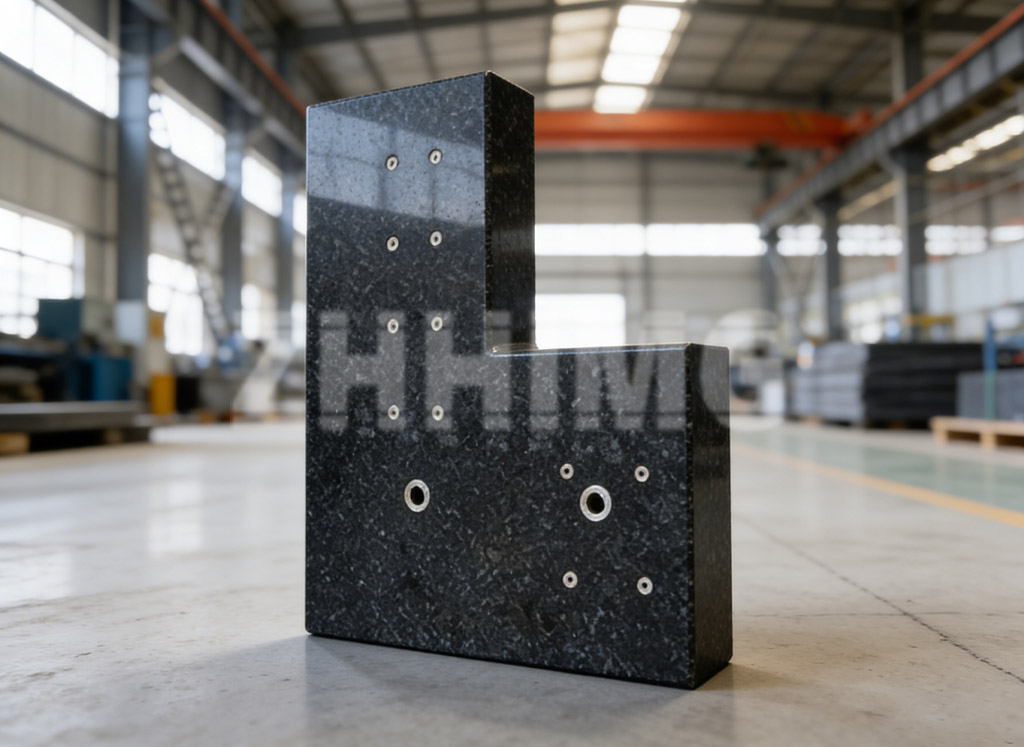
Granite measuring tools, by contrast, come from nature. Black granite or diabase quarried from specific geological formations provides the raw material. While natural variability exists between sources, modern processing techniques—including thermal annealing and stress-relief cycles—have largely addressed internal stress concerns that plagued earlier granite instruments. The material’s crystalline structure contributes to its characteristic damping behavior.
This fundamental difference in origin shapes nearly every performance characteristic that follows.
The Ceramic Advantage: Hardness, Insulation, and Light Weight
Vickers hardness testing reveals why ceramic dominates in wear-prone applications. Alumina ceramics achieve HV 1400–1800, compared to steel at HV 600–800 and granite at approximately HS 70. That represents more than double the surface resistance to abrasion compared to steel. In production environments where gauges contact parts thousands of times per shift, ceramic components last five to ten times longer before requiring recalibration. The economic implications compound over years of daily use.
The Young’s modulus of 300–380 GPa tells a similar story. Ceramic rigidity exceeds steel by a factor of 1.5 and granite by a factor of 4–5. Under measurement load, ceramic tools deflect less and return more precisely to original geometry. This stiffness advantage proves particularly valuable in dimensional gages where probe deflection introduces systematic error.
Weight tells perhaps the most dramatic story. Ceramic density sits around 3.90 g/cm³—roughly half that of steel and one-third that of granite. A single technician can carry a ceramic gauge plate that would require a hoist or crane for a granite equivalent. Portable measurement applications benefit enormously from this characteristic. Field service teams report significantly reduced operator fatigue when switching to ceramic instruments, and field measurement accuracy often improves simply because technicians can handle gauges properly without struggling against mass.
Electrical properties complete the ceramic profile. Volume resistivity exceeding 10¹⁴ Ω·cm means absolute electrical insulation. Ceramic produces no magnetic field, conducts no current, and contains no ferrous materials whatsoever. For semiconductor manufacturing, medical device production, and any operation involving magnetically sensitive electronic components, ceramic measuring tools eliminate an entire category of measurement error. Coordinate measuring machines equipped with ceramic probe styli demonstrate reduced thermal drift in ways that metal styli cannot match.
Corrosion resistance adds another dimension. Ceramic surfaces resist attack from nearly every industrial chemical. Hydrofluoric acid and strong alkalis at elevated temperatures present the few exceptions. While granite handles typical workshop environments adequately, ceramic thrives in cleanrooms, pharmaceutical labs, and chemical processing facilities where aggressive cleaning agents would gradually degrade lesser materials. Surface degradation on measurement tools translates directly to measurement error—ceramic avoids this failure mode entirely.
Thermal performance deserves nuanced discussion. With a thermal expansion coefficient of 7–8 ×10⁻⁶/°C, ceramic expands roughly twice as much as granite per degree temperature change. However, the argument for ceramic in extreme environments remains compelling. Some ceramic formulations maintain functionality above 1000°C, far beyond any metallic or granite alternative. For customers measuring parts at elevated temperatures, ceramic transfer standards provide a practical solution that granite simply cannot offer.
Industry standards validate ceramic performance characteristics. ISO 14704 specifies Flexural Strength testing procedures, while ISO 6507 covers hardness measurement methodology. NIST-traceable calibration certificates confirm that ceramic measuring tools meet the same metrological requirements applied to traditional steel and granite instruments.
The Granite Advantage: Damping, Stability, and Economy
Granite tells a different story—one written over millions of years of geological formation. The result is a material with extraordinary damping characteristics. A loss factor (damping ratio) of 0.012–0.015 means granite absorbs vibrational energy far more effectively than ceramic or steel. When CNC machines run cycles nearby, when forklift traffic shakes floor structures, when HVAC systems cycle on and off, granite surface plates keep measurement surfaces stable.
The practical implication matters enormously in real manufacturing environments. A granite table in a busy manufacturing floor might show measurement variations of 0.5 μm under conditions that would push ceramic instruments toward 2–3 μm oscillation. For coordinate measuring machines and other vibration-sensitive equipment, granite foundations provide passive stability that active isolation systems alone cannot match. Many CMM manufacturers specify granite bases as standard equipment for precisely this reason.
Thermal behavior follows a similar pattern. The lower expansion coefficient of 4.5 ×10⁻⁶/°C gives granite better dimensional stability through temperature swings. More importantly, granite exhibits superior thermal inertia. Temperature changes propagate slowly through the material mass, reducing transient measurement errors during shop floor thermal fluctuations. A granite surface plate might warm gradually through a morning shift as equipment heats up, with gradual, predictable expansion that skilled operators can compensate for. Ceramic surfaces respond more quickly to temperature changes, creating potential for faster drift.
Facilities without climate control often find granite performs more predictably than ceramic under these conditions. Large machine shops with high ceilings, seasonal temperature variations, and heat-generating equipment present challenges that granite handles better than most alternatives. Automotive manufacturing plants, heavy equipment facilities, and job shops typically specify granite measurement surfaces for precisely these reasons.
Cost considerations favor granite in large-format applications. Granite raw material comes from abundant natural sources, and quarrying techniques are well-established. Manufacturing processes for granite surface plates, machine bases, and similar large structures have been refined over decades. Ceramic production becomes increasingly expensive at larger sizes due to sintering constraints, kiln limitations, and yield challenges. A granite surface plate measuring one meter square might cost a fraction of an equivalent ceramic panel—and ceramic panels of that size simply do not exist commercially in most markets.
For applications requiring massive, flat reference surfaces—CMM bridges, large CNC machine foundations, optical table bases, gantry systems—granite delivers acceptable precision at accessible price points. ISO 8512-2 and ASME B89.3.7 standards define achievable flatness tolerances for granite surface plates, and manufacturers routinely meet requirements in larger formats where ceramic alternatives do not exist commercially.
The weight of granite actually becomes an advantage in stationary applications. Once installed on a properly designed foundation, granite equipment stays in place. Vibration isolation pads beneath granite bases can be optimized for mass loading. The inherent stability of a massive granite structure provides a measurement reference that lighter materials cannot match.
Direct Performance Comparison
Weighing the materials against each other reveals clear tradeoffs that define application suitability.
| Property | Ceramic | Granite |
|---|---|---|
| Vickers Hardness | HV 1400–1800 | HS 70+ |
| Young’s Modulus | 300–380 GPa | 60–100 GPa |
| Thermal Expansion | 7–8 ×10⁻⁶/°C | 4.5 ×10⁻⁶/°C |
| Damping Ratio | Lower | 0.012–0.015 |
| Density | 3.90 g/cm³ | 2.97–3.07 g/cm³ |
| Weight | Lightest | Heaviest |
| Electrical | Insulating | Conductive |
| Magnetic | Non-magnetic | Non-magnetic |
Accuracy figures reinforce the complementary nature of these materials. Ceramic plug gauges routinely achieve dimensional tolerances of ±0.0025 mm in metric sizes, with long-term drift measured in fractions of microns per year. This stability allows extending calibration intervals from annual to multi-year schedules for stable production environments—reducing instrument downtime and calibration costs over the tool lifetime.
Granite surface plates routinely achieve flatness of 2 μm or better per square meter, easily satisfying ISO 8512 requirements for most industrial measurement applications. The natural material maintains these tolerances remarkably well over decades of service with proper maintenance and periodic resurfacing. Some granite instruments remain in service for fifty years or more.
Industry-Specific Considerations
Semiconductor manufacturing demands ceramic measuring tools almost exclusively. Wafer handling, disk drive component measurement, and integrated circuit fabrication involve magnetic fields, electrostatic charges, and cleanliness requirements that rule out granite entirely. The precision ceramic components used in these environments include ceramic gauge blocks, ceramic measuring squares, and ceramic straight edges that maintain micron-level accuracy without contaminating sensitive processes.
Medical device manufacturing presents similar constraints. Joint replacement components, surgical instruments, and implantable devices require non-magnetic measuring equipment throughout production. Ceramic measuring tools provide the necessary material purity while meeting stringent dimensional tolerances.
Optical inspection systems benefit from ceramic’s thermal properties and granite’s mass. Large optical tables often combine both—ceramic surface plates mounted on granite bases, leveraging the strengths of each material. The ceramic top provides a non-magnetic, corrosion-resistant surface, while the granite base supplies vibration damping and thermal mass.
CNC machine tool calibration frequently employs both materials. Ceramic master squares and ceramic reference discs verify machine geometry quickly and accurately. Granite surface plates provide stable reference surfaces for part setup and intermediate measurements. The combination captures ceramic speed and granite stability.
Choosing the Right Material for Your Application
The decision framework depends heavily on operational context and measurement priorities.
Choose ceramic measuring tools when:
Production environments demanding gauges endure thousands of measurement cycles benefit immediately from ceramic wear resistance. The five-to-ten-times extended service life between calibrations delivers clear ROI in high-volume manufacturing. Semiconductor fabs, pharmaceutical manufacturing, and medical device production often require non-magnetic, non-conductive instruments to avoid interfering with products or processes. High-temperature applications exceeding 200°C clearly favor ceramic formulations designed for thermal stability. Field service operations prioritize weight above nearly everything else—a technician climbing a ladder to measure turbine components cannot use granite equipment. Corrosive environments involving acids, alkalis, or aggressive cleaning solvents call for ceramic’s chemical inertness.
Choose granite measuring tools when:
Vibration presents the primary measurement challenge. Machine shop floors with heavy equipment, facilities with forklift traffic, environments without active vibration isolation all favor granite damping characteristics. Large-format applications define the requirement—granite surface plates and machine bases at meter-scale represent mature, cost-effective solutions that ceramic cannot match economically. Budget constraints on foundational equipment push toward granite’s favorable economics for large purchases. Thermal stability through gradual temperature changes matters more than absolute low expansion coefficient. CMM installations in manufacturing facilities typically specify granite bases for this reason.
Consider both materials in hybrid approaches. A ceramic gauge set for portable measurement and in-process inspection might complement a granite surface plate for final verification. This approach captures ceramic advantages where they matter most—wear resistance, weight, electrical properties—while leveraging granite where large, stable reference surfaces provide clear benefits.
The Bottom Line
No single material wins universally. Ceramic measuring tools offer superior hardness, electrical isolation, chemical resistance, and weight advantages that make them indispensable for specific applications. Granite measuring tools provide better vibration damping, thermal stability through temperature fluctuations, and cost-effective performance in larger formats.
Successful implementation requires matching material properties to application priorities. The investment in understanding these tradeoffs pays dividends through better measurement results, longer tool life, and lower total cost of ownership.
For procurement decision-makers evaluating precision measurement equipment, the question is not which material is better—it is which material better addresses your specific operational challenges. A thoughtful analysis of measurement environment, production volume, accuracy requirements, and budget constraints will point clearly toward the right choice.
Post time: Apr-15-2026