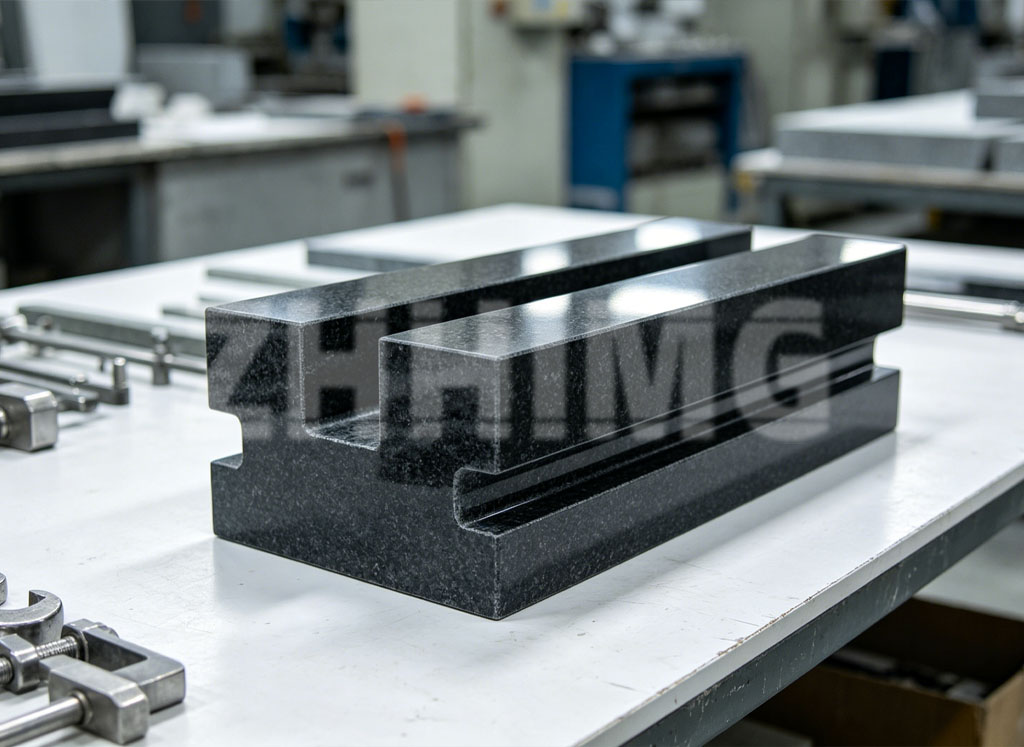
In the rarefied atmosphere of ultra-precision machinery, where tolerances are measured in sub-microns and thermal drift is the enemy of quality, the choice of structural material is not merely a design consideration—it is the defining factor of performance. As manufacturing pushes toward the limits of physics, particularly in sectors like semiconductor lithography, optical lens grinding, and coordinate measuring machines (CMM), the industry standard has firmly settled on granite. However, “granite” is not a monolith. Selecting the right granite components requires a nuanced understanding of geology, physics, and advanced manufacturing capabilities. This article guides engineers and procurement specialists through the critical factors of choosing the optimal granite components for ultra-precision applications.
The Geological Foundation: Not All Stone is Created Equal
The journey to selecting the right component begins deep underground. For ultra-precision machinery, the industry standard is almost exclusively black granite, often sourced from specific geological formations known for their fine grain and uniformity. The most renowned of these is the “Jinan Green” or “Jinan Black” granite found in the Shandong province of China, a region that has become a global hub for high-quality stone extraction.
When evaluating potential suppliers, the first criterion must be material purity. High-precision granite must be free of quartz veins, cracks, and impurities that could lead to structural failure or uneven wear over time. The ideal material possesses a dense, fine-grained structure with a Mohs hardness of roughly 6.5 to 7. This hardness is crucial; it ensures that the component resists scratching and abrasion during operation, maintaining its geometric integrity for decades. Furthermore, the material must be “stress-relieved” by nature. Unlike metal castings, which require artificial aging to remove internal stresses, natural granite has been aging for millions of years, offering a level of dimensional stability that synthetic materials struggle to match.
Thermal Stability: The Anchor in a Fluctuating World
In ultra-precision environments, heat is the primary source of error. As machine tools and motors generate heat, or as ambient factory temperatures shift, materials expand and contract. Steel, for instance, has a coefficient of thermal expansion (CTE) that can introduce significant errors over long distances.
The right granite component acts as a thermal anchor. High-quality black granite typically exhibits a CTE of roughly
4.6×10⁻⁶/∘C , which is significantly lower than that of cast iron or steel. This means that for every degree of temperature change, the granite structure changes dimension far less than its metallic counterparts. When selecting a supplier, it is vital to request the material’s physical property report, specifically looking for low hygroscopicity (water absorption) and a consistent thermal expansion coefficient. This ensures that the machine maintains its calibration even in environments where perfect climate control is difficult to sustain.
Precision Grades and Surface Finishes
Once the raw material is selected, the conversation shifts to processing capabilities. Granite components are generally categorized by precision grades, often adhering to standards like DIN 876 or ASME B89.3.7. For ultra-precision machinery—such as the base of a high-end CMM or the stage of a laser processing system—only the highest grades (00 or 0 grade) are acceptable.
Achieving these grades requires a blend of modern technology and artisanal skill. The manufacturing process typically begins with large-scale diamond sawing and CNC milling to achieve the rough geometry. However, the final surface finish and flatness are often achieved through hand-lapping. This is where the expertise of the manufacturer becomes critical. Master craftsmen use precision straightedges and electronic level instruments to scrape and polish the stone, removing microscopic high spots to achieve flatness tolerances of less than 1 micron per meter.
When choosing a partner, look for manufacturers who possess both heavy-duty CNC capabilities for roughing and a dedicated “clean room” environment for the final finishing stages. Dust and temperature fluctuations during the final lapping process can ruin the accuracy of the part, so a controlled environment is non-negotiable.
Customization and Integration: Beyond the Flat Plate
Gone are the days when granite was used solely as a flat inspection table. Modern ultra-precision machines require complex 3D structures—moving bridges,龙门 (gantries), and rotary tables. This necessitates a manufacturer capable of deep processing.
The right granite component will feature embedded metal inserts for mounting linear guides, threaded holes for assembly, and T-slots for fixturing. The process of inserting these metal elements into the stone is an art form in itself. It involves drilling precise holes, bonding stainless steel or brass threaded inserts with high-strength epoxy, and ensuring that the bond creates no internal stress that could warp the stone.
Furthermore, advanced manufacturers now utilize mineral casting (artificial granite) techniques alongside natural stone. This involves mixing crushed granite with epoxy resins to cast complex shapes that might be impossible to machine from a solid block. When evaluating suppliers, consider their ability to offer “hybrid” solutions—using natural granite for the critical reference surfaces and mineral casting for the structural bulk, optimizing both cost and performance.
The Importance of Metrology and Certification
In the world of ultra-precision, trust must be verified. A reputable granite supplier will not simply ship a part; they will provide a comprehensive “birth certificate” for the component. This documentation should include a detailed inspection report generated by laser interferometers or electronic autocollimators.
These reports map the surface of the granite, providing a contour map of peaks and valleys across the entire working area. For ultra-precision applications, you should demand a report that verifies the flatness across the entire surface, not just at a few sample points. Additionally, the supplier should be ISO 9001 certified, ensuring that their quality management system is robust enough to handle the rigorous demands of the aerospace, medical, or semiconductor industries.
Conclusion: A Partnership in Precision
Choosing the right granite components is not a transaction; it is a partnership. It requires finding a supplier who understands that they are not just cutting stone, but building the foundation of your machine’s accuracy. From the quarries of Jinan to the high-tech lapping workshops, every step of the process contributes to the final performance of the equipment.
By prioritizing material purity, thermal stability, precision grading, and certified manufacturing processes, engineers can ensure that their ultra-precision machinery stands on the most stable foundation possible. In an industry defined by exactness, high-precision granite remains the bedrock of quality.
Post time:
May-07-2026