
In the realm of aerospace manufacturing, the margin for error is nonexistent. From the turbine blades of a jet engine to the structural fuselage of a satellite, every component must meet specifications measured in single-digit microns. In this high-stakes environment, the accuracy of the manufacturing process is only as good as the stability of the equipment used to build and measure these parts. While advanced software and laser guidance often steal the spotlight, the physical foundation of precision engineering relies heavily on a material that has stood the test of time: high-precision granite.
Granite components are no longer just simple surface plates for manual inspection; they have evolved into complex, structural elements integral to Coordinate Measuring Machines (CMMs), high-speed machining centers, and optical alignment systems. This article explores why high-precision granite remains the material of choice for the aerospace industry and how it ensures the safety and performance of the next generation of flight.
The Imperative of Dimensional Stability
Aerospace components are often large, complex, and made from difficult-to-machine materials like titanium and Inconel. During the manufacturing process, these parts are subjected to immense forces and thermal variations. To certify that a part is airworthy, it must be measured against a reference plane that is more stable than the part itself. This is the “reference plane” concept. If the measuring platform expands, contracts, or vibrates even slightly, the data collected is compromised, potentially leading to the installation of defective parts.
High-precision granite, specifically grades such as black granite with a density of approximately 3100 kg/m³, offers the ultimate solution for dimensional stability. Unlike steel or cast iron, which can warp under stress or temperature changes, granite acts as a neutral, inert foundation. It provides a “zero point” that does not shift, ensuring that the measurements taken by laser trackers or CMMs are accurate reflections of reality. In an industry where a microscopic deviation can lead to catastrophic fatigue failure, this stability is not just a luxury—it is a safety requirement.
Thermal Stability: The Silent Guardian of Precision
One of the most significant challenges in aerospace manufacturing is managing heat. Large manufacturing halls may experience temperature fluctuations throughout the day, and the machining process itself generates significant heat. Metals have a relatively high coefficient of thermal expansion (CTE), meaning they grow when heated and shrink when cooled. If a CMM bridge or a machine base is made of steel, it will expand as the factory warms up, causing the machine to lose its calibration and introduce measurement errors.
Granite possesses an exceptionally low CTE, significantly lower than that of steel. This natural property makes it virtually immune to the minor temperature fluctuations found in controlled environments. By utilizing granite for the structural components of inspection and manufacturing systems, aerospace engineers ensure that the geometry of the machine remains constant regardless of ambient conditions. This passive thermal stability eliminates the need for complex and expensive active cooling systems in many applications, providing a reliable baseline for high-precision work.
Vibration Damping and Surface Finish
Aerospace parts often require mirror-like surface finishes and complex aerodynamic profiles. Achieving this requires a machining environment free from “chatter” or vibration. When a cutting tool engages with a hard material like a titanium landing gear component, it generates high-frequency vibrations. If the machine structure absorbs and reflects these vibrations, the surface finish suffers, and tool life is drastically reduced.
The crystalline structure of granite offers superior damping properties—up to ten times better than steel. This means that granite components absorb vibrational energy rather than transmitting it. In the context of a CNC machine or a high-speed laser scanner, a granite base acts as a massive shock absorber. This damping capability allows for higher feed rates and smoother cutting actions, resulting in superior surface finishes and reduced wear on expensive cutting tools. For optical inspection systems, this stability is equally critical; even the slightest vibration from a nearby forklift or HVAC system can blur high-resolution scans, rendering the data useless.
Rigidity and Load-Bearing Capacity
Aerospace components are often heavy, and the fixtures used to hold them are equally massive. A precision granite platform must support these loads without flexing. High-density black granite has a high modulus of elasticity, which translates to exceptional stiffness. This rigidity ensures that the platform remains flat even under heavy point loads.
Furthermore, granite is non-magnetic and non-corrosive. In aerospace manufacturing, where sensitive electronics and magnetic sensors are often used, the non-magnetic nature of granite prevents interference. Additionally, unlike cast iron, granite does not rust. It is resistant to coolants, oils, and solvents commonly found on the shop floor, ensuring that the precision surface remains intact for decades with minimal maintenance. This longevity makes it a cost-effective investment for long-term aerospace programs that may span twenty years or more.
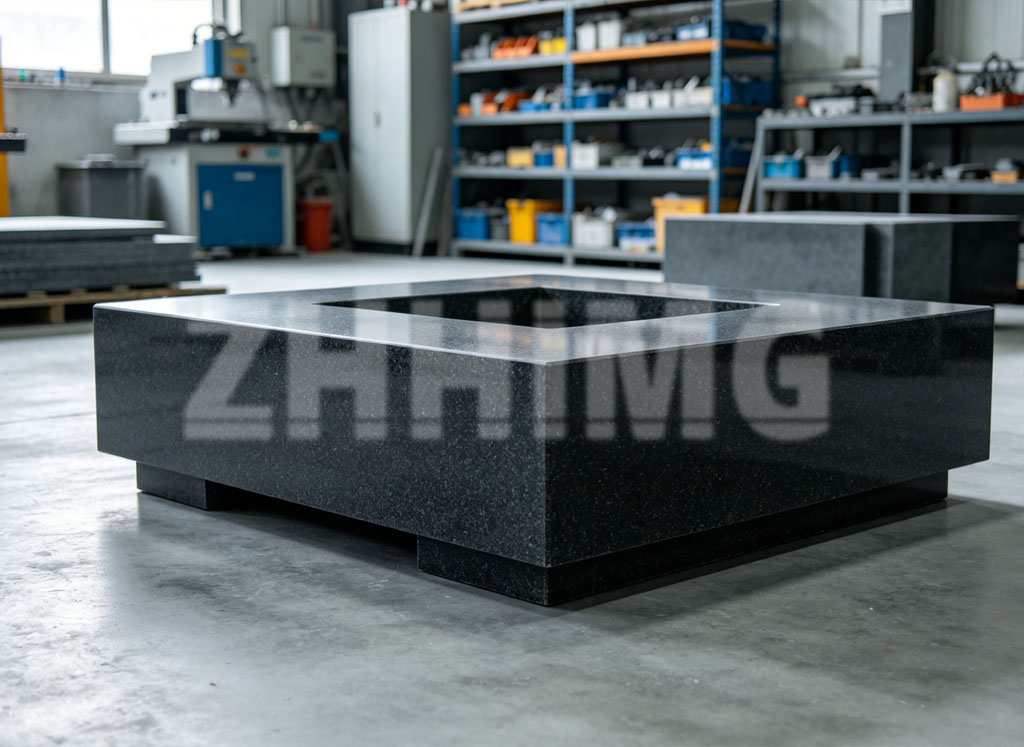
Advanced Manufacturing and Customization
The demand for granite in aerospace has driven significant advancements in how these components are manufactured. It is no longer enough to simply cut a block of stone; modern aerospace applications require complex geometries, embedded inserts, and nanometer-level flatness.
State-of-the-art facilities now utilize large-scale automated grinding machines followed by hand-lapping by master craftsmen to achieve flatness tolerances that were previously thought impossible. These processes ensure that granite components meet international standards such as DIN 876 or ASME B89.3.7. Additionally, the industry is seeing a trend toward larger specifications. As aerospace structures grow—such as the wing sections of next-generation transport aircraft—granite inspection tables are scaling up, with some lengths now exceeding 9 meters.
There is also a growing trend in the use of “artificial granite” or mineral castings for specific machine tool applications. These materials combine crushed granite with epoxy resins to create structures that are lighter and can be cast into complex shapes while retaining the thermal and damping benefits of natural stone. However, for the highest level of metrology and long-term stability, natural black granite remains the gold standard due to its geological age and stress-free nature.
The Role of Certification and Traceability
In the aerospace sector, documentation is as important as the physical part. Every granite component used in the certification of flight-critical parts must itself be certified. This involves rigorous testing in climate-controlled laboratories to verify flatness, parallelism, and density.
Manufacturers must provide calibration certificates that are traceable to national and international standards (such as NIST or PTB). This chain of custody ensures that the “ruler” used to measure the airplane part is accurate. Without this traceability, the data generated by a CMM or a laser tracker is invalid. Leading granite suppliers now operate within ISO-certified environments, ensuring that the components they ship are free from internal stresses and ready for immediate integration into high-precision systems.
Conclusion
As aerospace engineering pushes the boundaries of speed, efficiency, and fuel economy, the components that make up these aircraft must become lighter and stronger, requiring ever-tighter manufacturing tolerances. High-precision granite components provide the silent, stable foundation upon which this progress is built. By offering unmatched thermal stability, superior vibration damping, and immense rigidity, granite ensures that the tools used to build and inspect our aircraft are as precise as the engineering that designed them. In the quest for perfection in the skies, the industry continues to stand on solid ground—literally.
Post time: May-07-2026