
In the high-stakes world of Computer Numerical Control (CNC) machining, precision is not merely a goal—it is the currency of quality. As industries such as aerospace, medical devices, and automotive manufacturing demand tighter tolerances, the stability of the machinery itself becomes the limiting factor. While much attention is often paid to software algorithms and spindle speeds, the foundational material of the machine tool plays a critical, yet sometimes overlooked, role in determining accuracy.
Enter precision granite components. By integrating high-quality granite into the structural framework of CNC machines, manufacturers can significantly reduce tolerance errors caused by vibration and thermal instability. This article explores the science behind granite’s superior damping capabilities, its thermal properties, and why it remains the gold standard for high-precision machining.
The Challenge of Tolerance Errors in CNC Machining
To understand the value of granite, one must first understand the enemies of precision. In CNC machining, “tolerance” refers to the permissible limit of variation in a physical dimension. When a machine fails to hold tolerance, the resulting parts may be scrap or require expensive rework.
The primary sources of these errors are generally categorized into three areas:
- Geometric Errors: Imperfections in the machine’s guide ways, lead screws, or squareness.
- Thermal Errors: Expansion and contraction of machine components due to heat generated by motors, friction, and cutting processes.
- Dynamic Errors (Vibration): Oscillations caused by the high-speed movement of axes and the cutting forces interacting with the workpiece.
While geometric errors can be mapped and compensated for via software, and thermal errors can be managed with cooling systems, vibration is notoriously difficult to eliminate once it enters the system. This is where the physical properties of the machine base and moving components become paramount.
The Physics of Stability: Why Granite?
Granite is not just a rock; it is a complex mineral composite that possesses a unique set of physical properties ideally suited for metrology and machining. Unlike cast iron or steel, which have traditionally been used for machine bases, granite offers a distinct advantage in two key areas: damping capacity and thermal stability.
1. Superior Damping Capacity
Damping refers to a material’s ability to absorb and dissipate vibrational energy. When a CNC machine operates—spinning spindles, rapid axis movements, and cutting into material—it generates kinetic energy. If this energy is not absorbed, it manifests as chatter or vibration.
- The Granite Advantage: Granite has a damping capacity roughly 6 to 10 times higher than that of cast iron.
- The Mechanism: The internal structure of granite consists of interlocking crystals of quartz, feldspar, and mica. When vibrational waves pass through this structure, the energy is absorbed by the internal friction between these crystals and converted into negligible amounts of heat.
- The Result: By using granite for machine bases, guideways, or moving bridges, the amplitude of vibration is drastically reduced. This ensures that the cutting tool follows the programmed path exactly, rather than oscillating around it, leading to superior surface finishes and tighter form tolerances.
2. Thermal Stability and Low Expansion
Heat is the silent enemy of precision. As a machine runs, it warms up. Steel and iron expand noticeably with temperature changes, which can shift the position of the spindle relative to the workpiece by several microns—a fatal error in ultra-precision machining.
Granite possesses a very low coefficient of thermal expansion. This means it remains dimensionally stable even when ambient temperatures fluctuate or when the machine generates internal heat. By maintaining a stable “zero point,” granite components ensure that the machine’s geometry remains constant throughout the production run, significantly reducing thermal-induced tolerance errors.
Reducing Specific Tolerance Errors
The integration of granite components directly addresses specific types of machining errors.
| Error Type | Cause | How Granite Mitigates It |
|---|---|---|
| Surface Finish Errors | High-frequency chatter and tool vibration. | High damping absorbs chatter, allowing for smoother cuts and lower Ra values. |
| Positional Accuracy | Machine base twisting or warping under load. | High stiffness-to-weight ratio and structural rigidity prevent deformation. |
| Geometric Drift | Thermal expansion of the machine bed. | Low thermal expansion coefficient keeps axes square and aligned. |
| Tool Wear | Excessive vibration accelerates tool degradation. | Stable cutting environment reduces shock loading on the cutting edge. |
Applications in Modern CNC Technology
The use of precision granite is not limited to simple surface plates; it is now integral to the dynamic components of advanced machinery.
High-Speed Gantry Systems
In 5-axis machining centers and laser cutting machines, moving mass is a critical factor. Granite can be engineered to be lighter than steel while maintaining equivalent stiffness. This allows for higher acceleration and deceleration rates without inducing “ring out” (residual vibration) when the axis stops. This is crucial for maintaining contouring accuracy in complex 3D profiles.
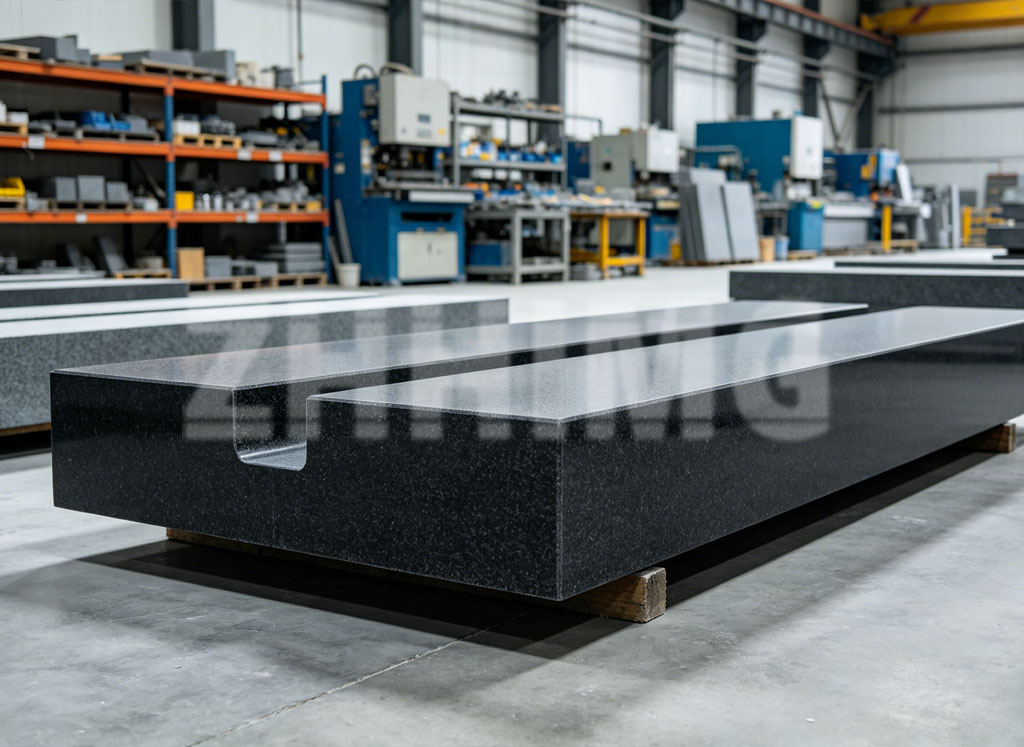
Coordinate Measuring Machines (CMM)
While not a cutting tool, the CMM is the guardian of CNC quality. Granite is the standard material for CMM bridges and tables. Because the inspection equipment must be more accurate than the part it measures, the stability of granite ensures that the measurement data used to correct CNC processes is reliable.
Linear Motion Guides
Advanced granite composites, such as epoxy-granite mixtures (often referred to as polymer concrete or mineral casting), are being used to create linear guideways. These materials offer the same vibration-damping benefits as natural granite but can be cast into complex shapes, allowing for optimized designs that further reduce weight and inertia.
Granite vs. Cast Iron: A Strategic Choice
For machine designers and buyers, the choice between granite and cast iron often comes down to the required level of precision.
- Cast Iron: Excellent for heavy-duty roughing where raw strength and low cost are priorities. However, it requires extensive aging to relieve internal stresses and is prone to rust.
- Precision Granite: Ideally suited for finishing, grinding, and micro-machining. It is naturally stress-relieved, corrosion-resistant, and requires less maintenance.
While the initial cost of high-grade granite components can be higher, the Total Cost of Ownership (TCO) is often lower due to reduced scrap rates, longer tool life, and the elimination of rust-prevention maintenance.
Future Trends: Smart Granite and Hybrid Materials
The future of precision granite lies in hybridization. Researchers are currently developing “smart” granite components that embed sensors directly into the stone structure during the manufacturing process.
These sensors can monitor:
- Real-time vibration levels: Allowing the CNC controller to adjust feed rates dynamically to avoid resonance.
- Temperature gradients: Enabling active thermal compensation.
- Structural health: Detecting micro-cracks or stress points before they lead to failure.
Furthermore, the development of artificial granite (mineral castings) continues to evolve. These materials allow for the inclusion of coolant channels and mounting points directly into the casting, reducing assembly time and increasing the overall rigidity of the machine structure.
Conclusion
In the pursuit of sub-micron accuracy, every variable must be controlled. Precision granite components provide a passive, reliable, and highly effective method for reducing tolerance errors in CNC machines. By leveraging the material’s natural ability to dampen vibration and resist thermal expansion, manufacturers can achieve:
- Higher Quality Parts: Better surface finishes and tighter geometric tolerances.
- Increased Productivity: Faster cycle times due to reduced need for secondary finishing.
- Machine Longevity: Reduced wear on spindles and bearings due to lower vibration levels.
Post time: May-07-2026