
In modern CNC machining, achieving high precision and maintaining consistent quality are critical challenges. Even minor vibrations or misalignments in a machine can compromise part tolerances, reduce tool life, and lower overall production efficiency. One solution increasingly adopted by leading manufacturers is the use of precision granite components as machine foundations, bases, or support structures.
This article explores how granite for CNC machines enhances stability, reduces vibration, and improves machining accuracy. Engineers, operations managers, and procurement professionals will gain practical insights for integrating granite solutions into their production processes.
Why CNC Machines Need Vibration Control
CNC machines operate at high speeds with multiple moving axes. Vibrations can arise from:
- Cutting forces during milling, drilling, or turning
- Imbalances in rotating spindles
- External environmental vibrations from nearby equipment
- Thermal expansion of machine components
Consequences of uncontrolled vibration:
- Reduced dimensional accuracy of machined parts
- Surface finish defects
- Accelerated wear of cutting tools
- Premature fatigue of machine frames
Traditional solutions, such as steel or cast iron bases, provide stability, but often fall short in vibration damping, especially for high-speed or high-precision applications. This is where precision granite offers a compelling advantage.
Why Granite for CNC Machines?
Granite is a natural stone with unique mechanical properties ideal for precision manufacturing:
- High rigidity: Granite maintains dimensional stability under heavy loads.
- Vibration damping: Its dense structure absorbs and dissipates vibration energy.
- Thermal stability: Minimal expansion ensures consistent alignment even in fluctuating temperatures.
- Corrosion resistance: Unlike metals, granite does not rust, reducing long-term maintenance.
These properties make granite an increasingly preferred material for CNC machine bases, gantries, and fixtures, particularly in industries such as aerospace, electronics, automotive, and high-precision tooling.
Key Benefits of Granite CNC Solutions
1. Superior Vibration Damping
Vibration damping is crucial for maintaining machining accuracy. Granite’s high density and internal damping characteristics reduce the transmission of cutting forces and machine vibrations.
Practical impact:
- Smoother surface finishes
- Reduced tool chatter
- Improved repeatability of precision parts
2. Enhanced Dimensional Stability
Granite’s low coefficient of thermal expansion (~4–7 × 10⁻⁶ /°C) ensures that CNC machines remain aligned even when exposed to temperature changes during continuous operation.
Practical impact:
- Accurate part geometries
- Reduced frequency of machine recalibration
- Consistent production quality
3. Long-Term Durability
Granite is highly resistant to scratching, denting, or chemical exposure. Unlike cast iron, it does not corrode, making it ideal for humid environments or chemical-laden machining processes.
Practical impact:
- Extended service life of machine foundations
- Minimal maintenance requirements
- Reliable reference surfaces for precision measurements
4. Cost-Effective Precision
While granite components may have higher upfront costs than traditional metal bases, the long-term benefits—improved part quality, reduced tool wear, and minimized downtime—translate into significant operational savings.
Practical impact:
- Lower scrap rates
- Reduced tool replacement costs
- Increased throughput and overall equipment efficiency
Applications of Granite in CNC Machines
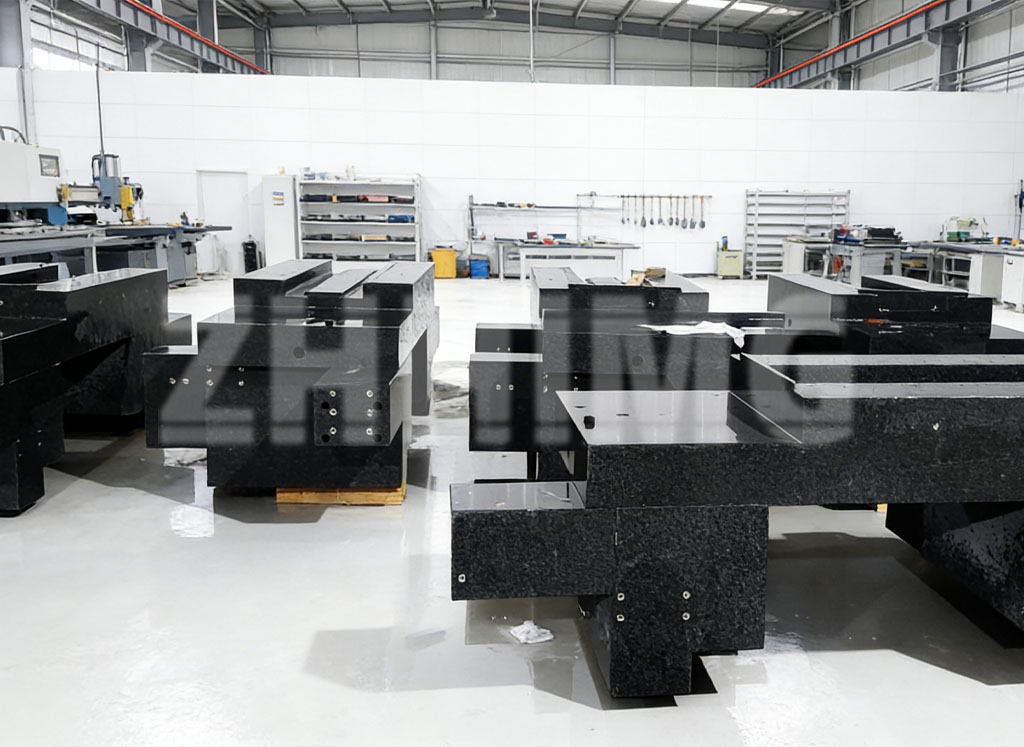
CNC Machine Bases
Granite bases provide a stable, vibration-damped foundation for heavy machining centers. Their flatness and rigidity allow high-speed operation without compromising accuracy.
Granite Gantries
High-precision granite gantries improve axis alignment, reducing error accumulation in multi-axis CNC machines. They are commonly used in aerospace and mold-making industries.
Granite Fixtures and Workholding
Granite plates and angle fixtures serve as vibration-free workholding surfaces, ensuring parts are held precisely during machining, measuring, or assembly.
Coordinate Measuring Machines (CMMs)
Granite is widely used in CMM bases to provide stable, dimensionally accurate surfaces for metrology inspections. Using granite for both machine and reference surfaces ensures minimal measurement error.
Choosing the Right Granite Solution for Your CNC Machine
When integrating granite into CNC machines, several critical factors must be considered:
1. Material Quality
- High-density granite (2.6–2.8 g/cm³) ensures better vibration damping and rigidity.
- Homogeneous mineral composition avoids localized weaknesses.
- Low porosity prevents moisture absorption and long-term deformation.
2. Surface Flatness
- CNC applications require granite surfaces with flatness tolerances in the micron range.
- Verify certificates of flatness and surface finish before procurement.
3. Customization Options
- Granite bases, gantries, and plates can be tailored for machine dimensions and mounting configurations.
- Consider T-slots, holes, or channels for fixtures and accessories.
4. Environmental Considerations
- Evaluate the operational environment, including temperature, humidity, and exposure to chemicals.
- Proper sealing and finishing can extend the service life of granite components.
Installation and Maintenance Tips
Installation
- Use vibration-isolating pads or mounts when installing granite bases to maximize damping.
- Level and align granite components carefully before anchoring CNC machines.
Maintenance
- Clean with mild detergents and water; avoid harsh chemicals.
- Inspect for chips, cracks, or surface wear periodically.
- For large granite bases, ensure professional handling to prevent damage during relocation.
Case Studies: Granite CNC Implementations
Aerospace Industry
Granite bases installed on 5-axis CNC machining centers reduced vibration-induced errors by up to 60%, improving surface finish and reducing rework.
Electronics Manufacturing
Granite workholding plates in PCB drilling machines stabilized high-speed spindles, allowing for tighter tolerances and fewer defective boards.
Mold-Making
Granite gantries for large mold CNC machines improved axis alignment and reduced scrap rates for high-precision injection molds.
Future Trends in Granite CNC Solutions
- Composite Granite: Combining granite with polymers or resins to reduce weight while maintaining damping properties.
- Smart Granite Bases: Embedding sensors to monitor vibration, temperature, and alignment in real-time.
- Advanced Surface Treatments: Coatings that improve scratch resistance and reduce friction.
These innovations aim to further improve machining accuracy, repeatability, and operational efficiency for CNC applications.
Conclusion
Integrating precision granite solutions for CNC machines is a proven strategy for improving vibration damping and machining accuracy. By selecting high-quality granite components, verifying flatness and density, and ensuring proper installation, manufacturers can achieve:
- Enhanced part quality
- Reduced tool wear and maintenance
- Higher productivity and lower operational costs
For modern CNC applications where precision and stability are non-negotiable, granite is not just a foundation—it is a competitive advantage.
Post time: May-06-2026