
In precision‑equipment manufacturing, a machine base is more than a simple load‑bearing support. It serves as the geometric reference carrier for the whole equipment, directly determining output accuracy, operational stability and full‑life‑cycle cost. Compared with conventional base materials such as cast iron, cast aluminum and composite materials, wear‑resistant granite machine bases excel not from a single property, but from a combination of mechanical performance, environmental resistance, metrological reference characteristics and operation‑maintenance economy. They meet industrial deployment demands of high‑end inspection, semiconductors, optics and high‑speed motion platforms and resolve practical pain points hardly addressed by metal bases.
First comes multi‑dimensional reference stability, realizing coordination between static accuracy and dynamic performance. Even after stress‑relief annealing, metal bases still undergo slow stress release during long‑term service, leading to invisible dimensional drift over time. High‑density granite benefits from natural geological aging plus multi‑stage artificial factory aging for sufficient internal stress relief, minimizing aging‑induced creep. With a thermal expansion coefficient ≤3e‑6/℃, it suffers negligible deformation under diurnal workshop temperature swings and local heat generated by equipment motors, and hardly accumulates systematic geometric errors. Unlike some materials featuring high rigidity yet insufficient damping, granite combines rigidity and high‑damping capacity. It maintains flatness and perpendicularity under static conditions and rapidly dissipates reaction‑force vibration from moving parts in dynamic operation to shorten system settling time. Consistent positioning and measurement accuracy are guaranteed both statically and dynamically, avoiding the common issue of “qualified static calibration yet drifting accuracy during operation”.
Second is environmental compatibility derived from physical‑chemical properties, reducing accuracy disturbances from working conditions. As an inorganic mineral material, granite resists oxidation rust and magnetization. Metal bases tend to rust and produce debris; expanded rust layers alter assembly states, and magnetization generates stray magnetic fields that interfere with sensors. Some composite materials suffer aging and outgassing and fail clean‑room requirements. Thanks to its dense structure, wear‑resistant granite hardly absorbs dust and chips. It resists material degradation under incidental splashes of cutting fluid and process additives. Being non‑magnetic and debris‑free, it fits both ordinary dusty processing workshops and semiconductor clean‑rooms as well as assembly sites for magnet‑sensitive components. Hidden precision loss triggered by environmental factors is reduced and deployment options for precision equipment are expanded.
High hardness and wear resistance deliver long‑life reference surfaces and extend the high‑precision service cycle of equipment. Repeated disassembly‑reassembly of guide rails and linear‑encoder modules, together with high‑frequency reciprocating motion of slides, continuously wear base reference surfaces. Long‑term friction causes surface abrasion on cast‑iron and aluminum‑alloy bases, directly changing mounting references of motion pairs and calling for frequent calibration or even base replacement. Premium wear‑resistant granite features high Mohs hardness and tightly interlocked mineral grains. After gradient grinding and micropore‑sealing treatment, its reference surfaces gain outstanding abrasive‑wear resistance. Under normal working conditions, surface loss is minimal, factory‑ground accuracy is retained for a long time, equipment performance decay caused by base abrasion is mitigated, and machinery maintains original design specifications for extended periods.
Powerful customization enables integrated realization of structure and precision. Wear‑resistant granite machine bases support monolithic one‑piece forming. Non‑standard modifications such as holes, embedded inserts, weight‑reduction cavities and reinforcing structures can be processed according to equipment requirements, eliminating vibration reflection and assembly‑stress risks brought by multi‑segment splicing. Large‑size monolithic bases build continuous and complete reference‑transmission paths. Guide rails, optical elements and moving modules of the whole machine share the same stone reference, lowering cumulative errors from multi‑part assembly and improving overall repeat‑positioning and measurement accuracy. Machined within constant‑temperature anti‑vibration workshops and verified by full‑set traceable metrological inspection, finished parts have controllable geometric tolerances and satisfy personalized development needs of various non‑standard precision equipment. 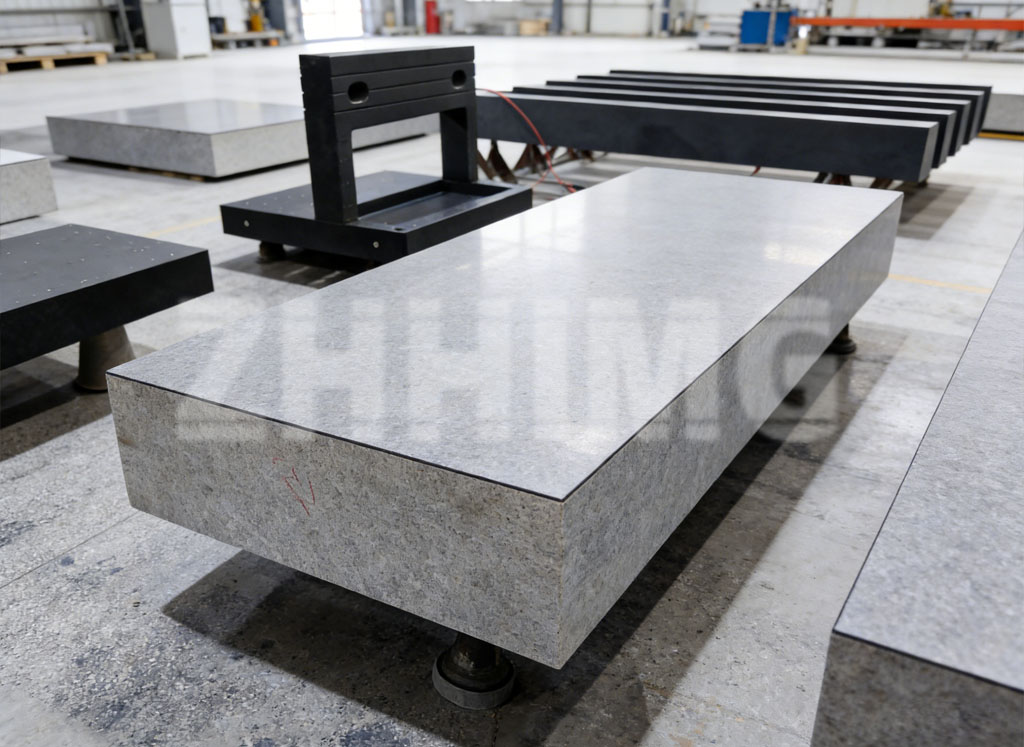
Full‑life‑cycle economic benefits should not be overlooked. Many purchasers note that granite machine bases require higher initial investment than cast‑iron alternatives. Nevertheless, their advantages become prominent when full‑life‑cycle costs are calculated. Metal bases demand regular rust removal and painting maintenance. Frequent calibration is required after rusting and wear, and complete base replacement is necessary in severe cases, resulting in substantial downtime and maintenance expenses. Wear‑resistant granite machine bases need no anti‑rust painting, simple daily maintenance and much‑prolonged calibration cycles. Long service life of the base cuts comprehensive costs from downtime, rework and spare‑part replacement. Especially in high‑value‑added production lines, stable base performance raises product yield and further amplifies overall economic returns.
Nevertheless, wear‑resistant granite machine bases have application limits. Its brittleness makes it unsuitable for heavy‑duty aggressive cutting and sustained violent‑impact scenarios. Loose ordinary marble cannot deliver the above‑mentioned comprehensive performance and shall not be misapplied. ZHHIMG selects high‑density black granite blanks with a density of 3100 kg/m³ and conducts blank flaw detection, multi‑stage stress relief, constant‑temperature gradient grinding, micropore treatment and closed‑loop pre‑delivery inspection to translate natural material advantages into finished‑part performance. Integrating dimensional stability, vibration damping, wear & corrosion resistance, clean non‑magnetic features, customization capability and full‑life‑cycle cost benefits, wear‑resistant granite machine bases represent a highly competitive base‑solution option for modern ultra‑precision equipment.
Post time: Sep-08-2026