
Machining and automated inspection production lines are constantly exposed to splashing cutting fluid, metal dust and oil mist. When benchmark parts made of cast iron or aluminum alloy work under such conditions for a long time, rust, dirt accumulation and surface wear tend to occur. Benchmark surfaces degrade gradually over service time, requiring frequent disassembly, inspection and re-lapping of equipment. ZHHIMG Group (ZHHIMG®) develops corrosion-resistant precision granite components. Adopting dense mineral substrate matched with micro-pore sealing technology, these components can steadily resist continuous erosion from workshop cutting fluid and metal dust, maintaining micron-level benchmark accuracy for a long time in wet processing and dust-intensive production lines.
Granite is naturally formed by tightly crystallized silicate minerals including quartz, feldspar and mica. It features strong chemical inertness and will never rust, unlike metal substrates vulnerable to oxidative corrosion. When common emulsified cutting fluid, semi-synthetic coolant and machine tool lubricant splash onto granite surfaces, no chemical reaction occurs with the stone matrix, and rust expansion is avoided. This eliminates hole position deformation and distortion of guide rail mounting surfaces caused by rust swelling. Nevertheless, natural granite still contains micron-scale connected micro-pores. Without dedicated sealing treatment, cutting fluid and oil will penetrate into micro-pores by capillary action, leaving stubborn stains and triggering slight hygroscopic expansion under humidity fluctuation. ZHHIMG adopts penetrating micro-pore sealing technology. Protective agent permeates the inner walls of stone micro-pores and forms a hydrophobic and oil-resistant barrier. It will not create thick coating on reference surfaces, preserves original flatness and roughness, and blocks penetration of cutting fluid and oil mist into the stone matrix, balancing precision stability and medium erosion resistance.
Corrosion-resistant granite components possess unique advantages when facing workshop metal dust and abrasive debris. Dense fine-grained granite substrate is high-hardness and hardly scratched by metal chips. Sealed surfaces are smooth and compact; dust merely adheres to the surface instead of embedding into stone pores. Metal dust will not be attracted by magnetism. Cleaning is simple: wipe dust and oil sludge residues with lint-free cloth and neutral detergent. In comparison, metal dust easily accumulates inside rust pits on cast iron platforms and gradually damages guide rails and benchmark surfaces. The sealed granite surface has no rust pits for dust accumulation, reducing measurement interference caused by dust falling onto gratings, optical lenses and sensors. It is especially suitable for on-line AOI, automated precision inspection platforms and machine tool XY substrates.
The manufacturing process of corrosion-resistant granite components has been optimized in many details for complex workshop working conditions. Micro-pore sealing is implemented after precision finishing and before delivery. Hidden areas including inner walls of holes, weight-reduction cavities and counterbore holes are protected synchronously, avoiding weak points with missing protection inside grooves and holes. Many manufacturers only treat main working surfaces while leaving native micro-pores inside holes and grooves. Cutting fluid seeps into holes and causes partial slight expansion after long-term accumulation. ZHHIMG’s overall sealing scheme grants equal corrosion resistance to all assembly features. Even if cutting fluid flows along threaded holes and wiring grooves, it cannot penetrate the stone matrix. After sealing treatment, components will stand still for inspection to verify protection performance and recheck geometric tolerances to ensure benchmark precision will not be altered. 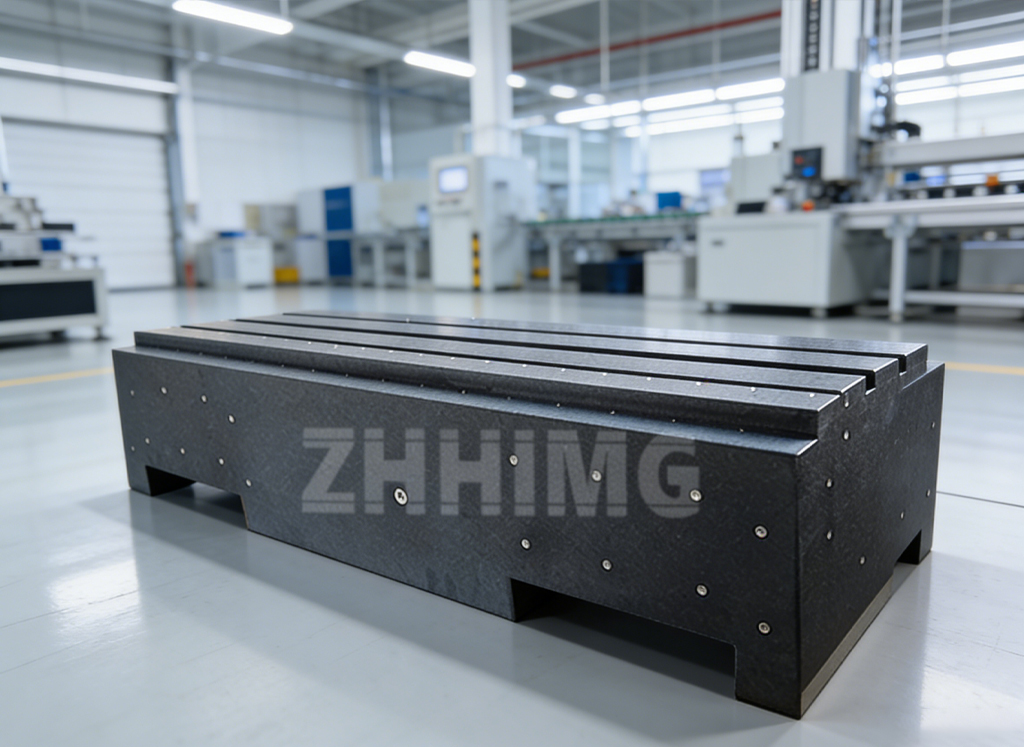
In terms of working condition adaptation, corrosion-resistant precision granite components can withstand intermittent splashing of common weak acid and weak alkaline cutting fluid, grinding fluid, hydraulic oil and lubricating oil in workshops. There are application boundaries though: long-time immersion in strong concentrated alkaline corrosive solution is not recommended. Intermittent splashing under daily working conditions can be handled stably. The components will not peel, powder or discolor after contacting cutting fluid. No particle shedding caused by metal corrosion occurs, lowering particulate pollution risks in clean workshops, suitable for production lines with strict dust control such as semiconductor sorting and new energy battery inspection.
From the perspective of equipment operation and maintenance, corrosion-resistant granite components greatly cut maintenance cost of production lines. Metal bases need regular anti-rust oil application, and oil stains will absorb dust and form stubborn sludge. Cleaning work easily scratches precision benchmarks. Granite requires no anti-rust oil and maintenance procedures are simplified. On automated production lines running 24/7 all year round, sudden benchmark failure and shutdown caused by rust will not happen, extending the overhaul cycle of complete machines. Many equipment manufacturers report that after switching wet inspection stations to corrosion-resistant granite substrates, benchmark accuracy stays stable for years, greatly reducing frequency of machine disassembly for calibration and benchmark re-lapping.
Corrosion-resistant precision granite components are not simply polished ordinary granite. They are a complete customized solution covering blank screening, precision machining, overall micro-pore sealing, medium resistance verification and full-range metrology. With manufacturing and inspection systems certified by ISO three-system and CNAS, ZHHIMG Group supplies granite precision components with cutting fluid resistance and dust erosion resistance for machine tool beds, automated inspection substrates, beams and square boxes. It addresses pain points of easy rusting, heavy dust accumulation and fast precision attenuation of benchmark parts in wet machining workshops, ensuring long-term stable operation of precision equipment.
Post time: Oct-13-2026