
Integral blank screening: the first barrier for ultra-long blanks
Short granite gauges can be processed from small raw blocks. Custom extended straightedges require monolithic giant stone blanks free of natural cracks and with evenly distributed mineral crystals. Tiny interlayers and hidden fissures inside natural granite are barely noticeable on short blanks. But once extended over several meters, machining vibration and thermal cycles amplify these defects and trigger gradual accuracy drift. Some market players use low-grade marble to fake granite; marble has high porosity and irregular crystal arrangement and cannot maintain long-term stability for extended gauges. ZHHIMG exclusively uses ZHHIMG® black granite with density around 3100kg/m³. Its dense crystals deliver superior physical performance compared with black granite sourced from Europe and America. Full-area flaw detection is implemented for incoming blanks, with adequate machining allowance reserved for multi-stage aging.
Balanced full-length stress control: the core challenge for ultra-long workpieces
Cutting and rough milling continuously introduce machining stress. Stress release for short blanks is simple. For long blanks, stress distribution tends to be uneven between the middle and two ends. If stress is not fully relieved before finishing, the ruler will deform slowly after delivery under temperature change and vibration, causing continuous linearity drift on the reference edge.
ZHHIMG adopts segmented rough machining plus multi-cycle graded aging. After each cutting pass, blanks rest in a constant-temperature workshop to simulate temperature fluctuation on customer sites and gradually release newly generated cutting stress. All procedures are completed in a 10,000 ㎡ constant-temperature & humidity workshop. The workshop floor is thicker than 1000mm, equipped with vibration isolation trenches. Silent overhead cranes reduce disturbance to guarantee stable stress release. Ultra-fine lapping only starts after stress across the whole blank reaches equilibrium.
Self-weight deflection pre-compensation: unique precision profiling challenge for long rulers
Elastic bending caused by self-weight between support points is unavoidable for long straightedges. This is the most distinctive technical difficulty separating extended granite straightedges from standard short gauges. If machined simply according to ideal straight lines, self-weight bending will bring systematic measurement error once the straightedge is placed on standard Airy support points.
At the early design stage, ZHHIMG engineers calculate deflection curves via finite element simulation based on customers’ actual support layout and embed compensation values into lapping workflow. Four large Taiwan Nantou grinders each worth more than 500,000 US dollars handle rough grinding of components up to 6 meters long. Senior technicians with over 30 years of manual lapping experience perform fine profiling segment by segment. Their micron-level tactile sensitivity works together with Renishaw laser interferometers and German Mahr dial gauges for real-time monitoring, gradually modifying edge profiles so that the reference edge approximates an ideal straight line under self-weight load.
Synchronized full-length lapping to avoid profile discontinuity from segmented processing
Extended straightedges cannot be fully ultra-fine lapped in one pass and require regional progressive processing. The major risk of segmented lapping is inconsistent stock removal across zones, creating barely visible steps and waviness over the full reference edge.
During machining, technicians strictly control material removal per lapping pass to reduce subsurface microcracks induced by grinding impact. Grid full-length linearity data is continuously collected along the reference edge, complying with DIN, ASME, JIS, GB and other global metrology standards. All measuring instruments hold calibration certificates issued by Shandong Metrology Institute and China National Institute of Metrology to ensure continuous and smooth full-length profiles without inconsistent accuracy between middle and ends. 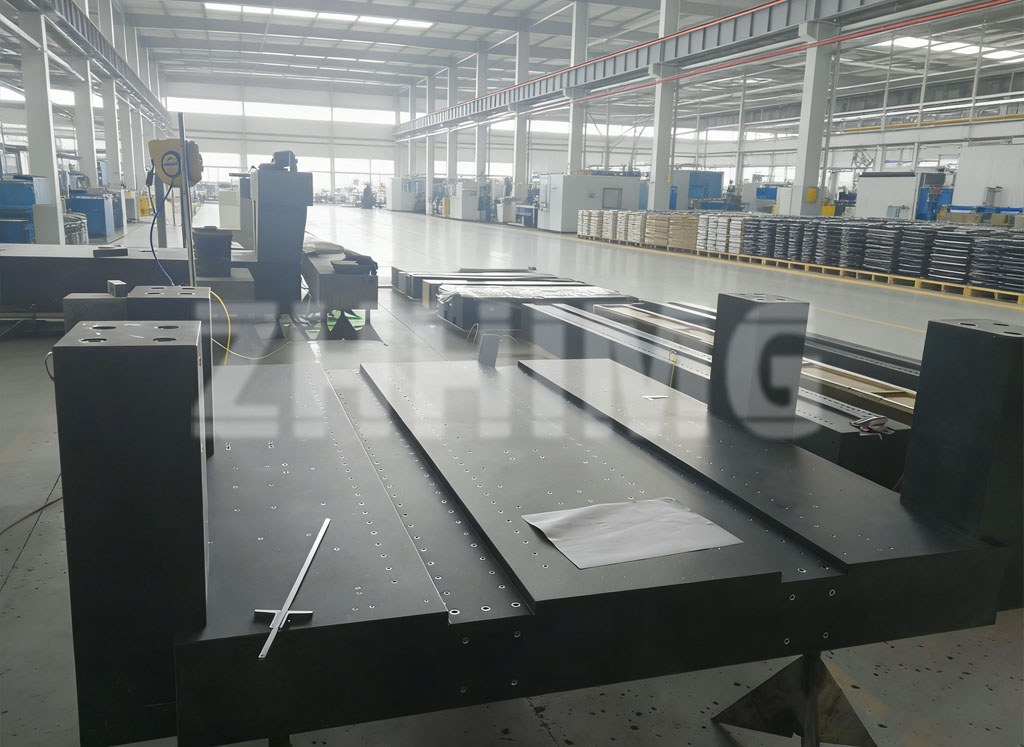
Inspection and transit protection for finished long-size products, the final precision defense
Finishing machining is not the end of production. Ultra-long components bear complex force during hoisting and transportation. Concentrated load easily triggers instantaneous deformation or hidden cracks. ZHHIMG designs dedicated hoisting points and reinforced packaging for each extended straightedge to prevent damage to finished reference edges during handling. In final inspection, thermal cycle tests simulate on-site temperature variation and verify uniform deformation over the full ruler. Products are delivered with exclusive calibration reports and support-point drawings to guide on-site operation.
As an ultra-precision component manufacturer holding ISO9001, ISO45001, ISO14001 and CE certifications simultaneously, ZHHIMG Group owns more than 20 international trademarks and patents registered across EU, United States and Southeast Asia. Long-term cooperation with National University of Singapore, National Physical Laboratory UK, Chinese Academy of Sciences and other research institutes continuously upgrades processing technology for ultra-large precision components.
Conclusion
Custom extended granite straightedges test not only single equipment capacity but the complete system workflow, covering raw blank screening, stress regulation, deflection simulation compensation, continuous long-span lapping and finished-product transit protection. In ultra-precision metrology, doubling the dimension often multiplies manufacturing difficulty many times over. Adhering to the quality policy “The precision business can’t be too demanding”, ZHHIMG follows values of Openness, Innovation, Integrity and Unity, continuously breaking through bottlenecks for large-span benchmark manufacturing, and supplying stable custom granite gauges for global semiconductor, optical inspection and large equipment calibration sectors.
Post time: Oct-15-2026