
In modern high-precision manufacturing, standard machine structures are no longer sufficient to meet the increasingly complex requirements of OEM equipment. Industries such as semiconductor processing, precision optics, aerospace systems, and advanced automation demand mechanical foundations that offer exceptional stability, long-term reliability, and high customization flexibility. As a result, custom granite components have become a critical engineering solution for OEM system designers.
These components are no longer limited to traditional surface plates or simple machine bases. Instead, they are now fully integrated structural elements designed to support high-performance motion systems, measurement platforms, and precision assembly equipment. The growing adoption of custom granite components reflects a broader shift toward system-level optimization in precision engineering.
One of the primary engineering advantages of granite is its inherent dimensional stability. Unlike metallic materials, granite is formed through natural geological processes over millions of years, resulting in a stress-relieved internal structure. This gives it excellent long-term geometric stability, making it highly suitable for OEM applications where repeatability and accuracy must be maintained over extended operational lifecycles.
When designing custom granite components, structural geometry plays a critical role. OEM equipment often requires complex shapes, multi-surface alignment features, and integrated mounting interfaces. Modern CNC grinding and diamond machining technologies allow granite to be processed with micron-level precision, enabling highly customized designs that meet strict engineering requirements. However, successful implementation depends on understanding the mechanical limitations and strengths of the material.
Granite performs exceptionally well under compressive loads but has limited tensile strength compared to metals. As a result, engineering design must carefully consider load distribution and support conditions. Finite element analysis is commonly used during the design phase to simulate stress behavior and ensure structural integrity under operational conditions. Proper engineering prevents stress concentration and ensures long-term durability of the component.
Another important aspect of OEM integration is interface design. Custom granite components often need to interface with metal structures, linear motion systems, sensors, and electronic equipment. This requires precise embedding of threaded inserts, bushings, and alignment features directly into the granite structure. These interfaces must be designed to accommodate mechanical loads while maintaining dimensional accuracy over time.
Thermal stability is another key factor influencing the performance of custom granite components. In many OEM applications, equipment is exposed to fluctuating environmental conditions or internal heat sources. Granite exhibits a low coefficient of thermal expansion, which helps maintain geometric stability under temperature variation. This makes it especially suitable for precision systems where thermal drift must be minimized.
However, thermal design is still an important consideration. Large or complex structures may experience localized temperature gradients that can influence system behavior. Engineers often incorporate thermal simulation into the design process to optimize geometry and minimize differential expansion effects. In high-precision systems, even small thermal distortions can impact performance.
Vibration damping is one of the most significant advantages of granite in OEM equipment. Compared to metallic structures, granite naturally absorbs and dissipates vibrational energy rather than transmitting it. This results in improved system stability, reduced noise, and enhanced measurement or machining accuracy. In high-speed automation systems, this damping capability directly contributes to improved process reliability.
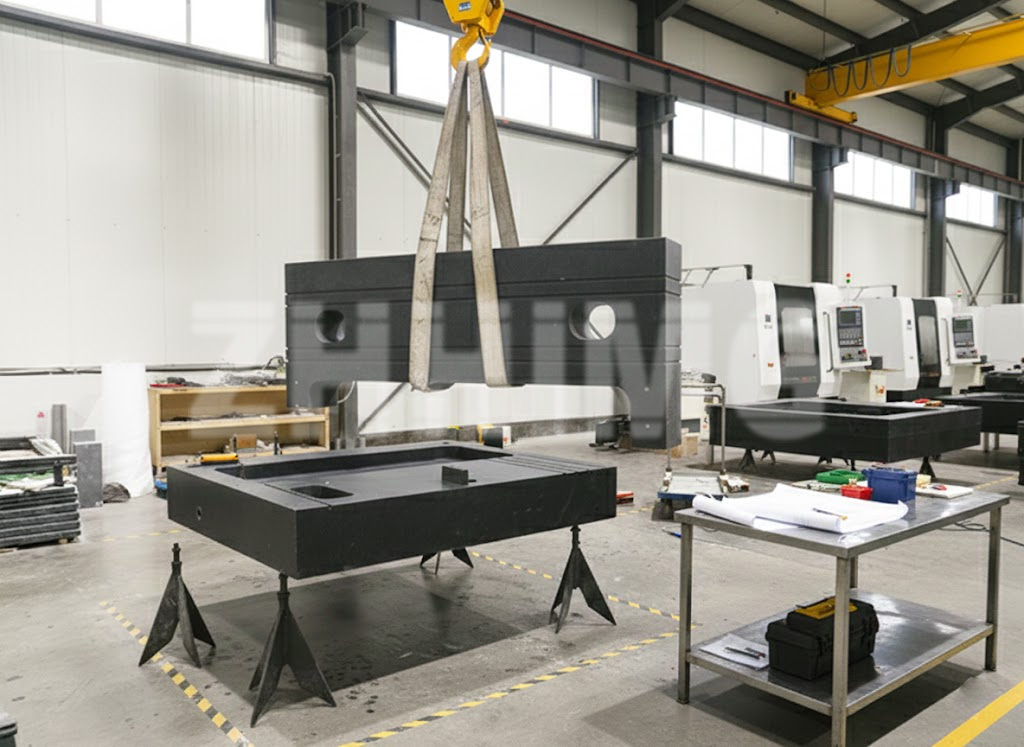
Design flexibility is another key benefit of custom granite components. Modern manufacturing techniques allow granite to be shaped into highly complex geometries, including multi-axis reference structures, integrated motion bases, and hybrid assemblies. This flexibility enables OEM manufacturers to optimize system architecture based on performance requirements rather than material limitations.
In addition, granite components can be combined with metal structures to create hybrid systems. This allows engineers to leverage the benefits of both materials, using granite for stability and damping while relying on metal for tensile strength and dynamic motion support. Such hybrid designs are increasingly common in advanced OEM equipment.
Precision manufacturing of granite components requires strict control of machining and finishing processes. Surface flatness, angular accuracy, and geometric tolerances must meet demanding specifications. Advanced metrology tools such as laser interferometers and coordinate measuring systems are used to verify dimensional accuracy throughout production.
Surface finishing techniques such as lapping and polishing are essential for achieving high-precision contact surfaces. These processes ensure that granite components meet stringent flatness requirements and provide stable reference planes for measurement or motion systems. Surface quality is particularly important in applications involving air bearings or precision guideways.
Handling and logistics must also be considered in the design of custom granite components. Due to their material properties, granite structures require careful transportation and installation procedures. Engineering designs often include integrated lifting features and modular assembly strategies to simplify handling and reduce installation risks.
From a cost perspective, custom granite components typically involve higher initial investment compared to standard metal structures. However, when evaluated over the full lifecycle of OEM equipment, they often provide significant economic advantages. These include reduced maintenance requirements, improved operational stability, and extended service life.
In high-value manufacturing environments, system downtime and recalibration costs can be substantial. By improving structural stability and reducing vibration-related errors, granite components help minimize these operational disruptions. This leads to improved productivity and lower total cost of ownership over time.
Sustainability is also becoming an increasingly important factor in material selection. Granite is a natural material with long service life and high durability, reducing the need for frequent replacement. This contributes to lower material consumption and supports long-term sustainability goals in industrial manufacturing.
As OEM equipment continues to evolve, the role of custom granite components is expected to expand further. Emerging technologies such as AI-driven automation, ultra-precision robotics, and integrated metrology systems are placing greater demands on structural performance. Granite’s combination of stability, damping, and customization capability positions it as a key material in next-generation OEM design.
In conclusion, custom granite components offer a powerful solution for OEM equipment requiring high precision, stability, and long-term reliability. Through careful engineering design and advanced manufacturing techniques, granite structures can be tailored to meet complex system requirements while delivering superior performance in demanding industrial environments.
Post time: Apr-23-2026