
In CNC machining, precision is not achieved solely through advanced control algorithms, high-speed spindles, or cutting-edge tooling. At its core, machining accuracy depends on the stability of the machine structure itself. Among the many factors that influence this stability, vibration damping stands out as one of the most critical yet often underestimated variables. As manufacturing moves toward tighter tolerances and higher surface quality requirements, the limitations of traditional metal machine bases—primarily steel and cast iron—are becoming increasingly apparent. In this context, granite foundations are emerging as a superior alternative, offering inherent vibration damping properties that significantly enhance CNC machine performance.
Vibration in CNC machines originates from multiple sources. Cutting forces during machining operations generate dynamic loads that propagate through the spindle, tool, and workpiece into the machine structure. External factors such as nearby equipment, floor resonance, and even environmental disturbances can further contribute to unwanted motion. These vibrations, whether high-frequency chatter or low-frequency structural oscillations, directly affect machining accuracy, surface finish, tool life, and overall process stability.
Traditional CNC machine bases made from steel or cast iron are designed primarily for strength and rigidity. While these materials provide the necessary load-bearing capacity, they are fundamentally limited in their ability to dissipate vibrational energy. Metals are elastic by nature, meaning they tend to transmit vibrations rather than absorb them. This results in the amplification of dynamic disturbances, particularly in high-speed machining applications where excitation frequencies can align with the natural frequencies of the machine structure.
Granite, by contrast, exhibits a fundamentally different behavior due to its internal crystalline composition. It possesses a high internal damping coefficient, which allows it to absorb and dissipate vibrational energy effectively. Instead of transmitting vibrations throughout the structure, granite converts this energy into negligible heat at a microscopic level. This property significantly reduces the amplitude of vibrations reaching critical components such as the spindle and cutting tool.
The practical implications of this difference are substantial. Reduced vibration leads to improved surface finish, as the cutting tool maintains more consistent contact with the workpiece. It also enhances dimensional accuracy by minimizing positional deviations during machining. In high-precision industries such as aerospace, mold manufacturing, and semiconductor equipment production, these improvements translate directly into higher product quality and reduced scrap rates.
Another important aspect of vibration control is the interaction between damping and stiffness. In machine design, achieving both high stiffness and high damping is a complex challenge, as these properties are often inversely related in metallic systems. Steel structures can be made extremely stiff, but increasing stiffness does not inherently improve damping. In fact, highly rigid metal structures can still exhibit significant vibration transmission if damping is insufficient.
Granite offers a more balanced combination of stiffness and damping. While it may not match the ultimate tensile strength of steel, its compressive strength and structural rigidity are more than adequate for CNC machine bases when properly engineered. More importantly, its superior damping capability compensates for any marginal differences in stiffness, resulting in an overall more stable machining platform.
Thermal stability further reinforces the advantages of granite foundations in CNC machines. Temperature fluctuations can induce thermal expansion in machine structures, leading to misalignment and dimensional errors. Metal bases, particularly steel, respond relatively quickly to temperature changes, which can exacerbate thermal drift during prolonged machining operations. Granite, with its lower coefficient of thermal expansion and higher thermal inertia, maintains dimensional stability over a wider range of environmental conditions. This reduces the coupling between thermal effects and vibration behavior, further enhancing machining accuracy.
The benefits of granite foundations are particularly evident in high-speed and ultra-precision machining applications. As spindle speeds increase, the frequency and intensity of vibrations also rise. In such scenarios, the ability of the machine base to damp vibrations becomes even more critical. Granite’s natural damping characteristics help suppress high-frequency chatter, enabling smoother cutting operations and extending tool life. This is especially valuable in the machining of hard or brittle materials, where vibration-induced defects can be costly.
In addition to performance advantages, granite foundations offer long-term stability that is difficult to achieve with metal structures. Metal components, especially those that are welded or cast, can retain residual stresses that may lead to gradual deformation over time. Even with stress-relief processes such as annealing, complete elimination of internal stress is challenging. Granite, formed under geological conditions over millions of years, is inherently stress-relieved. Once machined and stabilized, it maintains its shape with exceptional consistency, ensuring long-term alignment and accuracy of the CNC system.
Corrosion resistance is another practical benefit. Metal machine bases are susceptible to oxidation and require protective coatings or controlled environments to prevent degradation. In contrast, granite is chemically inert and does not corrode, making it suitable for a wide range of industrial environments, including those with high humidity or exposure to coolants and chemicals. This reduces maintenance requirements and contributes to lower total cost of ownership.
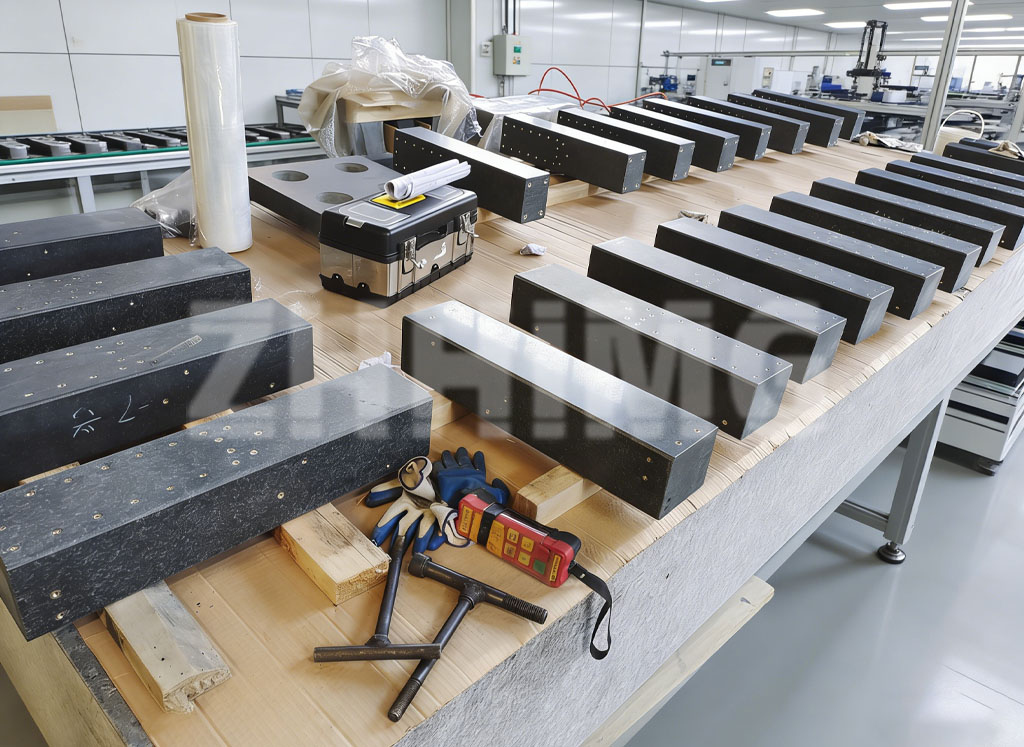
Advancements in manufacturing technology have played a significant role in enabling the adoption of granite foundations in CNC machines. Modern precision machining techniques, including CNC grinding and diamond tooling, allow granite components to be produced with high geometric accuracy. Additionally, the integration of threaded inserts, bonded joints, and hybrid assemblies has expanded the functional capabilities of granite structures. These innovations make it possible to design CNC machines that leverage the benefits of granite while maintaining compatibility with conventional mechanical components.
Despite its advantages, granite is not without challenges. Its brittleness requires careful handling during manufacturing, transportation, and installation. Impact resistance is lower than that of metals, and design considerations must account for load distribution and potential stress concentrations. However, these challenges are well understood within the industry and can be effectively managed through proper engineering and quality control.
Cost is another factor that influences material selection. Granite machine bases may have higher initial manufacturing costs compared to standard metal structures, particularly for complex designs. However, when evaluated over the full lifecycle of the machine, the benefits of reduced vibration, improved accuracy, lower maintenance, and extended service life often outweigh the initial investment. For high-value manufacturing applications, the return on investment can be substantial.
The growing adoption of granite foundations reflects a broader shift in CNC machine design philosophy. Rather than focusing solely on maximizing stiffness or power, modern designs emphasize holistic system performance, where vibration control, thermal stability, and material behavior are integrated into a unified approach. In this context, granite is not merely an alternative material—it is a strategic enabler of next-generation machining capabilities.
Industries that demand the highest levels of precision are leading this transition. In semiconductor manufacturing, where nanometer-scale features are common, even the smallest vibration can compromise product quality. In aerospace machining, where complex geometries and tight tolerances are standard, stability is essential for ensuring compliance and safety. In medical device manufacturing, where consistency and reliability are critical, vibration control directly impacts product performance.
Looking ahead, the importance of vibration damping in CNC machines will only increase as manufacturing technologies continue to evolve. High-speed machining, additive-subtractive hybrid systems, and AI-driven process optimization all place greater demands on machine stability. Materials that can effectively manage dynamic behavior will be essential for achieving the next level of precision and efficiency.
In conclusion, vibration damping is a fundamental determinant of CNC machine performance, influencing accuracy, surface quality, and operational efficiency. While traditional metal foundations provide strength and rigidity, they fall short in their ability to dissipate vibrational energy. Granite, with its inherent damping properties, thermal stability, and long-term reliability, offers a compelling alternative. As the demands of high-precision manufacturing continue to grow, granite foundations are poised to play an increasingly central role in the design and operation of advanced CNC systems.
Post time: Apr-23-2026