
In the world of precision manufacturing, the journey from concept to finished component is as critical as the final product itself. Custom granite components have become indispensable in industries demanding sub-micron accuracy—from semiconductor lithography equipment to coordinate measuring machines (CMMs). Understanding the complete manufacturing process helps engineers and procurement professionals make informed decisions when selecting a granite manufacturer for their critical applications.
This comprehensive guide walks through every stage of custom granite component production, from initial 3D drawings to rigorous final inspection, revealing the expertise and technology required to deliver precision granite parts that meet the most demanding specifications.
The Foundation: Understanding Custom Granite Components
What Makes Granite Ideal for Precision Applications?
Before diving into the manufacturing process, it’s essential to understand why granite has become the material of choice for precision metrology and high-tech manufacturing applications. Natural granite possesses a unique combination of properties that engineered metals simply cannot match:
Thermal Stability: Granite exhibits a low coefficient of thermal expansion (approximately 4.5×10⁻⁶/°C), which is 80% lower than steel. This means custom granite components maintain their dimensional accuracy even when ambient temperatures fluctuate by ±15°C or more—a critical advantage in environments where temperature control is challenging or costly.
Superior Vibration Damping: The internal crystalline structure of high-density black granite provides natural damping ratios of 0.012–0.015, compared to just 0.001 for cast iron. This translates to 95% vibration attenuation at frequencies between 50–500Hz, significantly reducing measurement errors and improving surface finish quality in machining applications.
Chemical and Magnetic Neutrality: Granite is naturally non-magnetic and resistant to corrosion from acids, alkalis, and coolants. This makes it ideal for cleanroom environments, semiconductor fabrication facilities, and applications where electromagnetic interference must be minimized.
Long-Term Dimensional Stability: Having undergone millions of years of natural aging, granite contains no residual internal stresses. Custom metrology parts manufactured from granite maintain their accuracy for decades with minimal maintenance, unlike metal components that may require frequent recalibration.
Applications Across Industries
Custom granite components serve as the foundation for precision across multiple sectors:
- Semiconductor Manufacturing: Granite bases and stages for photolithography equipment, wafer inspection systems, and EUV lithography tools
- Metrology Systems: CMM granite bases, surface plates, and inspection tables
- Aerospace: Precision assembly fixtures and measurement reference surfaces
- Optics: Granite structures for optical alignment systems and laser processing equipment
- Automotive: Inspection equipment and precision assembly tooling
Stage 1: Engineering Review and 3D Drawing Analysis
The Critical First Step
The manufacturing process begins when a customer submits their technical drawings—typically 3D CAD models in formats such as STEP, IGES, or native SolidWorks/ProE files. This initial stage is crucial and often determines the success of the entire project.
Drawing Feasibility Assessment: Experienced engineers review each drawing for manufacturability. Key considerations include:
- Geometry complexity: Can the required features be machined within tolerance?
- Material selection: Is the specified granite grade appropriate for the application?
- Structural integrity: Will the component maintain stability under expected loads?
- Tolerance achievability: Are the specified flatness, parallelism, and perpendicularity requirements realistic?
Tolerance Analysis: For custom metrology parts, tolerances are typically specified in microns. Engineers verify that requested tolerances align with international standards such as:
- DIN 876 (German standard for surface plates)
- ASME Y14.5 (American geometric dimensioning and tolerancing)
- GB/T 22095-2008 (Chinese standard for granite surface plates)
- ISO 8512-2 (International standard for granite surface plates)
Design Optimization Recommendations
A skilled granite manufacturer doesn’t simply execute drawings—they add value through design optimization. Common recommendations include:
- Stress distribution analysis: Suggesting geometry modifications to improve load-bearing capacity
- Thermal management features: Incorporating design elements that enhance temperature uniformity
- Mounting interface optimization: Designing attachment points that minimize distortion during installation
- Cost-effective alternatives: Proposing modifications that reduce machining complexity without compromising performance
This collaborative approach ensures that the final custom granite components not only meet specifications but exceed customer expectations in real-world applications.
Stage 2: Material Selection and Block Procurement
Selecting the Right Granite
Not all granite is created equal. For precision applications, material selection is governed by stringent criteria:
Mineral Composition: Premium granite for metrology applications should contain:
- High quartz content (≥25%): Quartz provides hard, wear-resistant bearing points
- Uniform grain structure: Ensures consistent mechanical properties throughout
- Low mica content (<5%): Excessive mica can compromise surface finish
Physical Property Requirements:
| Property | Requirement | Standard |
|---|---|---|
| Density | ≥2.65 g/cm³ | ASTM C97 |
| Hardness | ≥70 HS (Shore) | ASTM C135 |
| Water Absorption | <0.25% | ASTM C97 |
| Compressive Strength | ≥2290 kg/cm² | ASTM C170 |
| Elastic Modulus | >0.6×10⁴ kg/cm² | ISO 8512-2 |
Source Verification: Reputable granite manufacturers maintain documented supply chains and can provide material certificates verifying:
- Quarry origin and extraction date
- Physical and mechanical test results
- Petrographic analysis confirming mineral composition
Material Stress Relief
Freshly quarried granite contains internal stresses from the extraction process. Before machining, premium granite manufacturers implement stress-relief protocols:
Natural Aging: Large blocks are stored for extended periods (typically 6-12 months) allowing internal stresses to dissipate naturally.
Thermal Cycling: Some manufacturers employ controlled thermal cycling—heating granite to 80°C and allowing gradual cooling—to accelerate stress relief. This process is repeated multiple times to ensure dimensional stability.
Quality Verification: After stress relief, blocks undergo preliminary inspection using electronic levels or laser measurement systems to confirm dimensional stability before committing to extensive machining operations.
Stage 3: Precision Cutting and Rough Machining
From Block to Blank
Once material is selected and stress-relieved, the transformation from raw block to machined blank begins:
Primary Cutting: Large granite blocks are cut into slabs or rough blanks using:
- Diamond wire saws: Achieve cutting speeds of 1.5-2.0 m²/hour with minimal waste—ideal for expensive premium granite grades
- Gang saws: Process 25-45 m²/hour for high-volume production
- Bridge saws: Offer flexibility for custom sizes and complex cuts
Dimensional Allowance: Rough-cut blanks are intentionally oversized to accommodate material removed during subsequent grinding operations. Typical allowances include:
- Length/width: +5-10mm over final dimensions
- Thickness: +3-5mm over final specification
CNC Rough Machining
Modern granite machining services employ 5-axis CNC machining centers capable of:
- Positioning accuracy: ±0.01mm
- Complex contouring: Curved surfaces, angled features, and compound geometries
- Multiple operations in single setup: Drilling, milling, and profiling without repositioning
Feature Generation: During rough machining, operators establish:
- Primary mounting surfaces
- Major geometric features (holes, slots, counterbores)
- Preliminary flat surfaces ready for precision grinding
Stage 4: Precision Grinding and Lapping
The Heart of Granite Machining
Precision grinding transforms a rough machined blank into a metrology-grade component. This stage requires exceptional skill, specialized equipment, and controlled environmental conditions.
Multi-Stage Grinding Process:
Stage 1 – Rough Grinding: Using coarse diamond abrasives (60-100 grit), operators rapidly remove material to achieve approximate dimensions. This stage typically removes 1-3mm of material.
Stage 2 – Semi-Fine Grinding: Progressively finer abrasives (200-400 grit) remove deep scratches from rough grinding and refine flatness to within 0.01-0.02mm of final specification.
Stage 3 – Fine Grinding: Skilled technicians use precision grinding equipment with fine abrasives (600-1200 grit) to achieve tolerances within 0.001-0.005mm.
Stage 4 – Lapping/Polishing: Final surface finishing using diamond pastes or specialized lapping compounds produces the characteristic mirror-like finish of precision granite components. Surface roughness (Ra) valuesof 0.1-0.4 μm are typical for metrology-grade surfaces.
Environmental Control
Precision grinding must be performed in temperature-controlled environments to achieve sub-micron tolerances:
- Temperature stability: ±0.5°C or better
- Humidity control: 40-60% relative humidity
- Vibration isolation: Floors isolated from external vibration sources
- Clean air filtration: Minimizes airborne particles that could contaminate grinding surfaces
Manual Fine Grinding: The Art of Precision
Despite advances in CNC technology, the final stages of precision grinding often rely on skilled manual techniques. Experienced craftsmen develop an intuitive feel for:
- Optimal grinding pressure and speed
- Detection of subtle surface irregularities
- Correction of geometric errors measured in millionths of an inch
This combination of automated precision and human expertise is what separates premium granite manufacturers from commodity suppliers.
Stage 5: Feature Machining and Insert Installation
Precision Drilling and Milling
Custom granite components frequently require features that integrate with other equipment:
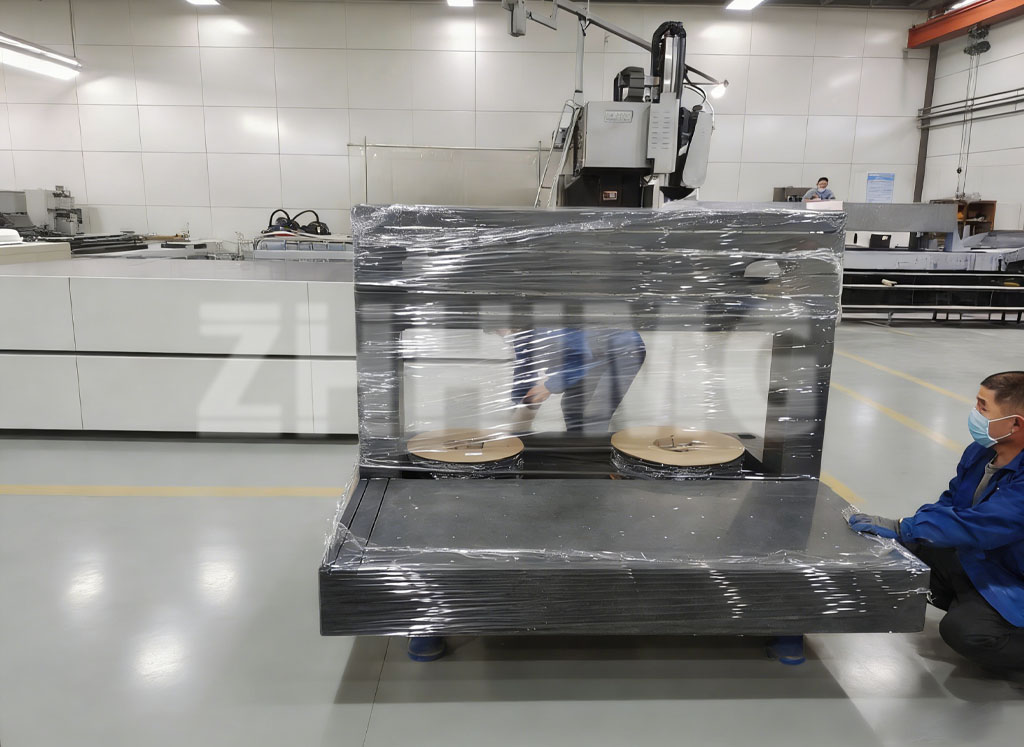
Hole Features:
- Through-holes for mounting hardware
- Counterbored holes for flush-mounted fasteners
- Precision-bored holes for bearing sleeves or定位pins
Slotting and Milling:
- T-slots for workholding accessories
- Dovetail slots for precision slides
- Cable management channels
Steel Insert Installation
Steel inserts are commonly installed in granite components to provide:
- Threaded mounting points
- Hardened wear surfaces for sliding components
- Ground reference surfaces for precision assembly
Insert Bonding Methods:
- Epoxy bonding: High-strength epoxy compounds provide permanent attachment
- Mechanical locking: Inserts with serrated or knurled surfaces engage with the granite substrate
- Thermal fitting: Inserts installed with interference fits using thermal expansion/contraction
Quality-conscious granite manufacturers verify insert installation through:
- Pull-out strength testing
- Positional accuracy verification using coordinate measuring machines
- Thread gauge verification for threaded inserts
Stage 6: Dimensional Verification and Calibration
Measuring Precision Granite Components
Final inspection is perhaps the most critical stage in producing custom metrology parts. Measurement accuracy must exceed the tolerances being verified—a principle known as the “10:1 rule” (measurement uncertainty should be ≤10% of tolerance).
Key Measurement Parameters:
| Parameter | Measurement Method | Typical Tolerance |
|---|---|---|
| Flatness | Electronic level, laser interferometer | 0.5-2.0 μm/m² |
| Parallelism | Laser measurement, CMM | 1.0-5.0 μm |
| Perpendicularity | Optical comparator, precision square | 1.0-5.0 μm |
| Surface roughness | Profilometer | Ra 0.1-0.4 μm |
| Dimensional accuracy | CMM, laser tracker | ±0.01-0.05mm |
Calibration Equipment and Standards
Reputable granite manufacturers maintain calibration programs traceable to national standards:
- Laser interferometers: Renishaw XL-80 or equivalent for high-accuracy linear measurements
- Electronic levels: WYLER or similar for flatness and angle measurements
- Coordinate measuring machines: Calibrated to ISO 10360 standards
- Surface plates: Reference-grade granite surface plates for comparative measurements
Stability Testing
Before final acceptance, precision granite components undergo stability verification:
12-Hour Stabilization: After initial calibration, components are allowed to stabilize for 12 hours in a controlled environment before re-measurement.
Repeatability Verification: Multiple measurement cycles confirm that dimensional readings are repeatable within specified tolerances.
Environmental Conditioning: Some manufacturers subject components to controlled temperature variations to verify thermal stability.
Stage 7: Final Inspection and Documentation
Comprehensive Quality Verification
The final inspection stage ensures that custom granite components meet all customer requirements before shipment:
Visual Inspection: Surface examination under controlled lighting to identify:
- Scratches, chips, or other surface defects
- Color and texture consistency
- Quality of edge profiles and corner treatments
Dimensional Verification: Complete measurement against original drawings:
- All critical dimensions verified and recorded
- Geometric tolerances (flatness, parallelism, perpendicularity) confirmed
- Feature locations (hole positions, slot dimensions) validated
Functional Testing: For components with special requirements:
- Insert pull-out strength (where specified)
- Surface friction characteristics
- Compatibility with mating components
Documentation and Traceability
Professional granite manufacturers provide comprehensive documentation with each custom granite component:
- Inspection reports: Detailed measurement results with actual values versus specifications
- Material certificates: Verification of granite grade and physical properties
- Calibration certificates: Traceability documentation for all measuring equipment used
- Packing lists and handling instructions: Guidelines for proper storage, transportation, and installation
Choosing the Right Granite Manufacturer
Evaluating Manufacturing Capabilities
When selecting a partner for custom granite components, consider these critical factors:
Technical Expertise:
- Engineering support for design optimization
- Experience with your specific application (semiconductor, metrology, aerospace)
- Capability to achieve your required tolerances
Quality Systems:
- ISO 9001 certification (minimum requirement)
- Calibration program traceable to national standards
- Documented quality control procedures
Manufacturing Infrastructure:
- Temperature-controlled machining and inspection facilities
- Modern CNC equipment capable of your required precision
- In-house measurement capabilities (CMM, laser interferometer)
Project Support:
- Responsive communication and technical support
- Realistic lead times and on-time delivery record
- Flexibility for design changes during production
Questions to Ask Potential Suppliers
- What granite grades do you offer, and can you provide material certificates?
- What is your largest single-piece machining capability?
- Can you achieve tolerances of [your specification]—and provide documented proof?
- What is your typical lead time for custom granite components of this complexity?
- Do you offer design review and optimization services?
- Can you provide references from customers with similar applications?
Conclusion: Precision from Start to Finish
The manufacture of custom granite components is a sophisticated process that combines geological science, precision engineering, and skilled craftsmanship. From the initial review of 3D drawings through final inspection, each stage requires specialized knowledge, advanced equipment, and unwavering attention to detail.
For engineers and procurement professionals sourcing OEM granite parts, understanding this complete process provides valuable context for evaluating suppliers and setting realistic expectations. The best granite machining services don’t simply produce parts—they partner with customers to optimize designs, ensure manufacturability, and deliver precision components that perform reliably for decades.
As industries continue pushing toward tighter tolerances and higher precision, the role of custom granite components will only grow in importance. Whether you’re developing next-generation semiconductor equipment, upgrading metrology systems, or designing precision automation platforms, the foundation you choose matters. Select a granite manufacturer with the expertise, capabilities, and commitment to quality that your application demands.
Post time: Apr-17-2026