
Ordering a custom granite machine base begins with a clear definition of what the base must support, locate, and reference within your machine.
For OEM engineers and procurement teams, a useful request for quotation (RFQ) should include more than overall dimensions. It should identify the functional surfaces, mounting interfaces, geometric tolerances, support conditions, and inspection requirements that determine whether the finished component will fit and perform as intended.
This guide provides a practical checklist for preparing a granite machine base inquiry, reviewing your drawings, and comparing supplier quotations.
What Should You Include in a Granite Machine Base RFQ?
For an initial technical review, prepare the following information:
| Information | What to provide |
|---|---|
| Application | Equipment type and the role of the granite base |
| Drawings | Current 2D drawings and available 3D models |
| Overall dimensions | Length, width, height, and major structural features |
| Functional surfaces | Reference faces, mounting faces, and inspection datums |
| Tolerances | Required dimensions and geometric tolerances |
| Mounting interfaces | Threaded inserts, holes, slots, recesses, and mating components |
| Load and support | Component loads, support locations, and installation arrangement |
| Operating conditions | Relevant temperature, cleanliness, and other environmental requirements |
| Inspection | Required measurements, reports, and acceptance criteria |
| Delivery | Quantity, destination, requested schedule, and packaging requirements |
If some information is not yet available, identify it as pending rather than leaving the supplier to assume the requirement.
1. Explain the Application and Supply Scope
Start by describing the equipment and the function of the granite component.
Is it a structural machine base, a metrology reference, a gantry component, or part of a precision motion assembly? Will the supplier deliver a standalone granite part, a component with installed inserts, or an assembly that includes additional hardware?
A short application description helps establish the scope of the quotation.
For example:
We require a custom granite base for an optical inspection machine. The supply scope includes the granite component, installed threaded inserts, and an inspection report. Linear guides, motion components, and final machine assembly are excluded.
This is more useful than an inquiry that simply states “granite base required.”
Also identify the responsibilities of each party. If the customer supplies mating components or assembly drawings, specify when those items will be available.
2. Provide Controlled Drawings and Available 3D Models
Send the current drawing revision and make sure every file describes the same design.
A 3D model can help communicate the shape and arrangement of a component. The drawing should clearly state the requirements used for manufacturing and acceptance, including dimensions, tolerances, material notes, and inspection references.
Useful drawing information includes:
- Part name and part number.
- Revision number and issue date.
- Units of measurement.
- Overall dimensions.
- Datum references.
- Critical dimensions and geometric tolerances.
- Insert and mounting details.
- Applicable technical notes.
Where the drawing and model contain different information, state which document governs or resolve the difference before production approval.
For quotation-stage designs, clearly mark preliminary features. This allows the supplier to distinguish confirmed requirements from details that may still change.
3. Identify Functional Surfaces and Datums
Not every surface on a granite machine base performs the same function.
Some surfaces support machine components. Others locate an assembly or establish a reference for inspection. Your drawing should distinguish these functional areas from surfaces that have no precision locating role.
Identify, where applicable:
- The primary reference surface.
- Linear guide or stage mounting areas.
- Vertical locating faces.
- Assembly reference edges.
- Support contact areas.
- Surfaces requiring a specified finish.
For each important surface, explain what it interfaces with and which other features it must relate to.
For example, a mounting face may need a defined relationship to a reference plane. An insert pattern may need to be located from specified datums rather than from an unqualified outside edge.
The goal is to make the functional requirements clear, so manufacturing and inspection address the same design intent.
4. Specify the Required Accuracy by Feature
“High precision” is not a complete acceptance requirement.
Instead, identify which features require control and how those requirements will be evaluated. Depending on the design, the drawing may address:
- Flatness.
- Straightness.
- Parallelism.
- Perpendicularity.
- Feature location.
- Overall dimensions.
- Surface texture.
These terms describe different characteristics. Avoid using a single statement such as “accuracy: 1 μm” without identifying the feature, measurement extent, datum relationship, and acceptance conditions.
Likewise, do not apply the tightest requirement to every surface unless the design genuinely requires it.
If a tolerance is still being evaluated, ask the supplier to review it rather than treating an unconfirmed figure as a final production requirement.
5. Define Threaded Inserts, Holes, and Mounting Interfaces
Mounting interfaces deserve the same attention as the main granite geometry.
For each threaded insert, specify the information needed to identify and install it, such as:
- Thread type and size.
- Required thread engagement or usable depth.
- Insert location.
- Insert orientation.
- Position relative to the mounting surface.
- Relevant material or compatibility requirements.
- Any specified assembly or tightening requirements.
Also show clearance holes, recesses, slots, access openings, and features needed for surrounding components.
Where possible, include the mating component drawing. This can help clarify whether the interface is intended for fastening, locating, adjustment, or clearance.
If particular inserts or accessories must be customer-approved, state that requirement in the RFQ.
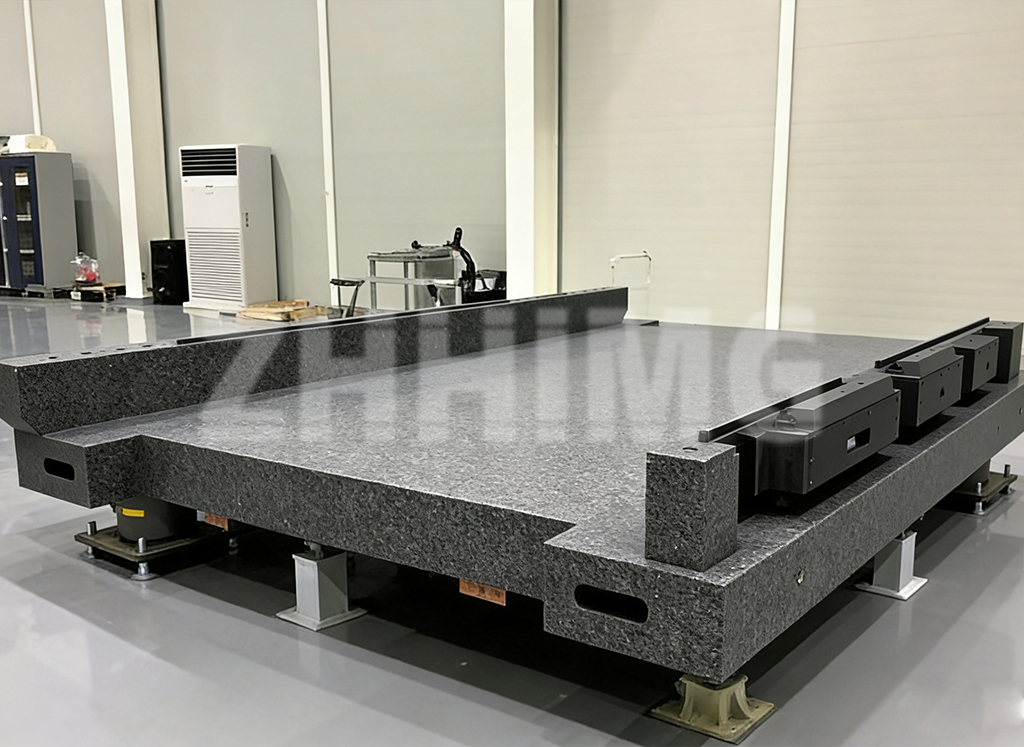
6. Describe Loads and Support Conditions
Include a drawing or sketch showing how the granite base will be supported and what it will carry.
Useful information includes:
- Support locations and contact areas.
- Equipment or component masses.
- Concentrated loads and their locations.
- Moving assemblies and their operating range.
- Mounting arrangements between the base and its stand.
- Any defined lifting or handling restrictions.
Distinguish normal operating conditions from transport and installation conditions.
If performance must be checked in a particular support arrangement, make that arrangement part of the inspection discussion. The quotation and acceptance plan should not rely on different, unstated assumptions about how the base is supported.
7. Agree on Inspection and Acceptance Before Ordering
Define the required inspection deliverables during the quotation stage.
Rather than asking only for a “quality certificate,” list the characteristics that require recorded results.
An inspection request might identify:
| Inspection item | Information to agree |
|---|---|
| Overall dimensions | Dimensions to be recorded and acceptance limits |
| Reference surface | Specified geometric requirement and measurement extent |
| Mounting faces | Required relationships to the agreed datums |
| Insert locations | Features to be checked and reporting format |
| Inspection conditions | Relevant support arrangement and environmental conditions |
| Documentation | Report identification, drawing revision, and required traceability information |
If your organization requires a particular standard, provide its full designation and applicable edition for review.
Also distinguish component acceptance from final machine acceptance. A conforming granite component does not, by itself, demonstrate that every performance target of the completed machine has been achieved.
8. Include Packaging and Delivery Requirements
For an international order, the RFQ should also define the delivery scope.
Provide:
- Order quantity.
- Delivery destination.
- Requested delivery schedule.
- Applicable delivery terms.
- Packaging or handling restrictions.
- Receiving-site unloading limitations.
- Required shipping and inspection documents.
Ask the supplier to identify any exclusions in its quotation.
Where the equipment project has fixed installation dates, discuss the sequence of drawing approval, manufacturing, inspection, packing, and shipment rather than relying only on a requested arrival date.
How to Compare Granite Machine Base Quotations
Before comparing prices, check that each supplier has quoted the same scope.
Review whether the offers include:
- The same drawing revision.
- The same granite component and accessories.
- The same insert specification.
- The same tolerances and inspection requirements.
- The same assembly work.
- The same packaging and delivery responsibilities.
Ask suppliers to list assumptions, exceptions, and proposed changes separately.
A quotation is easier to evaluate when the technical scope is explicit. A lower price with missing inspection, accessories, or delivery items is not a like-for-like comparison.
Copy-and-Use RFQ Template
Use the following template when preparing your inquiry:
Subject: RFQ — Custom Granite Machine Base for [Equipment/Application]
Dear ZHHIMG Team,
Please review the attached documents and provide a quotation for the following custom granite component.
Application:
Part number and drawing revision:
Quantity:
Overall dimensions:
Required supply scope:
Critical surfaces and tolerances:
Threaded inserts and mounting interfaces:
Load and support arrangement:
Operating conditions:
Inspection and documentation requirements:
Delivery destination:
Requested schedule:Please identify any additional information required, technical exceptions, and assumptions included in your quotation.
Discuss Your Custom Granite Base Project with ZHHIMG®
ZHONGHUI Group supplies precision granite components, machine bases, measuring products, and granite assembly solutions for precision equipment applications.
For a project inquiry, send your current drawings, application description, quantity, and inspection requirements. If the design is preliminary, identify the details that remain open for discussion.
A clearly defined RFQ gives both your team and the supplier a stronger starting point for technical review, quotation, and production planning.
Post time: Oct-29-2026