
A useful quotation for a custom granite machine base starts with more than its overall dimensions. To evaluate your project properly, a supplier needs to understand how the base will be used, which surfaces are critical, how components will be mounted, and how the finished part will be inspected.
Whether you are developing a linear motor stage, a metrology system, a laser machine, or semiconductor inspection equipment, a clear request for quotation—RFQ—helps establish a shared understanding before manufacturing begins.
This guide explains what to include in your RFQ, which technical details to confirm, and how to compare quotations on a consistent basis.
1. Explain the Application and Scope of Supply
Start with a short description of the equipment and the role of the granite base.
Will it serve as a structural foundation, a measurement reference, a mounting platform for linear guides, or part of an air-bearing system? Does the project require a single granite component, a matched set of components, or an assembly?
Include:
- Equipment type and intended application.
- The function of the granite component.
- Prototype quantity and expected production quantity.
- Components that will be mounted on the base.
- Whether the supplier is quoting the granite part only or additional assembly and inspection work.
For example, “granite base for an inspection machine” leaves several questions unanswered. A more useful description would identify the motion system, mounting interfaces, approximate load, and critical reference surfaces.
If your design is still under development, identify which requirements are confirmed and which remain open for discussion.
2. Provide Controlled Drawings and a 3D Model
Send a dimensioned 2D drawing and, where available, a corresponding 3D model.
The drawing should communicate the requirements used for manufacturing and acceptance. The 3D model helps explain the geometry, particularly where the base includes pockets, channels, recesses, or multiple mounting interfaces.
Your drawing package should identify:
- Overall length, width, and thickness.
- Critical dimensions and tolerances.
- Datum surfaces and their order of reference.
- Mounting holes, inserts, slots, pockets, and recesses.
- Precision working surfaces.
- Drawing number, revision, units, and issue date.
Make sure the drawing and model refer to the same design revision. If a dimension or feature differs between files, clarify which document takes precedence before requesting a final quotation.
A clearly controlled drawing package also makes it easier to compare quotations from different suppliers.
3. Identify Critical Surfaces and Geometric Requirements
A request such as “high-precision granite base” does not define an acceptance requirement.
Instead, identify the surfaces and relationships that matter to your machine. Depending on the design, these may include:
- Flatness of a working or mounting surface.
- Straightness of a guideway or rail seat.
- Parallelism between mounting surfaces.
- Perpendicularity between horizontal and vertical reference faces.
- Position of holes, inserts, and locating features.
Specify the required tolerance for each critical feature rather than applying the tightest requirement to the entire component.
For example, a rail mounting surface, an underside clearance pocket, and an external non-functional face may serve very different purposes. Your drawing should make those differences clear.
Where a requirement depends on a particular support arrangement or inspection condition, include that information in the specification.
4. Describe Loads, Supports, and Installation Interfaces
The supplier should understand how the base will be supported and what will be installed on it.
Provide the information available for your project, including:
- Mass and location of fixed equipment.
- Moving payload and travel range.
- Relevant operating forces or motion conditions.
- Support locations and mounting interfaces.
- Connections to a machine frame or isolation system.
- Installation constraints at the destination.
A simple assembly layout can be helpful when the load distribution is difficult to explain in text.
Also distinguish between the condition used for inspection and the condition used in the final machine. If these arrangements differ, discuss how the acceptance requirements should be defined.
Avoid leaving support locations to assumption when they are important to the machine design.
5. Define Threaded Inserts and Machined Features
Threaded inserts and mounting features should be included in the RFQ rather than treated as details to resolve after ordering.
For each insert or mounting interface, specify the applicable requirements:
- Thread size and pitch.
- Insert location and depth.
- Insert material, where required.
- Position relative to the drawing datums.
- Mating component or installation purpose.
- Relevant fastening or loading requirements.
Also identify through-holes, counterbores, clearance pockets, cable channels, and other machined features.
If rail seats, motor mounts, encoder interfaces, or air-bearing surfaces are involved, provide the relevant mating-part information. Do not assume that a general equipment description defines these interfaces.
Where a feature is not yet finalized, mark it as pending confirmation rather than allowing it to become an undocumented assumption.
6. Agree on Inspection and Acceptance Before Ordering
Inspection requirements belong in the RFQ, not only in the final delivery discussion.
Ask the supplier to confirm:
- Which features will be inspected.
- Which requirements will appear in the inspection report.
- The proposed measurement methods.
- The support arrangement during inspection.
- Relevant environmental conditions.
- Required calibration or traceability documentation.
- Whether customer review or witness inspection is needed.
If your quality system requires measured values rather than a pass/fail statement, specify that requirement in advance.
Likewise, if you require a particular standard, identify its exact designation, applicable edition, and relevant requirements. Avoid relying on an informal description such as “international standard accuracy.”
For demanding projects, an agreed inspection plan can help establish how the drawing requirements will be verified.
7. Confirm Material Requirements
If your project requires a particular granite material, state it in the RFQ.
Useful information may include:
- Material designation or agreed specification.
- Required material documentation.
- Restrictions on material substitution.
- Any project-specific requirements for appearance or surface condition.
If a material property is important to your equipment design, request the relevant data and clarify its basis.
Material selection and finished-part acceptance should be discussed separately: a material description alone does not define the geometric accuracy of the completed base.
8. Include Packaging, Handling, and Delivery Requirements
The RFQ should also explain where the component is going and how it will be received.
Provide:
- Destination country and delivery location.
- Requested delivery terms.
- Required delivery date.
- Site access or unloading restrictions.
- Available lifting equipment.
- Packaging or shipment-document requirements.
- Any storage period expected before installation.
For large or complex components, request confirmation of the proposed handling and packaging arrangements.
Also distinguish manufacturing completion from arrival at your facility. This avoids comparing quotations that use different definitions of delivery time.
9. Compare Quotations Against the Same Requirements
Before selecting a supplier, check that each quotation covers the same drawing revision and scope.
| Comparison item | What to confirm |
|---|---|
| Design baseline | Same drawing and model revision |
| Material | Agreed material and documentation |
| Precision requirements | Same features, tolerances, and acceptance conditions |
| Inserts and machining | All specified interfaces included |
| Inspection | Agreed report scope and measurement requirements |
| Assembly | Clear distinction between included and excluded work |
| Packaging | Suitable arrangements included or separately identified |
| Delivery | Consistent delivery terms and schedule basis |
| Open issues | Assumptions, exclusions, and pending decisions clearly listed |
A lower price is difficult to evaluate when the underlying scope is different.
Ask suppliers to identify exceptions explicitly. This makes the quotation review more useful than comparing a total price alone.
Custom Granite Machine Base RFQ Checklist
Before sending your inquiry, check whether your RFQ includes the following:
- Application and equipment description.
- Prototype or production quantity.
- Current 2D drawing and available 3D model.
- Drawing revision and units.
- Critical surfaces and datum definitions.
- Dimensional and geometric tolerances.
- Load information and support arrangement.
- Threaded insert and mounting-interface requirements.
- Material requirements.
- Inspection and documentation requirements.
- Scope of assembly, if applicable.
- Packaging, destination, and delivery requirements.
Not every project begins with a complete specification. If information is missing, identify it clearly and request a technical review before the design is released for production.
Discuss Your Project with ZHHIMG®
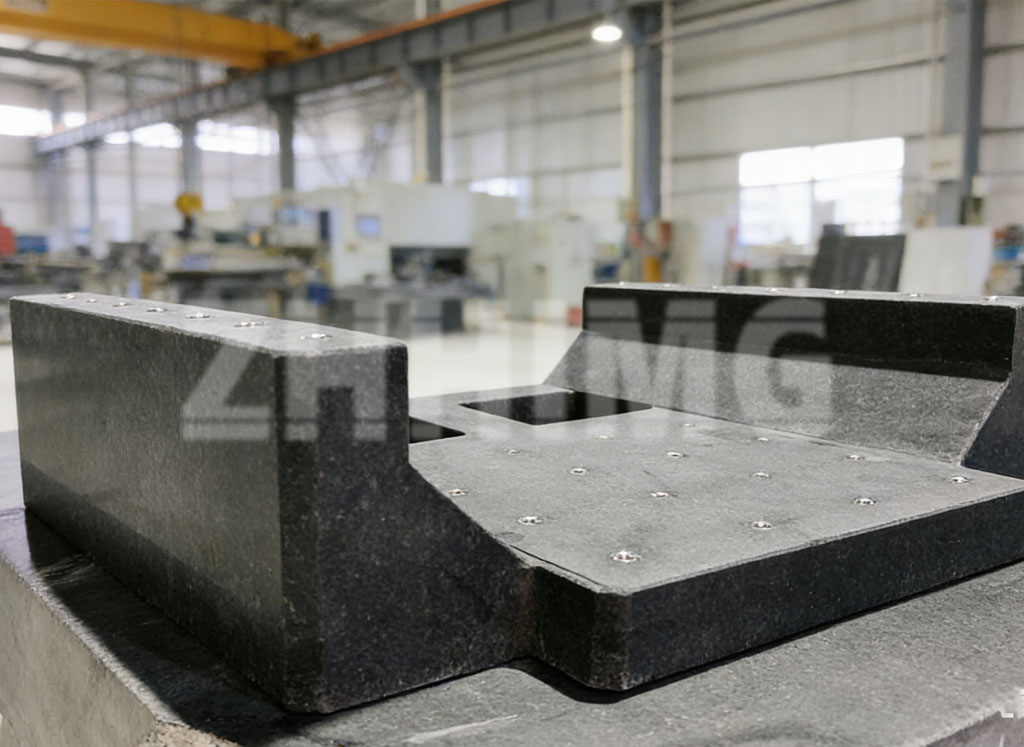
ZHHIMG® offers custom precision granite bases and components, including designs with rail mounting surfaces, threaded inserts, holes, slots, and other machined interfaces. Available configurations include granite bases for linear-motion, metrology, laser, and semiconductor equipment applications.
To start a project discussion, send your drawings together with the application, quantity, critical tolerances, mounting requirements, and delivery destination.
If the design is still being developed, tell us which requirements are fixed and which need further review. A clear technical discussion is the first step toward a quotation that matches your project.
Suggested inquiry subject: Custom Granite Machine Base RFQ – [Project Name / Drawing Number]
Frequently Asked Questions
Can I request a quotation before the design is complete?
Yes. Submit the available drawings and identify unresolved requirements. Ask whether the response is a preliminary estimate or a quotation based on a confirmed specification.
Do I need both a 2D drawing and a 3D model?
Providing both is helpful. The 2D drawing should define dimensions, tolerances, datums, and acceptance requirements, while the 3D model helps communicate the overall geometry. Confirm the required file formats with the supplier.
What if I do not know which tolerance to specify?
Describe the function of the surface, the mating components, and the machine’s performance requirements. Request a technical discussion rather than selecting a tolerance without a defined engineering basis.
Can the base include threaded inserts and mounting interfaces?
ZHHIMG® lists custom granite components with threaded inserts, mounting holes, rail seats, pockets, and other interfaces. The required geometry and acceptance criteria should be confirmed for each project.
What should I review besides the quoted price?
Review the material, drawing revision, tolerances, inspection scope, included assembly work, packaging, delivery terms, and any exclusions. Compare prices only after confirming that the scope is consistent.
Post time: Nov-10-2026