When designing high-precision equipment for semiconductor manufacturing, coordinate measuring systems, or optical inspection platforms, OEM engineers face a fundamental question: what material will provide the thermal stability, vibration damping, and long-term dimensional accuracy that mission-critical applications demand? For decades, natural granite has emerged as the definitive answer for precision machine components where sub-micron stability is non-negotiable. Unlike metals that corrode, warp under temperature fluctuations, or introduce unwanted vibrations into sensitive measurement systems, granite offers a combination of properties that no engineered material can fully replicate. This is precisely why custom granite components have become essential building blocks for equipment manufacturers who cannot compromise on accuracy, durability, or total cost of ownership.
The decision to specify custom granite components rather than standard catalog parts typically stems from three core requirements. First, the geometric complexity of modern equipment often demands structural elements that cannot be adequately addressed with off-the-shelf surface plates or bases. Second, the integration of mounting interfaces, cable routing channels, air-bearing surfaces, and precision datum features requires a component designed specifically for the assembly. Third, as equipment becomes more specialized and production volumes more controlled, OEMs increasingly recognize that their competitive advantage depends on optimized machine designs rather than generic foundations. Working with experienced granite machining suppliers who can produce parts from customer-supplied CAD drawings enables engineers to achieve designs that maximize performance while minimizing material waste and secondary operations.
Understanding the inherent advantages of granite as an engineering material is essential for making informed design decisions. The most significant property is granite’s exceptional thermal stability, with a coefficient of thermal expansion typically ranging from 4.5 to 5.8 × 10⁻⁶ per degree Celsius, which is approximately 80 percent lower than steel and roughly one-third that of cast iron. This means that a one-meter granite component will expand only about 6 micrometers when temperature rises by one degree, compared to 23 micrometers for aluminum under identical conditions. For equipment operating in environments with temperature variations exceeding ±15°C, this dimensional stability translates directly into measurement accuracy that metals simply cannot maintain. Beyond thermal properties, granite exhibits natural vibration damping characteristics with a damping ratio of 0.012 to 0.015, which is three to five times higher than cast iron and more than ten times superior to aluminum. This intrinsic ability to absorb vibrations in the 50 to 500 Hz frequency range proves invaluable for semiconductor lithography systems, high-speed CMM platforms, and laser processing equipment where even minor vibrations can compromise operational precision.
The chemical inertness of granite deserves equal consideration in design planning. With pH stability across the range of 1 to 14 and resistance to corrosion from coolants, hydraulic oils, and industrial solvents, granite components maintain their surface integrity and dimensional accuracy in harsh manufacturing environments without the protective coatings that metals require. This corrosion resistance directly contributes to lower maintenance costs and extended service life, with properly specified granite components often exceeding fifteen years of reliable operation in demanding applications. The hardness of precision granite, typically 6 to 7 on the Mohs scale, provides excellent wear resistance that preserves critical reference surfaces through thousands of measurement cycles without the surface degradation common to cast iron plates that require regular resurfacing.
When initiating a custom granite component design, engineers must carefully evaluate several interdependent factors that will influence both performance and manufacturability. Geometric tolerances represent the most critical specification, as they directly determine what level of machining precision the supplier must achieve and, consequently, the cost and lead time of the component. Standard commercial-grade granite components can achieve flatness tolerances of approximately 20 micrometers per square meter, which suffices for woodworking CNC machines and general-purpose applications. Precision-grade components typically require flatness within 5 micrometers per square meter, suitable for automotive tooling and general metrology. Ultra-high-precision applications such as optical alignment systems, semiconductor wafer handling equipment, and aerospace metrology demand flatness specifications of 1.5 micrometers per square meter or tighter, requiring specialized grinding techniques, climate-controlled manufacturing environments, and laser interferometry verification. Understanding the actual accuracy requirements of the complete system prevents over-specification that unnecessarily increases cost while ensuring that functionally critical surfaces receive the precision they require.
Surface finish requirements should be specified separately from flatness, as these represent distinct quality characteristics that affect different aspects of component performance. For air-bearing applications where a thin film of compressed air supports moving masses, surface roughness typically must not exceed Ra 0.4 micrometers to ensure consistent film formation and prevent air leakage that would compromise bearing stiffness. Reference measurement surfaces may require smoother finishes of Ra 0.1 to 0.2 micrometers to minimize friction with probe styli and ensure repeatable contact measurements. Sliding surfaces for precision linear guides often specify Ra values between 0.2 and 0.4 micrometers, balancing smoothness with adequate oil retention for lubricated guideways. Communicating the functional purpose of each surface to the granite machining supplier enables appropriate selection of grinding and finishing techniques.
Structural rigidity requirements for custom granite components depend on the anticipated load conditions, support configuration, and deflection tolerances of the complete machine system. Finite element analysis has become a standard tool for optimizing granite component geometries, allowing engineers to identify areas where material can be strategically removed to reduce weight while maintaining required stiffness. Modern precision machine bases increasingly employ hollow-core box structures with internal ribbing rather than solid monolithic slabs, achieving weight reductions of 20 to 30 percent without compromising structural performance. This optimization approach also reduces material costs and shipping expenses while simplifying installation by reducing the mass that handling equipment must support.
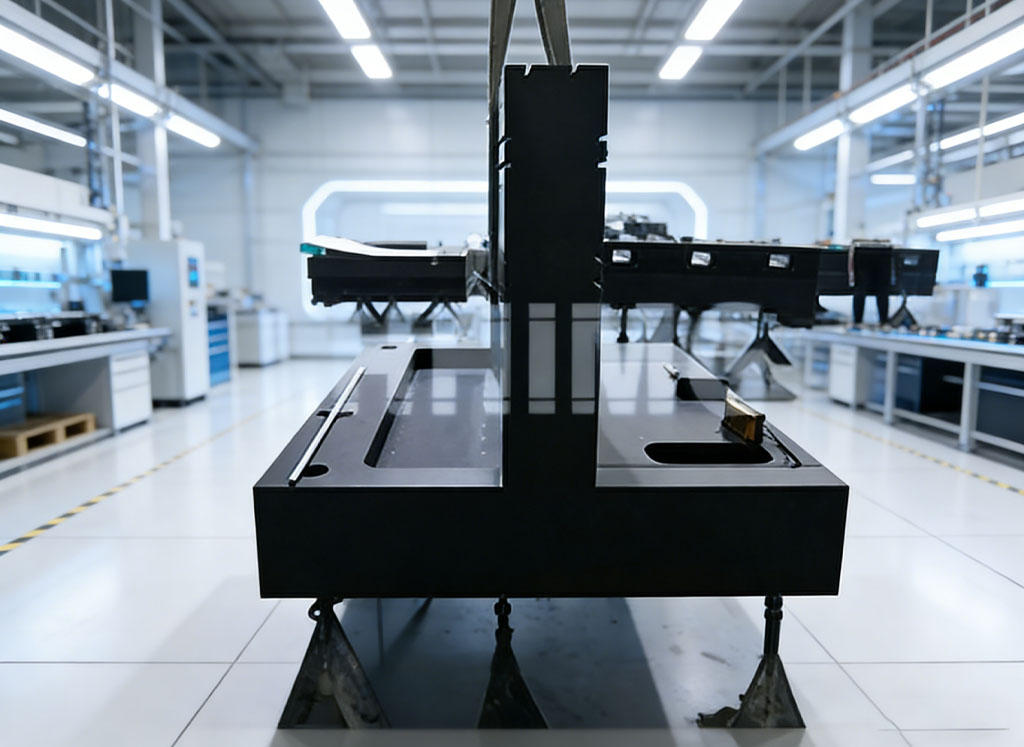
Wall thickness design for hollow granite structures requires careful attention to prevent local deflection under concentrated loads from mounting fasteners, equipment feet, or integrated mechanisms. As a general guideline, wall thicknesses should not fall below 25 millimeters for structural sections carrying significant loads, while thinner sections can be employed in areas of the component remote from critical datum surfaces. Internal stiffening ribs should be positioned to provide support at regular intervals, typically not exceeding 300 to 400 millimeters between rib contacts for precision applications. When mounting interfaces require threaded inserts or embedded metal components, the granite surrounding these features must be thick enough to prevent cracking under assembly torque or operational loads. Experienced granite machining suppliers can provide design-for-manufacturing feedback that identifies potential structural concerns before tooling commitments are made.
The specification of mounting hole locations, sizes, and tolerances represents a critical interface between the granite component and the equipment it supports. Through holes for passing fasteners typically require diameters of 12 millimeters or larger to accommodate standard machine screws, with positional tolerances of ±0.2 millimeters for general mounting and ±0.05 millimeters for precision attachment points where alignment directly affects system accuracy. Blind threaded inserts, usually fabricated from stainless steel or brass, require careful coordination between the hole diameter, insert specifications, and threading requirements. Expansion anchors or adhesive bonding may be specified for applications where through-fastening is impractical, though these methods typically provide lower positional accuracy than direct threaded engagement.
Material selection among granite types requires balancing several performance characteristics against availability and cost considerations. Black granite varieties, including Jinan Black from China, Black Galaxy from India, and South African granites, have become the preferred choice for precision metrology components due to their high density typically exceeding 3,000 kilograms per cubic meter, minimal quartz variance that ensures consistent machining response, and low thermal expansion coefficients. These dark-colored granites also provide aesthetic advantages in visible machine installations where lighter stones might show wear or contamination more prominently. Blue Pearl granite, characterized by distinctive blue-gray coloration from labradorite crystals, offers excellent durability and is sometimes specified for applications where visual distinction between components aids assembly or maintenance. When specifying granite material, engineers should request material certification that confirms density, compressive strength, and thermal expansion coefficient values, as significant variation exists between quarries and even between blocks from the same source.
The manufacturing capabilities of the granite machining supplier directly influence what design features can be economically incorporated into custom components. Modern precision granite machining employs CNC grinding systems with positional accuracies of ±0.01 millimeters or better, enabling the production of complex geometries including angled surfaces, tapered features, and curved contours that would be impossible to achieve with manual techniques. Five-axis grinding centers can machine multiple datum surfaces in a single setup, minimizing accumulated positioning errors and reducing cycle time. For applications requiring the highest precision, hand lapping by technicians with decades of experience remains the most effective method for achieving sub-micron flatness and parallelism, though this labor-intensive process increases cost and lead time. Understanding the supplier’s manufacturing capabilities enables engineers to specify tolerances that the production process can consistently achieve rather than nominal values that statistical process variation will render impractical.
Quality verification procedures deserve explicit attention in component specifications to ensure that delivered parts meet design intent. Laser interferometry provides NIST-traceable verification of flatness and straightness with resolution better than 0.5 micrometers, making it the preferred method for calibrating precision granite components. Electronic levels with sensitivity of 0.5 arc-seconds or finer enable verification of angular relationships between datum surfaces. Ultrasonic flaw detection can identify internal voids or cracking that might compromise structural integrity, particularly important for large components where internal defects might not become apparent until after years of service. Requesting calibration certificates that document the measurement methods, equipment traceability, and environmental conditions during inspection provides documentation that the component meets specified requirements and establishes a baseline for future recalibration comparisons.
The collaborative relationship between OEM engineers and granite machining suppliers significantly influences project outcomes. Providing comprehensive technical documentation, including detailed CAD models in standard formats such as STEP or IGES, tolerance specifications using standard symbols and notations, and functional descriptions of how the component interfaces with other system elements, enables suppliers to identify potential issues early in the project lifecycle. Design for manufacturing reviews, where supplier engineers analyze drawings and provide feedback on producibility, often reveal opportunities to simplify geometries, adjust tolerances on non-critical features, or modify wall sections to reduce machining difficulty without compromising functional performance. This collaborative approach typically reduces total project cost and accelerates delivery by preventing rework that arises from misunderstood specifications or unrealistic tolerance requirements.
Prototype fabrication before committing to full production runs provides valuable validation of design assumptions and supplier capabilities. Rapid prototype delivery of custom granite components typically requires 10 to 15 working days following receipt of approved CAD files, enabling design verification within compressed development schedules. First article inspection reports that document measurements of all critical features against specifications allow engineers to confirm that the component meets requirements before authorizing continued production. Maintaining open communication throughout prototype evaluation enables rapid resolution of any discrepancies and captures lessons learned for future projects.
The application landscape for custom precision granite components spans industries where measurement accuracy, positioning repeatability, and long-term stability are paramount concerns. Coordinate measuring machine manufacturers specify granite bases, bridge beams, and column structures that provide the reference geometry against which all subsequent measurements are referenced. The flatness and rigidity of these components directly determine the volumetric accuracy that the CMM can achieve, making granite selection and machining quality critical procurement decisions. Semiconductor equipment applications, including lithography stages, wafer inspection platforms, and chemical mechanical polishing pedestals, demand granite components that maintain sub-micron accuracy across temperature variations and vibration environments typical of cleanroom manufacturing facilities. Optical inspection systems for display panels, printed circuit boards, and precision machined components rely on granite bases that isolate sensitive measurement pathways from environmental disturbances while providing thermally stable reference geometry.
Laser processing equipment, including cutting systems, welding stations, and additive manufacturing platforms, increasingly specifies granite machine structures to achieve the positioning accuracy and vibration control that advanced laser applications require. The inherent damping characteristics of granite reduce chatter during high-speed motion, while thermal stability minimizes focus drift that would compromise cut quality or weld penetration consistency. Precision machine tool builders recognize that granite bases and column structures contribute to the geometric accuracy that differentiates premium equipment from commodity offerings, justifying the investment in high-quality granite components that enhance machine tool value propositions.
Medical device manufacturing equipment, including surgical instrument inspection systems, implant machining centers, and pharmaceutical filling line inspection stations, operates under regulatory environments that demand documented measurement accuracy and traceability. Granite components specified for these applications must often be accompanied by comprehensive calibration documentation that supports quality system requirements and regulatory submissions. The corrosion resistance and cleanroom compatibility of granite surfaces provide additional advantages in these sensitive manufacturing environments where surface contamination represents unacceptable risk.
As precision manufacturing continues advancing toward smaller tolerances and faster cycle times, the fundamental value proposition of granite as an engineering material becomes increasingly compelling. The combination of thermal stability, vibration damping, wear resistance, and long-term dimensional integrity addresses challenges that limit the performance of alternative materials. OEM engineers who master the principles of custom granite component design gain access to a manufacturing partner network capable of producing structural elements that elevate equipment performance to levels unachievable with conventional materials. The investment in learning to specify, procure, and integrate custom granite components effectively pays dividends across the equipment development lifecycle, from initial concept through production deployment and ongoing field support.
For engineers ready to explore custom granite solutions for their precision equipment designs, the path forward begins with a clear specification of functional requirements, followed by engagement with experienced machining suppliers who can translate design intent into manufacturable components. The combination of sound engineering principles, collaborative supplier relationships, and rigorous quality verification ensures that custom granite components deliver the performance, reliability, and value that demanding applications require.
Post time:
Apr-24-2026
