
As the core beam component of gantry‑type inspection equipment, long‑travel linear‑motor gantries and large‑scale optical scanning machinery, granite gantry beams feature large overall spans and bear dynamic reciprocating loads. They must not only maintain high rigidity, but also complete locking assembly with columns, sliding tables and guide‑rail assemblies via a large number of embedded thread sleeves. Different from partial embedding on ordinary tables, granite gantry beams are long‑span beam‑type components with widely‑distributed thread sleeves enduring continuous alternating tension, shear force and vibration impact. Once embedded thread sleeves suffer poor bonding, loosening, position offset or abnormal stress, assembly misalignment between the beam and mating parts will directly occur, reducing the overall machine’s repeat positioning accuracy. In severe cases, local cracking of the gantry beam may even be triggered. Many production processes only focus on the positional dimensions of thread‑sleeve holes, ignoring stress, deformation and process‑sequence issues unique to beam components, which leave hidden dangers for long‑term equipment operation. Drawing on manufacturing experience of multiple large‑span granite gantry‑beam projects, ZHHIMG sorts out critical details that must be strictly controlled during the machining of embedded thread sleeves for granite gantry beams. It avoids process defects from multiple dimensions: preliminary structural evaluation, hole preparation, thread‑sleeve selection, glue injection and curing, machining sequence and special verification.
Preliminary structural evaluation shall fully consider the mechanical characteristics of granite gantry beams as bending members. Different zones of the gantry beam bear distinct stress states: connection zones at both ends endure large locking tension, while the mid‑span section mainly undergoes bending deformation. Layout of thread sleeves cannot copy design experience for ordinary flat plates. Safe edge distances from thread sleeves to beam edges and weight‑reduction cavities shall be recalculated. Where stone wall thickness is reduced close to weight‑reduction cavities and grooves, arranging thread sleeves in such positions will easily generate micro‑cracks around holes under bolt‑locking force, which spread outward along cavity corners. When receiving orders for granite gantry beams, ZHHIMG prioritizes reviewing thread‑sleeve layout and keeps them away from stress‑concentration zones. Local stone thickening is adopted for high‑stress connection points. Where necessary, quantity and distribution of thread sleeves are adjusted to disperse locking loads and prevent over‑stress at single points. Meanwhile, embedding depth of thread sleeves is limited according to beam thickness; insufficient embedding depth leads to poor pull‑out resistance, while excessive depth may drill through the beam and damage its structure.
Drilling process shall guarantee both hole‑position accuracy and hole‑wall integrity for long beam components. For long overall dimensions of granite gantry beams, feeding deviation of equipment and clamping‑induced beam deformation during drilling may easily cause out‑of‑tolerance coaxiality and position tolerance of thread‑sleeve holes. Micro‑cracks on hole walls constitute invisible sources of embedding failure. Tiny cracks keep expanding under continuous vibration during equipment operation. Diamond water‑cooled drilling is adopted with properly controlled feed rate to reduce thermal damage caused by cutting heat. Drilled holes cannot go directly to embedding. Hole bottoms and walls shall be thoroughly cleaned, and stone debris shall be blown off by high‑pressure air. For large‑size long beams, stone powder inside deep holes is hard to discharge. Residual stone powder mixed inside adhesive forms isolation layers and greatly reduces pull‑out performance of thread sleeves. Every hole shall be visually inspected and preliminarily checked for hidden cracks. Holes with chipping or defects shall be repaired or relocated. Holes with defects shall never be used for direct thread‑sleeve embedding.
Selection and pretreatment of thread sleeves shall adapt to alternating‑load working conditions of granite gantry beams. Ordinary thin‑walled knurled sleeves are only suitable for static tables. For granite gantry beams enduring long‑term reciprocating vibration and alternating shear force, thickened stainless‑steel thread sleeves with multi‑knurling or annular grooves on outer surfaces are preferred to enhance mechanical interlocking with adhesive. Thread‑sleeve surfaces shall be degreased and cleaned. Oil contamination weakens bonding strength of epoxy adhesive. Among dozens of thread sleeves on a long beam, oil stain on a single sleeve may trigger single‑point failure and further impair assembly accuracy of the whole gantry frame. Ordinary carbon‑steel sleeves are forbidden; corrosion caused by long‑term ambient moisture will produce rust expansion, squeezing granite hole walls and resulting in stone cracking. For some non‑magnetic‑demanding gantry equipment, non‑magnetic stainless‑steel thread sleeves shall be selected to avoid magnetic interference with optical inspection paths.
Glue injection, pressing‑in and curing control are links prone to batch‑level hidden risks for long‑span granite gantry beams. Due to large quantities of thread sleeves on gantry beams, simultaneous glue injection for multiple holes easily leads to uneven glue dosage and trapped internal bubbles. High‑shear‑strength low‑shrinkage special epoxy structural adhesive shall be adopted, matching the thermal‑expansion difference between granite and stainless steel and resisting alternating stress during equipment operation. Adhesive shall uniformly fill gaps between sleeve outer walls and hole walls without excessive overflow contaminating reference surfaces of the beam. Thread sleeves are vertically pressed and positioned by special tooling to guarantee perpendicularity between thread central axes and beam reference surfaces. Long beams are prone to tilted thread sleeves; subsequently assembled bolts will generate lateral component force and continuously pull hole openings of stone. Curing environment is critical. Large‑volume granite gantry beams shall complete full curing in a vibration‑free and temperature‑stable environment. Transfer or lapping before full curing is strictly prohibited. Internal stress is generated by adhesive shrinkage during curing. Synchronized shrinkage of multiple thread sleeves on long beams will cause superposed stress and trigger minor beam deflection, damaging beam straightness. Sufficient static curing period must be reserved to release adhesive shrinkage stress before subsequent finishing processes.
Special machining sequence for granite gantry beams shall be strictly followed without reversal. Some manufacturers lap guide‑rail mounting reference surfaces of granite gantry beams to finished accuracy first and then conduct drilling and thread‑sleeve embedding. Drilling impact and adhesive curing shrinkage stress will deflect finely‑finished long‑beam reference surfaces and destroy beam straightness. ZHHIMG implements standardized process flow: sufficient raw‑block aging for stress release → rough machining of beam profile and weight‑reduction cavities → drilling for all thread‑sleeve holes → embedding of all thread sleeves → full static curing for stress release → ultra‑precision lapping of beam guide‑rail surfaces and assembly reference surfaces in constant‑temperature‑humidity workshop. The workshop is equipped with anti‑vibration foundation and shock‑absorbing trenches to mitigate interference from external vibration on lapping accuracy of long beams. After lapping, end faces of thread sleeves sit slightly below granite working surfaces, preventing hard contact between metal sleeves and mating parts during assembly, avoiding local stress points and beam bending caused by assembly force.
Special‑purpose inspection after machining shall not copy inspection modes for ordinary surface plates. As long‑span beam‑type parts, granite gantry beams require special tests for embedded thread sleeves besides conventional inspection of straightness, flatness and position tolerance. High‑precision measuring instruments are used to verify thread condition, perpendicularity and coordinate of each thread sleeve. Sampling pull‑out‑resistance tests are carried out to simulate actual assembly locking tension and check for virtual bonding or debonding at bonding interfaces. Inspection shall be performed under simulated actual mounting support conditions for granite gantry beams instead of free horizontal placement. Stress states differ between free‑lying long beams and two‑point‑supported installed beams. Qualified inspection results under free‑lying conditions may shift after installation‑induced structural deformation, changing relative positions of thread sleeves. All measuring instruments are traceable to metrology standards. With decades‑long process experience and compliance with multiple international metrology standards, the technical team confirms all thread sleeves meet dynamic‑working‑condition requirements before delivery. 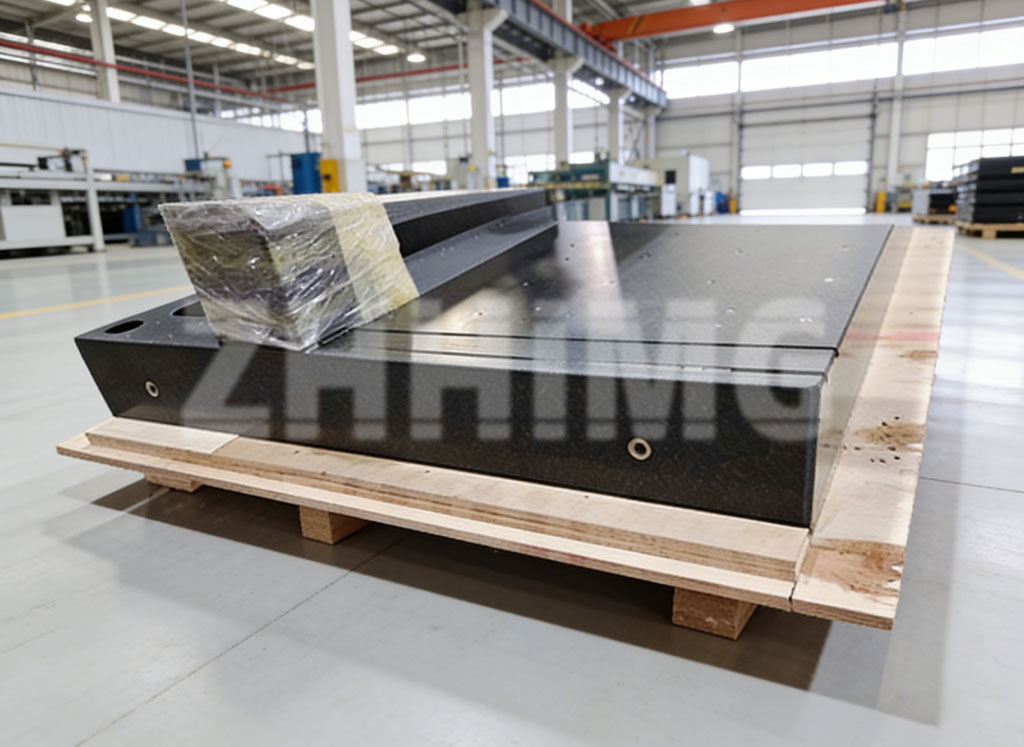
Supported by industry‑university‑research tests with metrology institutes and universities, ZHHIMG builds a process database for embedded thread sleeves of large‑span granite gantry beams. Long‑term reliability of sleeve‑granite bonding interfaces is verified under simulated vibration and high‑low‑temperature cycles. The company holds ISO three‑system certifications, CE and CNAS qualifications as well as multiple patents. Adhering to the service principle of no cheating, no concealment and no misleading, ZHHIMG provides process optimization suggestions for beam thread‑sleeve layout at early project phases to avoid structural risks originating from drawing design.
Embedding thread sleeves for granite gantry beams is far more than simple bushing insertion; it represents a systematic process combining beam‑body stress and vibration working conditions. Quality of thread sleeves directly determines assembly accuracy and service life of the whole gantry frame. Upholding its quality policy “For precision‑oriented business, no pursuit of perfection is excessive”, ZHHIMG controls every embedding detail and supplies highly‑reliable granite gantry‑beam components for long‑travel gantry equipment.
Post time: Sep-07-2026