
In the field of ultra‑precision equipment, many users pay attention to the factory‑out accuracy of granite machine tool beds, yet tend to overlook stone compactness, a fundamental factor. Qualified factory inspection results only reflect the precision status at the time of delivery. Whether the micron‑level reference can be maintained steadily after years of on‑site operation largely depends on the internal compactness of stone materials. Even among granite machine tool beds, differences in mineral grain arrangement, porosity and compactness of raw blanks can lead to vastly different long‑term precision performance. Drawing on abundant project practice, ZHHIMG analyzes how stone compactness influences the long‑term precision performance of machine tool beds and clarifies easily‑ignored key points for material selection in the industry.
Stone compactness generally refers to the bonding tightness of mineral grains inside stone, which reflects porosity, crystal interlocking condition and internal compact level. High‑compactness granite features interlocked mineral grains and extremely few internal micro‑pores. In contrast, stone with poor compactness has abundant internal micro‑pores and loose structure. Even if no defect can be observed externally after fine machining, inherent risks already exist. Some suppliers in the market adopt low‑compactness stone or even marble to cut costs. Test data after processing can meet standards temporarily, which is merely a short‑term illusion. Under the impact of ambient humidity changes, penetration of cutting fluid moisture and continuous load pressure, micro‑pore structures will produce subtle deformation slowly, which evolves into equipment precision drift over time.
Compactness directly determines a bed’s resistance to environmental medium erosion. Workshop production environments are not ideal laboratories. Moisture in air, cutting fluid mist and dust keep contacting the bed surface. High‑density black granite has minimal pores, so water vapor and corrosive media can hardly penetrate into stone interiors and only stay on the surface, which can be removed by simple wiping without damaging the stone matrix. For stone with poor compactness, capillary pores absorb water vapor and chemical media, triggering slow physical changes inside the material and causing invisible local expansion or contraction on the guide‑rail mounting reference surface. This directly impairs the repeat positioning accuracy of linear motor stages, coordinate measuring machines and laser processing equipment. Such precision deviation develops gradually and is hard to detect in routine inspections. By the time deviations are identified, quantities of defective workpieces have already been produced.
Resistance to load creep also relies on high stone compactness. Machine tool beds bear sustained static loads and alternating loads from guide‑rail modules, moving units and fixture clamps. In compact structures, mineral grains interlock with one another, and stress can be dispersed and transferred evenly to avoid local creep. The black granite adopted by ZHHIMG reaches a density of around 3100 kg/m³ with closely‑arranged crystals, effectively restraining slow deformation under long‑term compression. Even large‑tonnage oversized beds can maintain stable geometric references under long‑term full‑load operation. For stone with insufficient compactness, weak bonding between grains gives rise to micro‑slippage inside under prolonged pressure. The flatness of the machine bed will degrade gradually, requiring frequent disassembly and re‑calibration and raising equipment operation‑and‑maintenance costs.
It is worth noting that compactness is an inherent property of raw materials, which cannot be remedied by post‑processing. Advanced grinding machines and superior manual grinding craftsmanship can only optimize surface flatness instead of changing internal pores and grain bonding conditions of stone blanks. If raw blanks suffer from insufficient compactness, exquisite finishing can only deliver favorable short‑term test results rather than solve precision attenuation during long‑term service. This explains why some granite beds keep almost unchanged precision for more than ten years while others show obvious precision decline within two to three years even with identical specifications.
Nevertheless, to give full play to advantages brought by stone compactness, a complete manufacturing chain is indispensable. Raw stones must go through sufficient natural aging after quarrying to release geological residual stress. Fine machining shall be completed in constant‑temperature anti‑vibration workshops with stable processing environments, and finished‑product indicators shall be verified via complete metrology inspection. ZHHIMG implements strict screening upon stone incoming, pre‑evaluating compactness and grain structure and eliminating blanks with internal cracks and excessive pores so as to avoid inherent defects from the source. Supported by a full set of traceable metrology systems and technical teams proficient in multiple national metrology standards, material merits of granite are converted into tangible long‑term stability for equipment. Equipped with ISO triple‑system certifications, CE certification and multiple international patents and trademarks, the company adheres to integrity principles and opposes the industry malpractice of passing low‑compactness stone off as high‑end bed‑grade granite. 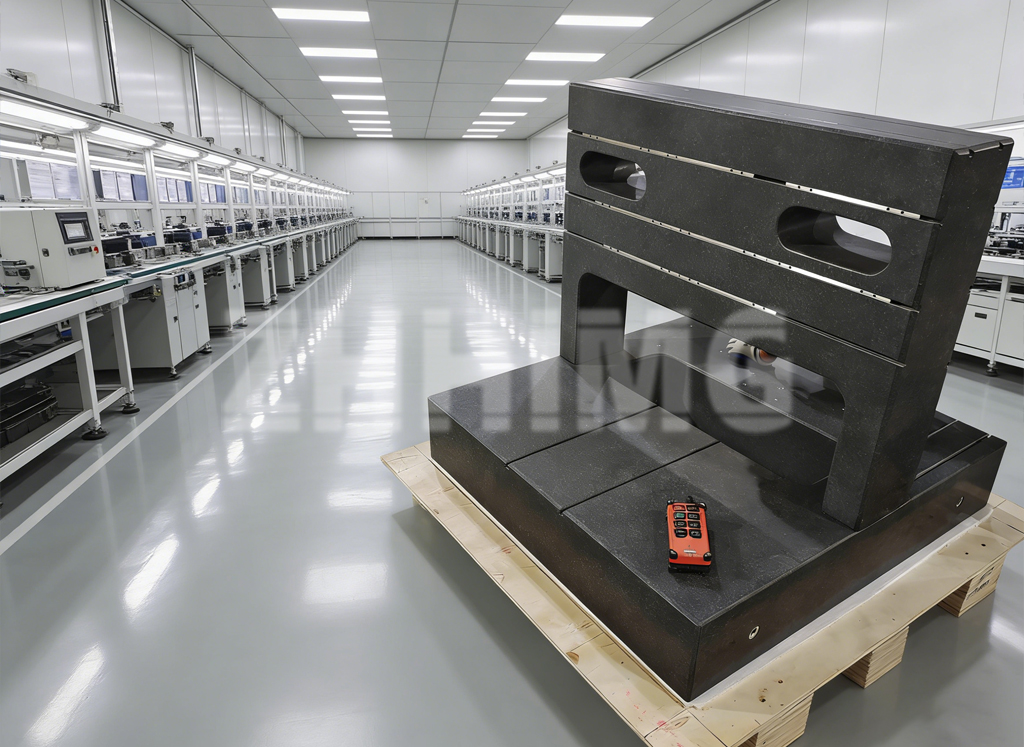
During procurement and type‑selection, many purchasers focus on factory‑out indicators such as flatness and dimensional tolerance, while seldom taking stone compactness into evaluation. For high‑end equipment running continuously for long cycles, such as semiconductor devices, perovskite equipment, precision inspection instruments and femtosecond‑laser machines, machine beds are not consumables. Apart from high precision upon delivery, sustained accuracy over five‑year or ten‑year service cycles is required, for which stone compactness serves as the fundamental cornerstone.
With continuous upgrading of the global ultra‑precision industry, equipment keeps raising requirements for long‑term reliability. Downstream customers will gradually attach importance to physical indicators of stone substrates besides machining accuracy. Only by emphasizing raw‑blank compactness screening and tightening full‑process manufacturing and inspection can granite machine tool beds exert their value persistently and deliver durable and reliable precision bases for diverse high‑end equipment.
Post time: Sep-03-2026